
BedJet Dual Zone Alternative: Two bFans for Less Than Half the Price
By Kurt Tompkins, Bedfans USA. Reviewed November 2026.
Quick answer: The most practical BedJet dual zone alternative is two bFans, one centered below each sleeper at the foot of the bed. Each person gets their own airflow under the covers and their own remote, for $409.90 at list price, compared with a $1,549 list price for a queen BedJet 3 Dual Zone system. Two bFans are less than half the price of a dual-zone BedJet, use about 18 W each on average, and work with your own sheets.
If you have looked at dual-zone bed cooling, you have probably run into the same problem many couples do. One person sleeps hot and the other does not. One wants airflow all night, and the other only wants a little help falling asleep. Then you see the price of a dual-zone system and start wondering if there is a simpler way to get the same personal control. There is.
Why do couples look for a BedJet dual zone alternative?
Most couples want separate comfort on each side of the bed without paying premium prices. They are trying to fix a real sleep problem, not collect features.
Night sweats, hot flashes during menopause, medications that make you run warm, a heat-trapping memory foam mattress, or a partner who likes the room warmer can all turn bedtime into a negotiation. One thermostat setting cannot suit two people whose bodies handle heat differently. Dual-zone bed cooling solves that by giving each sleeper their own climate under the covers. The question is how much you need to spend to get it.
See why couples sleep at different temperatures for the science behind the mismatch.
What does the BedJet Dual Zone system include?
According to BedJet, the Dual Zone system includes two BedJet 3 Mini units, two remotes, and a Dual Zone Cloud Sheet. Its list price is $1,549 for queen, $1,559 for king, and $1,669 for split king.
The BedJet blows room air through a hose into its Cloud Sheet, and it can also warm that air for cold nights. Many shoppers assume it works like a mini air conditioner for the bed. It does not. Neither the BedJet nor the bFan makes the air colder. Both use the air already in the room and move it through the bed so your body can release heat. Once you see that, the comparison comes down to cost, comfort, sound, power use, and day-to-day practicality.
How do two bFans create dual-zone bed cooling?
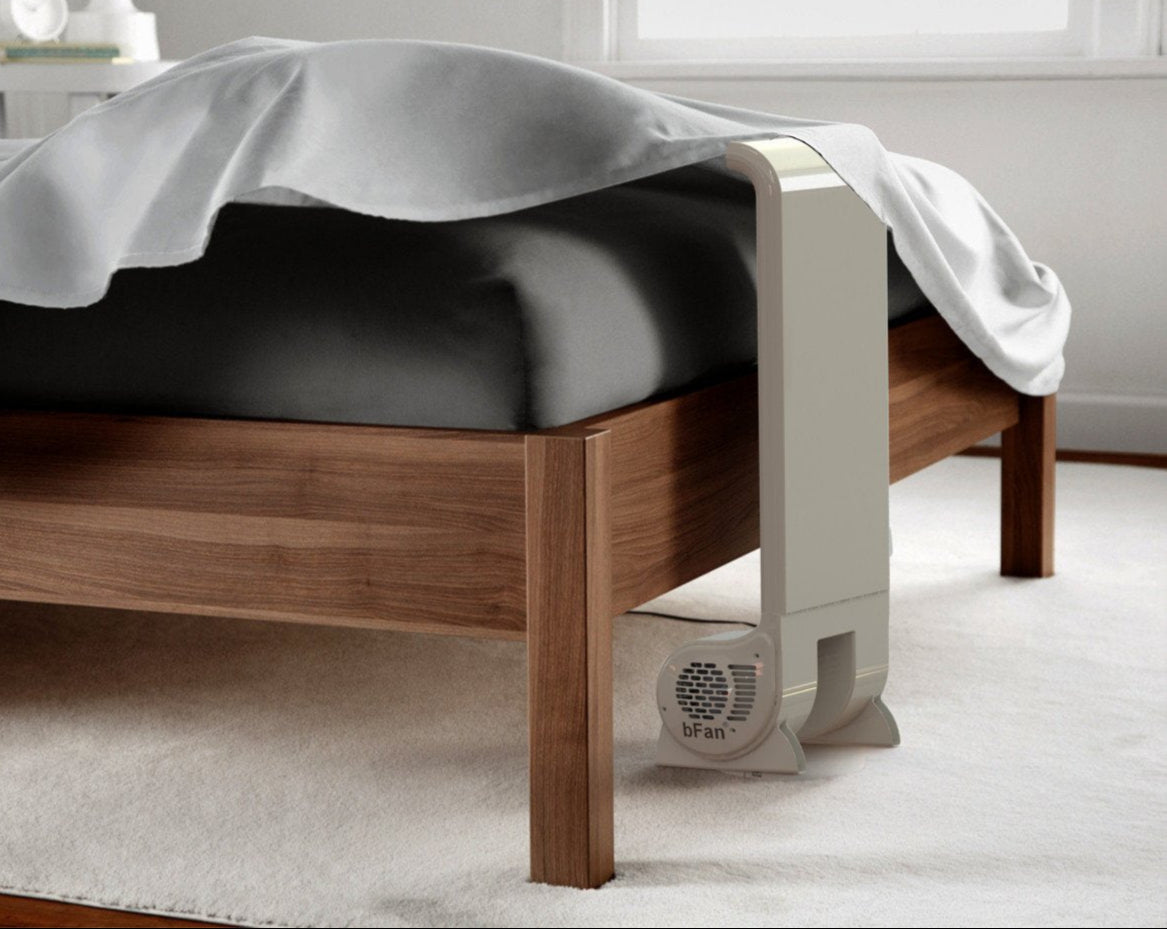
Center one bFan below each sleeper at the foot of the bed, and each person controls their own side. There is no special sheet and no need to split one device between two preferences.
The bFan from Bedfans USA sits at the foot of the bed with its base centered under the mattress and a flat duct panel rising under the bedding. It sends room air under the covers, across your body, and out near your shoulders. Direct airflow helps stop sweat before it starts. With two fans, each sleeper gets their own microclimate: one person can run strong airflow all night while the other uses a gentle setting or a short timer, or leaves theirs off.
Its large squirrel cage blower gives the bFan higher static pressure than other bed fans, so it pushes air under the covers effectively at any speed. Bedfans USA invented the Bedfan and has sold it since 2004, years before the BedJet came to market. The bFan is built in Texas with over 80 percent American made parts.
- Left side: one sleeper sets their own airflow and timer.
- Right side: the other sleeper does the same, or leaves their fan off.
- Your own sheets: works with the bedding you already have.
- No built-in chiller: like every air-based bed system, it uses the room air.
How does the BedJet Dual Zone price compare with two bFans?
At list price, two bFans cost $409.90 and a queen BedJet Dual Zone costs $1,549. Two bFans are less than half the price of a dual-zone BedJet.
Two bFans:
- List price: $409.90 ($204.95 each)
- Room air moves under your own covers
- Does not make the air colder
- No warming
- About 18 W each on average
- About 28 to 32 dB at normal speed
- A remote for each fan
BedJet 3 Dual Zone (queen):
- List price: $1,549
- Room air moves through a hose into a Cloud Sheet
- Does not make the air colder
- Can warm the air on cold nights
- Draws more power when warming
- A remote for each unit
Single sleepers see the same pattern: one bFan is less than half the price of a BedJet 3, which lists at $699. Prices are list prices from each brand's website in November 2026; prices change often, so check before you buy.
What about Chilipad, Eight Sleep, and Orion for couples?
Water-based systems can actively chill, but they cost much more and come with more upkeep. They are a different category from air-based bed cooling.
Water-based systems pump chilled or warmed water through a mattress topper or cover. The Chilipad 2.0 from Sleepme lists at $2,998 for a dual queen. The Eight Sleep Pod, now in its sixth generation after the Eight Sleep Pod 5, adds sleep tracking and automatic temperature regulation but requires an Autopilot subscription. The Orion Sleep System lists at $2,395 for a queen. These systems need water refills and routine cleaning, and their control units sit beside the bed.
If you want features like sleep tracking and active chilling, they may be worth it. If you mainly want each side of the mattress to stop trapping heat, two bFans cover that for a small fraction of the cost.
Do bed cooling systems actually lower the temperature?
Air-based systems do not lower the air temperature; they help your body release heat. Your room still matters.
A cool, dark room supports good sleep quality. The bed is where heat gets trapped, and that is what an under-the-covers airflow system addresses. Many customers tell us they raise the thermostat and still sleep comfortably once the bed stops holding heat, which helps with energy use too.
Your bedding matters. Bedfans USA recommends higher thread count, tightly woven sheets with a bed fan. A tighter weave keeps the airflow under the covers instead of letting it escape through the fabric, the way a sail holds the wind and a loose net cannot. Heavy comforters and dense toppers work against any bed cooling system.
Is the bFan quiet and efficient enough to run all night?
Yes. It runs at about 28 to 32 dB at normal speed and uses about 18 W on average. That lets it fade into the background for most sleepers.
- Sound: about 28 to 32 dB at normal operating speed (is the bFan quiet?)
- Power: about 18 W on average and 24 W at maximum, far less than running central air colder all night
- Controls: remote speed from 5 to 100 percent and a sleep timer
- Clearance: needs 6.75 inches under the bed; with less clearance, the base can be turned around so it sits in front of the foot of the bed instead of underneath
- HSA and FSA: eligible through a simple letter of medical necessity process
The timer is handy for hot flashes or night sweats that are worst in the first hours of sleep. Run it strong while you fall asleep, then let it shut off or turn it down without waking your partner.
Which option fits your bedroom best?
Choose based on what you actually need each night. For most couples looking for a BedJet dual zone alternative, the goal is separate comfort without a big bill.
- You only need cooling on one side: one bFan.
- You both run warm but at different levels: two bFans, each with its own remote.
- You need warming on cold nights too: a BedJet adds heat, at a much higher price.
- You want active chilling and sleep tracking: a water-based system, if the cost and upkeep fit.
For more ideas, see the sleep cooling system for couples guide.
Ready for better sleep?
Order the bFan from Bedfans USA and get a quiet cooling breeze under your covers, built in Texas by the company that invented the Bedfan.
Frequently Asked Questions
Can two bFans fit on a queen bed?
Yes. Each bFan base is centered below one sleeper at the foot of the bed, with its flat duct panel rising under the bedding, so two fans fit side by side on a queen or king. Each needs 6.75 inches of clearance under the bed. If your frame sits lower, the base can be turned around so it sits in front of the foot of the bed instead of underneath. A footboard can get in the way, so check the space before you order. Each fan has its own remote, so you can keep them on your own nightstands.
Will my partner feel the airflow from my side?
Usually very little. Each bFan sends air under the covers on its own side, across the sleeper's body and out near the shoulders. A tightly woven sheet and a top layer that tucks in or drapes evenly help keep the airflow on your side. If you share one large comforter and your partner sleeps cool, keep your fan at a lower speed at first and adjust from there. Some couples use separate top blankets so each side can be set up independently.
Do I need special sheets for a dual-zone setup with bFans?
No special sheet is required. The bFan works with the sheets and blankets you already own. Higher thread count, tightly woven sheets work best, because a tighter weave keeps the airflow under the covers instead of letting it escape through the fabric. Lightweight top layers work better than heavy comforters. You do not need to buy a proprietary sheet or send one through the laundry separately, which keeps ongoing costs down.
Can I use one bFan now and add a second later?
Yes, that is one of the advantages of separate fans. Start with one bFan on the side of the hotter sleeper, see how it works for your bed and bedding, then add a second if your partner wants one too. Each fan works on its own, with its own remote and timer, so there is nothing to pair or reconfigure. That makes it a low-risk way to try bed cooling.
Is a dual-zone system worth it if only one of us sleeps hot?
Often not. If only one person overheats, a single bFan on their side gives them airflow under the covers while the other side stays as it is. That is less expensive than buying a full dual-zone system and paying for a side that may sit unused. If your needs change later, for example during menopause or after starting a medication that makes you run warm, you can add a second fan then.
Can two bFans help with hot flashes for one partner?
Many people use a bFan during menopause because the airflow under the covers helps release built-up heat during a hot flash without uncovering or waking a partner. With two fans, the partner who has hot flashes can run stronger airflow or a longer timer, while the other partner keeps a gentle setting or none. Hot flashes have many causes, so talk with a clinician if they are frequent or severe, and see our menopause sleep guide for more ideas.
Resources
- BedJet: BedJet 3 Dual Zone system for couples: The manufacturer's product page with list prices, sizes, and what is included.
- BedJet: BedJet 3 single system: The manufacturer's page for the single sleeper BedJet 3.
- Eight Sleep: Pod: The manufacturer's page for the current Pod, its features, and membership.
- Sleepme: Chilipad: The manufacturer's site for Chilipad water-based mattress toppers.
- Sleep Foundation: The best temperature for sleep: Explains why a cool sleep environment supports better sleep.
- National Institute on Aging: Hot flashes: Explains hot flashes and practical ways to manage them.
Compartir