
Fan for Bed: Quiet Under Sheet Airflow for Hot Sleepers
By Kurt Tompkins, Bedfans USA. Reviewed October 2026 against the bFan product specifications at bedfans-usa.com. Bedfans USA has made under sheet bed fans since 2004.
Quick answer: A fan for bed use sends air under your top sheet instead of across the room. The bFan from Bedfans USA sits centered at the foot of the bed, needs 6.75 inches of clearance under the bed (or sits in front of the foot of the bed with its base turned around), runs at about 28 to 32 dB, and uses about 18 watts on average. Direct airflow helps stop sweat before it starts, and one bFan costs less than half the price of a BedJet.
If heat builds up under your covers every night, another fan somewhere in the room rarely solves it. A fan for bed use is built for one job: moving air through the space between your sheets, where body heat and humidity get trapped. Bedfans USA designs, builds, and sells the bFan in Texas with over 80 percent American made parts, for hot sleepers, people with night sweats, women in menopause, and couples who sleep at different temperatures.
What is a fan for bed, and how is it different from a room fan?
A fan for bed moves room air under your covers and across your body, while a room fan or ceiling fan only moves air above the bedding. That difference matters because most nighttime overheating happens under the blanket, not in the room.
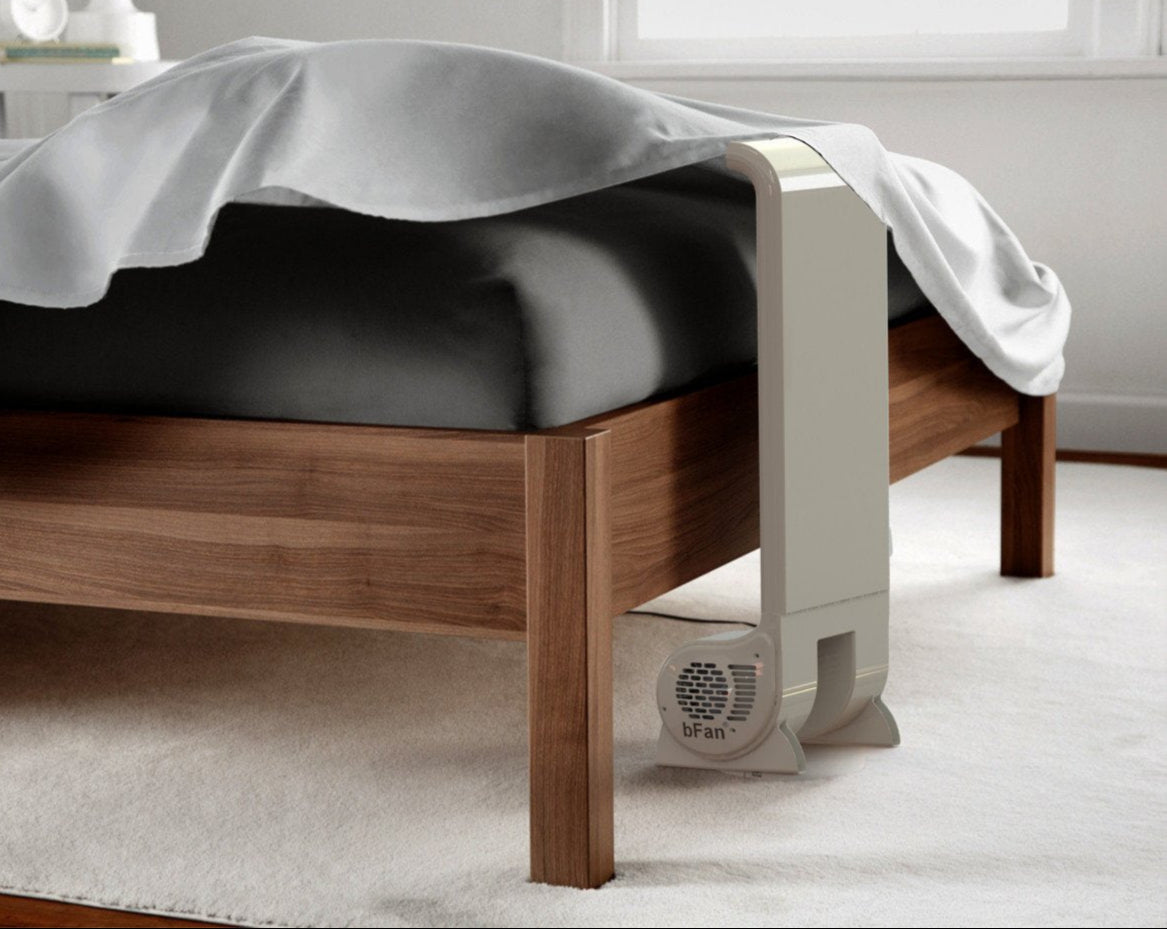
The bFan sits on the floor at the foot of the bed, with its two drum blower base below the frame and a flat panel tucked under the bedding at mattress height. Air flow runs under the top sheet, over your body, and out near your shoulders as a cooling breeze. Neither the bFan nor a BedJet lowers the air temperature; both use the air already in your room. What changes is where that air goes. See how the bFan works for the full airflow path.
Fan for bed vs ceiling fan
A ceiling fan helps the whole room feel fresher, but a fan for bed puts air flow where heat is trapped, under the covers. Many hot sleepers use both.
A ceiling fan pushes air down onto the top of your comforter. That helps with stuffy rooms, but the comforter does its job and keeps that air out. A fan for bed works from the inside of the bedding. You get comfort without a breeze across your face, which some people find drying or distracting. Our article on why the Bedfan outshines the ceiling fan goes deeper on the comparison.

Who a fan for bed helps most
A fan for bed is the best fit when heat builds up inside your bedding even though the room feels fine. That pattern is common with menopause, medication related overheating, and naturally hot sleepers.
- Menopause and hot flashes: The National Institute on Aging suggests layered bedding and a fan at night for hot flashes. Our menopause guide covers more options.
- Night sweats: Direct airflow helps stop sweat before it starts. If night sweats are heavy, frequent, or new, talk to your doctor; see when to see a doctor for night sweats.
- Medication related overheating: Some prescriptions cause sweating at night. Our guide to medications that contribute to night sweats lists common ones.
- Couples: Two bFans give dual zone comfort, one centered below each sleeper, so one person can run stronger airflow while the other turns theirs down or off.
bFan at a glance: noise, power, and fit
The bFan is quiet, energy efficient, and adjustable, with verified specs you can check on the product page.
- Noise: about 28 to 32 dB at normal operating speed, from a whisper quiet brushless DC motor. See is the bFan quiet.
- Energy efficient: about 18 watts on average and never more than 24 watts, so it costs pennies a night to run.
- Air flow: two squirrel cage blower wheels and remote speed control.
- Timer: a sleep timer for extra airflow while you fall asleep.
- Fit: 6.75 inches of clearance under the bed (or turn the base around to sit in front of the foot of the bed); Short model for bed heights of 18 to 28 inches from the floor to the top of the mattress, Tall model for 28 to 38 inches.
- Price: $204.95 with the fan, power supply, and remote.
- Support: replacement remotes, power supplies, and control boards are sold separately, and there is a 30 day satisfaction guarantee.
Many customers report raising the thermostat up to 6°F and still sleeping comfortably, which can trim cooling costs. Results vary with your home and climate. Our article on an energy efficient bed fan explains the math.
Fan for bed vs BedJet
The bFan and BedJet both move room air under the covers, but the bFan is simpler and less expensive. One bFan costs less than half the price of a BedJet, and two bFans cost less than half the price of a dual zone BedJet.
BedJet adds heating and an app, which some people want. If your goal is quiet under sheet airflow for hot nights, the bFan keeps the setup simple: a compact base at the foot of the bed, a remote, and nothing on top of the mattress. Compare more details in our BedJet alternative guide.
How to set up a fan for bed for the best comfort
Setup is simple: center the fan at the foot of the bed, choose the right height, and use tight weave sheets.
- Measure from the floor to the top of your mattress and pick the Short or Tall model.
- Center the bFan at the foot of the bed, flush with the frame, with the panel at mattress height.
- Drape the top sheet over the panel and tuck it lightly along the sides so air travels toward your shoulders.
- Choose tight weave or higher thread count sheets; see our cooling sheets guide.
- Start at a low speed and raise it until you feel steady air flow without a draft.
Ready for better sleep?
The bFan sits at the foot of your bed and sends a quiet stream of air under your sheets. Direct airflow helps stop sweat before it starts, and one bFan costs less than half the price of one BedJet, making it the less expensive alternative. Shop the bFan at bedfans-usa.com
Frequently Asked Questions
Does a fan for bed work under a heavy comforter or weighted blanket?
A fan for bed works best when the top sheet forms a channel for air, so the layer right above you matters most. Under a heavy comforter or weighted blanket, air can still travel under the top sheet, but very dense layers press the sheet down and slow the flow toward your shoulders. Many people get better comfort by switching to a lighter blanket in warm months or folding a weighted blanket down to cover only the legs. Raise the bFan speed a little if you keep a heavier layer on top.
Can a fan for bed replace a ceiling fan?
A fan for bed and a ceiling fan do different jobs, so many hot sleepers keep both. A ceiling fan moves air around the room and over your bedding, which helps a stuffy bedroom feel fresher. A fan for bed sends air under the covers, where body heat gets trapped. If you only run one at night, the under sheet fan usually does more for overheating in bed, while the ceiling fan helps more with overall room comfort. Running the ceiling fan on low and the bFan on a moderate setting is a common mix.
Does a fan for bed blow air in your face?
No, a fan for bed like the bFan sends air under the top sheet from the foot of the bed, so the air flow stays inside the bedding and exits near your shoulders. Your face stays out of the breeze, which many people prefer because air blowing directly on the face can feel drying or disturb sleep. If you feel air near your neck, lower the speed or tuck the sheet a little more along the sides. That keeps the air moving across your body before it leaves the bedding.
Can a fan for bed help in a bedroom without air conditioning?
A fan for bed can still help in a room without air conditioning, because it sends a cooling breeze under the covers. It does not lower the room temperature, so results depend on how warm your bedroom is. It works best when the room is reasonably comfortable, ideally close to the 65°F the Sleep Foundation suggests for most adults. On very hot nights, opening a window in the evening, using light bedding, and running a room fan along with the bed fan gives the best comfort.
Where should a fan for bed go, at the foot of the bed or the side?
The bFan is designed to sit at the foot of the bed, centered for one sleeper or with one fan centered below each person for couples. From the foot, air travels the full length of your body under the sheet before leaving near your shoulders, which gives the most even air flow. The base sits on the floor under the bed frame and the panel rests at mattress height under the bedding. Follow the setup steps on bedfans-usa.com, and contact Bedfans USA if your frame needs a different placement.
Resources
- National Institute on Aging advice on hot flashes: suggests layered bedding and running a fan at night to manage hot flashes and night sweats.
- Sleep Foundation guide to the best temperature for sleep: explains why a bedroom around 65°F supports better sleep.
- Sleep Foundation on noise and sleep: explains how sound in the bedroom affects sleep quality, useful when comparing fan noise.
- Review on thermal environment and sleep: a Journal of Physiological Anthropology review on how heat, humidity, and the bed climate under the covers affect sleep.
- MedlinePlus guide to hot flashes and night sweats: recommends keeping air moving with fans and wearing loose cotton clothing at night.
- Cleveland Clinic on night sweats causes and care: covers common causes such as menopause and medications, plus when to see a doctor.
Share