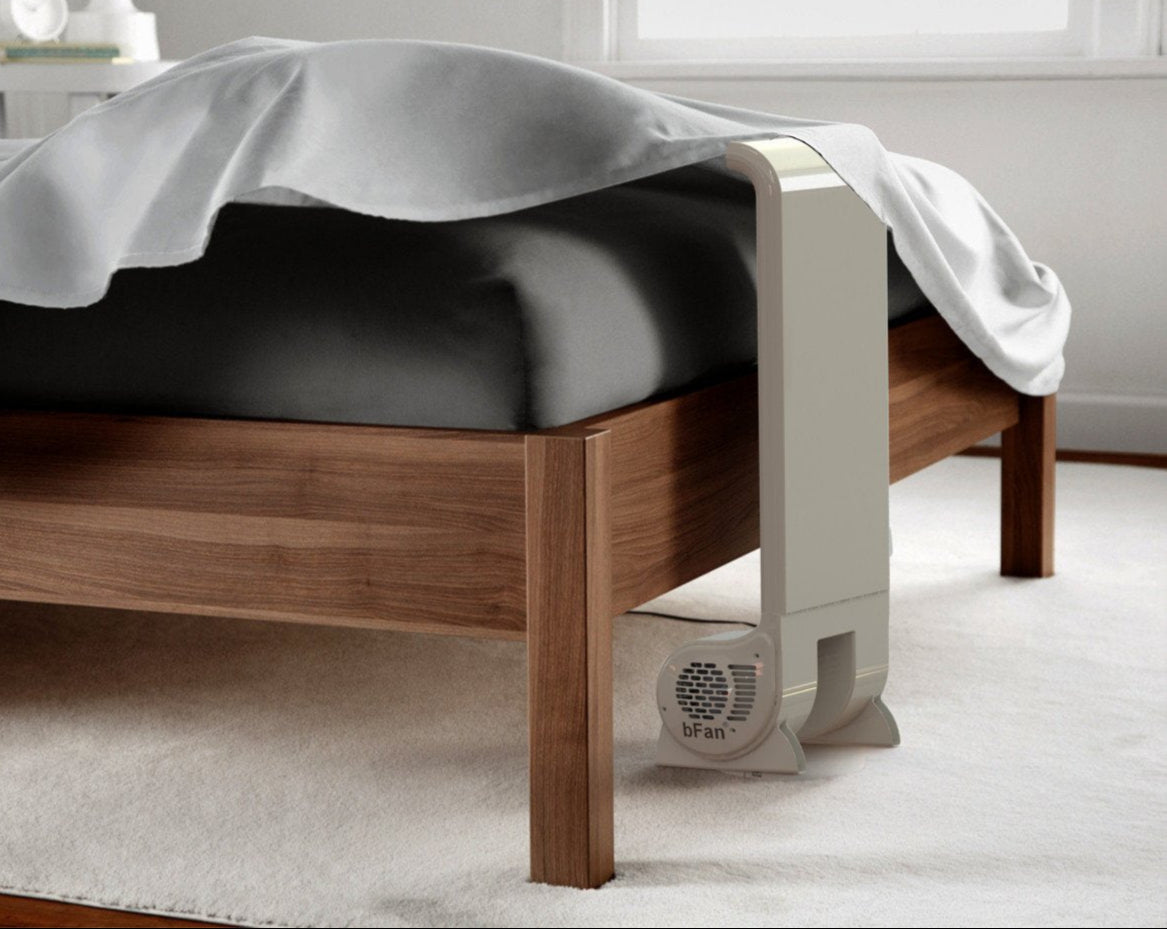

Under Bed Fan: 5 Clearance Checks Buyers Should Make
Buying an under bed fan is really a fit problem before it becomes a comfort problem. Bedfans USA, the Texas manufacturer behind the bFan Bedfan, an under-sheet bed cooling system, is a useful example because its sizing rules make one thing clear: you need more than a quick glance under the bed. Get the fit right and a steady cooling breeze under the covers helps stop sweat before it starts.
TL;DR: Summary
- The right way to buy an under bed fan is to measure under-bed clearance, floor to the top of the mattress, and the mattress-to-footboard gap before ordering.
- For the Bedfans USA bFan, the key fit numbers are about 6.75 inches of under-bed clearance (or the base can be turned around to sit in front of the foot of the bed), a bed height of 18 to 38 inches from the floor to the top of the mattress, and in footboard setups, about 1.75 inches between the mattress and footboard.
- The footboard gap is not just a fit issue. FDA hospital bed guidance calls the space at the end of the mattress "Zone 7", where mattress shift and compressibility can affect entrapment risk.
- Mattress height and under-bed clearance are not the same measurement. A tall bed can still fail the under-bed check, and a low platform bed may mean turning the base around so it sits in front of the foot of the bed.
- Neither a bed fan nor a BedJet cools the air itself. Both move room air, so sleep experts' 60°F to 67°F bedroom range still matters.
- If you want a practical under-sheet option, check fit first, then look at airflow path, sheet weave, noise, power use, and whether you want dual-zone control.
If you skip one of those checks, you can end up with a fan that does not slide under the bed, does not line up with the mattress, or clashes with the footboard. That is why the smartest buyers measure first, then compare noise, wattage, and price.
What measurements matter most for an under bed fan?
Three measurements decide fit: under-bed clearance, floor-to-top mattress height, and the mattress-to-footboard gap. Bedfans USA makes this explicit for the bFan. The base needs about 6.75 inches of clearance under the foot of the bed, and if there is not enough clearance, the base can be turned around so it sits in front of the foot of the bed instead of underneath. The bFan fits beds from 18 to 38 inches tall, measured from the floor to the top of the mattress. The Short top fits 18 to 28 inches and the Tall top fits 28 to 38 inches, and a 28 inch bed takes the Tall without the adjustment tabs installed. If you have a footboard, leave about 1.75 inches between the mattress and the footboard.
Those numbers do different jobs. Under-bed clearance tells you whether the base can slide into place or should be turned around. Floor to the top of the mattress tells you whether the air duct will reach the right height. The footboard gap tells you whether the airflow path has room to pass through the bed end without binding or bunching.
This is where buyers get tripped up. A lot of people measure only the visible frame opening and assume they are done. They are not. A center rail, an adjustable-base motor, or a lip under the footboard can cut into usable space. FDA hospital bed guidance is a useful reference here, because the space between the inside of a headboard or footboard and the mattress end is treated as Zone 7, a gap that can change with mattress compressibility and shifting.
How do you measure under-bed clearance correctly?
Measure the lowest obstruction, not the most open spot. Slats, center supports, carpet pile, and adjustable-base hardware often reduce usable clearance more than the side view suggests.
Start at the foot of the bed, where an under bed fan usually installs. Place a tape measure on the floor and measure straight up to the lowest point the fan would need to pass under. Do not measure to the decorative side rail if a center beam hangs lower. If the bed sits on carpet, press the tape to the actual floor, not the top of the carpet fibers.
Then move left, center, and right. The narrowest point wins. If your bed has an adjustable base, measure it fully flat and in any position you actually use. A common mistake is checking only the corners, then finding the middle crossbar blocks the unit.
"Bedfans USA says the bFan base needs about 6.75 inches of under-bed clearance, and if your bed is lower, the base can be turned around to sit in front of the foot of the bed."
One more thing: bedding can hang lower than you think. If a comforter or dust ruffle drapes tightly across the foot, it can interfere with airflow even when the housing fits underneath.
What are the 5 clearance checks buyers should make?
The five checks are simple: under-bed clearance, footboard gap, floor-to-mattress height, obstruction depth, and adjustable-base movement. Miss any one of them and fit becomes guesswork.
Before you compare brands, run through these five in order. It takes a few minutes and saves a return.
- Under-bed clearance: Measure from the floor to the lowest obstruction at the foot of the bed. For the bFan, the base needs about 6.75 inches, or it can be turned around to sit in front of the foot of the bed.
- Mattress-to-footboard gap: Check the narrowest space between the mattress end and the inside of the footboard. For the bFan footboard setup, about 1.75 inches is the target.
- Floor to the top of the mattress: Measure all the way to the sleeping surface, including topper height if you sleep on one. This decides which top you need: the Short top fits 18 to 28 inches and the Tall top fits 28 to 38 inches, and a 28 inch bed takes the Tall without the adjustment tabs installed.
- Hidden obstructions: Look for center rails, drawers, trim, feet, and adjustable-base parts that sit lower than the visible frame edge.
- Movement and compression: Recheck with the mattress pushed gently toward the footboard and, if relevant, with the adjustable base in its normal sleep position.
The short version is this: an under bed fan is not a one-number purchase.
How do you measure floor to the top of the mattress before ordering?
Measure from the floor straight up to the sleeping surface you actually use. That means including mattress toppers, pads, and any extra layer that changes where your body rests.
Stand at the foot of the bed and pull the tape from the floor to the top center of the mattress. If the mattress has a pillow top or plush crown, measure to the level where your body actually lies, not just the highest stitched edge. If you sleep with a thick topper most nights, leave it on while measuring.
This number matters because the duct has to deliver air at the mattress level, not halfway up the footboard. The bFan covers beds from 18 to 38 inches tall, measured from the floor to the top of the mattress, which takes in most standard setups. Platform beds, tall hybrid mattresses, and adjustable bases can vary a lot, so measure your own bed.
A quiet misconception here is that mattress thickness tells you mattress height. It does not. A 12-inch mattress on a low platform and a 12-inch mattress on a tall foundation are two very different installs.
How do you check the mattress-to-footboard gap safely?
Check the narrowest point, then check it again with pressure on the mattress. Mattress shift and compressibility can change the real gap more than a quick glance suggests.
Slide a ruler or tape between the end of the mattress and the inside surface of the footboard. Measure the gap at the center and both corners. Then press lightly on the mattress or sit near the foot to see whether the gap shrinks or changes shape. If the bed has slats or a loose frame, recheck after pushing the mattress toward the footboard.
This is not only about installation. FDA hospital bed entrapment guidance identifies the space between the mattress end and the headboard or footboard as Zone 7. The agency notes that compressibility, mattress movement, and loosened boards can change the opening. If the gap becomes a V-shaped opening near the bed structure, that deserves extra caution.
"Bedfans USA says footboard setups need about 1.75 inches between the mattress and footboard, plus about 6.75 inches under the bed or room to turn the base around in front of the foot of the bed."
So if you are checking a fit guide, do not treat the footboard gap as a throwaway number. It affects both performance and peace of mind.
Is under-bed clearance the same as mattress height?
No. Under-bed clearance is the empty space below the bed, while mattress height is the distance from the floor to the sleeping surface. One tells you if the housing fits, the other tells you if the airflow reaches the right target.
Picture two beds. Bed A is a low platform bed with a 14-inch mattress, so the top surface may sit fairly high, but the gap under the frame might be almost zero. Bed B is an older metal frame with lots of space underneath, but a very tall mattress stack could place the sleeping surface higher than expected. Same comfort level, very different install result.
If you only measure mattress height, you might buy a unit that cannot get under the bed. If you only measure under-bed clearance, you might get airflow that sits too low or misses the cover path.
That is why these numbers should always be paired, not swapped.
What changes with adjustable bases and zero-clearance frames?
Adjustable bases and zero-clearance frames are the trickiest cases. Some can sit directly on a platform or even the floor, which can remove usable under-bed space entirely.
The term zero clearance usually means the base can rest on a solid platform without legs. For an under bed fan, no gap underneath means the base cannot slide in. With the bFan, the base can be turned around to sit in front of the foot of the bed instead. It is still worth confirming with the frame manufacturer whether a model is zero clearance before you order.
There is also a trade-off here. FDA consumer guidance around adult portable bed rails mentions lowering a bed close to the floor as one way to reduce certain bed-rail-related risks. That may help in one safety context, but it can eliminate the space an under bed fan needs, so plan on turning the base around. If your bed serves mobility or caregiving needs, fit and safety have to be reviewed together, not in isolation.
Does an under bed fan chill the air or move it under the covers?
It moves room air under the covers. It does not refrigerate or chill the air itself. That is true for a bed fan and for a BedJet.
That distinction matters because your bedroom temperature still sets the baseline. Sleep experts commonly recommend a room around 60°F to 67°F. With a Bedfan, many people find they can set the room a few degrees warmer and still sleep cooler, because the cooling breeze helps carry trapped body heat away from the skin and out from under the bedding.
Pro tip: Tightly woven sheets usually work better than loose, airy knits for this setup. They help keep the air path defined so it travels across your body instead of leaking out immediately. Tucked top bedding also matters, because the goal is to evacuate hot air trapped between the sheets, not just blow around your calves.
On efficiency, the Bedfan uses about 18 watts on average and no more than 24 watts, and normal operating sound is around 28 dB to 32 dB. That is a very different energy profile from lowering whole-room AC all night.
How does the bFan compare with BedJet on price, airflow style, and zones?
Bedfans USA positions the bFan as an under-sheet airflow system, while BedJet pushes room air into the bed climate space through a different delivery style. The biggest trade-offs are fit, price, and zoning, not whether either product actually cools the air.
Both products use the air already in the room. Neither the bFan nor the BedJet cools the air itself. The real question is how the air gets to you, what the setup demands, and how much you want to spend.
- Price: A single Bedfan lists at $204.95, less than half the price of one BedJet 3 ($699 list). If you need split cooling for two people, two Bedfans are less than half the price of the dual-zone BedJet, which lists at $1,549. The bFan is also HSA/FSA eligible, with a letter of medical necessity provided at checkout.
- Zones: Two Bedfans can create dual-zone microclimate control, which is helpful for couples with different temperature needs.
- Air path: The bFan is designed to sit at the foot of the bed and send air under the covers, while the BedJet uses its own delivery approach into the bedding space.
- Category history: The original Bedfan was invented in 2003 and came to market in 2004, about a decade before BedJet launched on Kickstarter in late 2013.
If your main goal is a less expensive under-sheet cooling setup, the bFan from Bedfans USA is a sensible under bed fan to look at, and it moves air with higher static pressure than other bed fans. If your main goal is a specific feature set and you are less price-sensitive, then a BedJet comparison may still be worth your time.
What setup details make an under bed fan work better after it passes clearance checks?
Correct placement and bedding control matter more than people expect. Once fit is handled, airflow path is what makes the breeze feel strong or weak.
A purpose-built under-sheet setup usually places the blower housing under the foot of the bed, parallel to and touching the mattress. Air then travels up the foot of the bed, over the mattress edge, under the tucked top bedding, across your body, and out near the shoulders. That path is the whole point. If the covers are loose at the foot, the air escapes early and the effect drops fast.
That is also why sheet choice matters. Tightly woven sheets tend to guide air better and carry away heat more evenly. For more on fabrics, see this guide to sheets for hot sleepers. If you deal with night sweats, that controlled path can feel more useful than simply pointing a room fan toward the bed.
One last practical detail: timer controls are worth using. Many people want stronger airflow while falling asleep, then less later in the night. Since comfortable sleep is usually tied to the 60°F to 67°F range, a timer can help you stay comfortable without overdoing airflow until morning.
Share