
7 Best Bed Fans for Hot Sleepers
By Kurt Tompkins, Bedfans USA. Reviewed October 2026. Prices are regular list prices from each maker's store in October 2026. Bedfans USA makes the bFan, so we have tried to be clear about where other options fit better.
Quick answer: The best bed fan for most hot sleepers is an under sheet fan such as the bFan, which sits centered at the foot of the bed and pushes room air under the covers for $204.95 at about 28 to 32 dB. Couples do best with two bFans, one per side. A BedJet 3 at $699 suits people who also want heat, and simpler fixes like a ceiling fan or a bedside fan help the room but not the space under your blanket.
Hot sleepers usually do not need a colder house. They need less heat trapped under the covers. That is why the best bed fan is the one that moves air where your body overheats: between the sheets, across your skin, and out of the bedding near your shoulders. Below are seven bed fan options, from purpose built under sheet fans to the workarounds people try first, with honest notes on noise, air flow, energy use, and list price.
What makes the best bed fan for hot sleepers?
The best bed fan sends air under the covers with enough pressure to reach your whole body, runs quietly, and uses little power. Brand popularity and app features matter less than where the air actually goes.
The Sleep Foundation puts the ideal bedroom temperature for sleep at about 65°F, and most doctors suggest a range in the mid 60s. Many hot sleepers already keep the room there and still wake up sweaty, because blankets hold body heat and humidity close to the skin. A bed fan does not change the room temperature. It replaces that warm, damp air under the covers with room air, so the bed feels closer to the room around it.
Five things separate a good bed fan from a disappointing one:
- Air path: Does the air travel under the sheets, or just blow near the mattress edge?
- Static pressure: Can the fan push air the full length of the bed under a comforter, or does the air stall at your knees?
- Noise: Light sleepers should look for a level near 30 dB at normal speed.
- Energy use: An energy-efficient bed fan should use a fraction of the power of an air conditioner.
- Zones: Couples often need separate air flow on each side more than one stronger device.
The 7 best bed fan options compared
The seven options below range from purpose built under sheet fans to simple workarounds, ranked for a typical hot sleeper with night sweats. The right pick depends on your bed, your partner, and how much air you want under the covers.
1. bFan by Bedfans USA: best bed fan overall
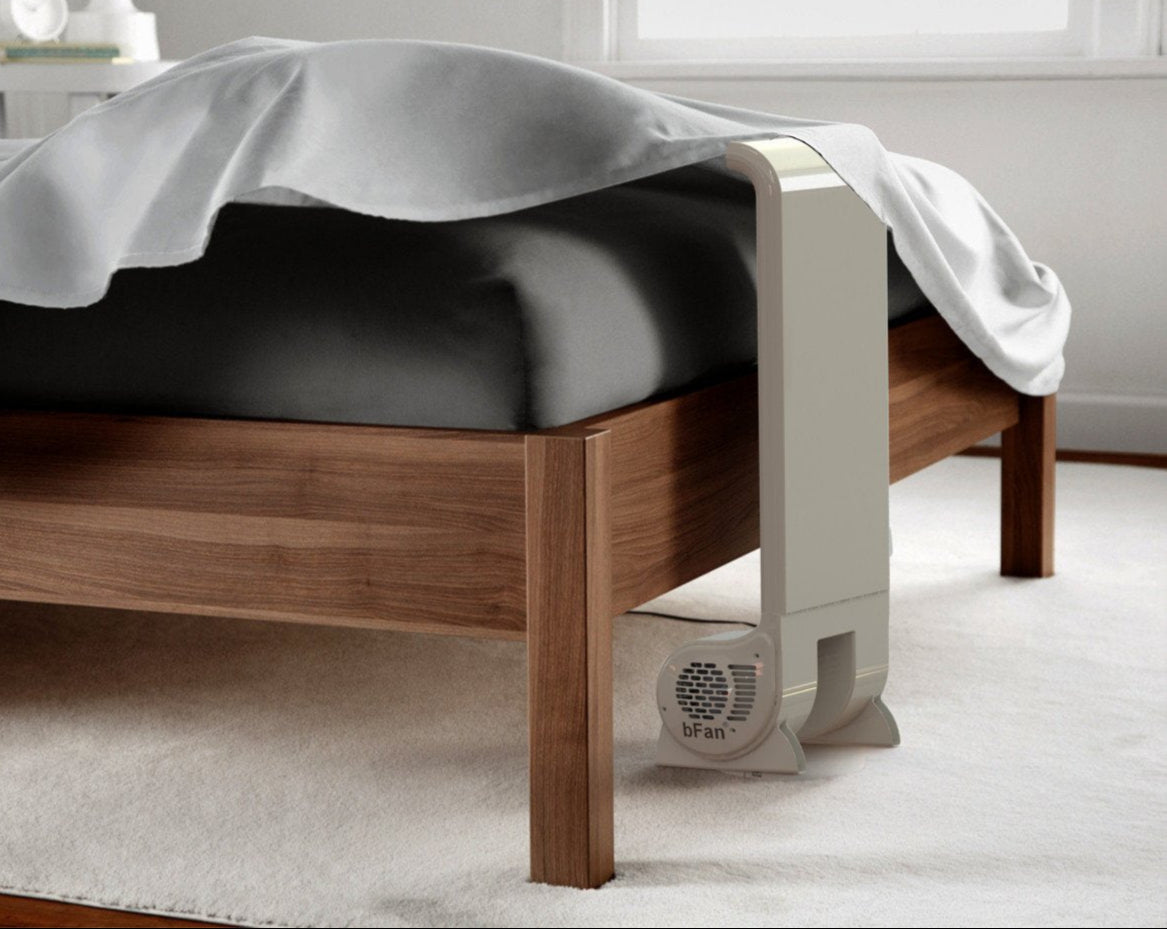
The bFan sits centered at the foot of the bed. Its two drum base rests on the floor, and a flat panel rises flush against the foot of the bed and tucks under the bedding at mattress height, sending room air under the covers. The bFan's large squirrel cage blower gives it higher static pressure than other bed fans, so it pushes air under the covers effectively at any speed and the airflow fully covers you with a cooling breeze. It runs at about 28 to 32 dB, uses about 18 watts on average, and costs $204.95 with the power supply and remote. Learn how the bFan works.
2. Two bFans on one bed: best for couples
Two bFans give each sleeper a separate zone with a separate remote. One partner can run a strong breeze while the other turns theirs low or off. Two bFans cost less than half the price of a dual-zone BedJet. See our guide to the sleep cooling system for couples.
3. BedJet 3: best if you also want heat
The BedJet 3 is an air based system that blows room air into the bed through a hose and adds a heating mode. It lists at $699. Like the bFan, it does not lower the air temperature. If you mainly want relief from heat and night sweats, one bFan costs less than half the price of one BedJet.
4. BedJet dual-zone: premium split control
The BedJet dual-zone queen lists at $1,549. It suits couples who want heating and app style controls on both sides and do not mind the cost. Two bFans give the same two zone idea for airflow at less than half that price.
5. Bedside fan aimed at the bed: a quick workaround
A tower or box fan on the floor aimed at the bed costs little and helps the room. Very little of that air gets under a comforter, so it helps more with a sheet only setup. Many box fans get noticeably louder on their higher settings. Our comparison of the best bedside fans for night sweats goes deeper.
6. Ceiling fan with breathable bedding: a whole room helper
The U.S. Department of Energy says a ceiling fan can let you raise the thermostat about 4°F without losing comfort, because moving air creates a wind chill effect on your skin. A ceiling fan is energy-efficient for the room, but it moves air above the bed, not under the blanket.
7. DIY under sheet fan setup: a test, not a long term fix
Some people try a small fan with a homemade duct under the sheets to test the idea. Fit, noise, and safety are hard to get right, and most DIY setups lack the pressure to reach past your hips. If the test convinces you that air under the covers helps, a purpose built under sheet fan is the next step.
If you want the shortest path to relief, purpose built under sheet fans usually beat the improvised fixes. The main reason is pressure and air direction, not fan size.
How does a bed fan help without air conditioning?
A bed fan helps by moving room air through your bedding, not by chilling it. Products like the bFan and the BedJet replace the warm, humid air trapped under the covers with the air already in your room.
This point gets misunderstood all the time. Neither the bFan nor the BedJet lowers the air temperature. Both depend on the room being reasonably comfortable to begin with. The bFan sends air up the foot of the bed and under the top sheet, so the warm air around your body moves out near your shoulders. If the top sheet and comforter are too loose at the foot of the bed, the air leaks out early and you lose much of the effect.
How to choose the best bed fan for your bed and sleep style
Start with your bed and your sleep habits, not the marketing. A queen bed with a tucked comforter needs different air flow than a twin with a loose throw.
- Find where the heat collects. If your chest and back sweat, you need airflow that travels the full length of your body under the covers.
- Check your bedding habits. If you kick the comforter off every night, an under sheet fan has less to work with.
- Measure your bed. The bFan needs about 6.75 inches of clearance under the bed and fits bed heights from 18 to 38 inches, measured from the floor to the top of the mattress, with short and tall versions. Platform beds with no gap can still work with the base turned around so it sits in front of the foot of the bed.
- Decide on one zone or two. Couples who sleep at different temperatures usually do better with two fans than one larger device.
Our guide to under sheet bed fans and what to look for covers fit and controls in more detail.
Bed fan vs BedJet: which is the better value?
For most hot sleepers, the bFan is the better value, while the BedJet is the feature heavy alternative with a heating mode. Both move room air; neither one lowers the air temperature.
At list prices, one bFan costs less than half the price of one BedJet, and two bFans cost less than half the price of a dual-zone BedJet. The BedJet adds heat and an app, and it uses a hose to deliver air into the bed. The bFan stays simple: a quiet blower at the foot of the bed with a remote and a sleep timer. A higher price does not mean colder air. If your room is too warm to start with, both systems lose effectiveness. The original Bedfan came to market in 2004, several years before the BedJet. Compare more in our guide to BedJet alternatives.
Bed fan vs cooling mattress pad
A bed fan usually clears trapped heat faster than a cooling pad when your problem is sweaty sheets. Water based pads change the surface you lie on, while a bed fan changes the air around you.
If your mattress feels warm against your back, a water based pad can help, but those systems cost much more and need water and maintenance. A gel topper or cool to the touch cover only feels cool at first. A bed fan leaves your mattress alone and sends a cooling breeze through the whole space under the covers. See our comparison of mattress cooler alternatives.
What bedding works best with a bed fan?
Tight weave sheets work best with a bed fan, because they keep the air under the covers long enough to reach your body. Cotton percale and sateen are good choices.

- Tight weave top sheet: Bedfans USA recommends higher thread count, tightly woven sheets. A tighter weave keeps the airflow under the covers instead of letting it escape through the fabric, the same way a sail needs tight cloth because a loose net cannot hold the wind.
- Stable top layer: A comforter that stays in place works better than a light throw that gaps open.
- Breathable fibers: Cotton handles moisture well without blocking air flow.
- Tuck at the foot: A light tuck keeps air moving toward your shoulders instead of spilling out the sides.
Our guide to cooling sheets explains more. Even heavier bedding can work well when the airflow path is controlled.
Can the best bed fan help with night sweats?
A bed fan can make night sweats more comfortable, but it does not address the medical cause. Direct airflow helps stop sweat before it starts, which is why many people with night sweats use one every night.
Night sweats are common with menopause, some medications such as antidepressants and steroids, low blood sugar, infections, alcohol, and anxiety, according to the NHS. A bed fan gives local relief without making everyone else in the house sleep in a cold room. If night sweats are new, drenching, or come with fever, weight loss, or swollen glands, talk with a doctor. Our night sweats page and menopause page cover common causes.
How much energy and noise should you expect from a bed fan?
An energy-efficient bed fan uses very little power and makes only a soft, steady sound. The bFan averages about 18 watts and runs at about 28 to 32 dB at normal operating speed.
That makes the bFan an energy-efficient choice: eighteen watts is less than a single old 60 watt incandescent bulb and a small fraction of what an air conditioner uses. The savings depend on your climate, your home, and how cold you usually set the thermostat. Many customers report they can raise the thermostat up to 6°F and still sleep comfortably. Read more about bFan noise levels.
bFan at a glance
- Price: $204.95 with fan, power supply, and remote
- Blower: large squirrel cage blower with higher static pressure than other bed fans
- Sound level: about 28 to 32 dB at normal operating speed
- Power use: about 18 watts average, 24 watts maximum
- Motor: brushless, digitally controlled DC motor
- Controls: remote speed control and a sleep timer
- Fit: bed heights 18 to 38 inches (floor to top of mattress), about 6.75 inches under bed clearance, or turn the base around to sit in front of the foot of the bed
- Made in: Texas, with over 80 percent American made parts
- Guarantee: 30 day satisfaction guarantee; HSA and FSA eligible, with a simple letter of medical necessity process from Bedfans USA so you can pay with your HSA or FSA card in one place
When is a bed fan not the right answer?
A bed fan is not ideal if your bedroom is already very hot or you never use covers. The bFan and the BedJet both rely on room air, not refrigeration.
If your bedroom sits at 78°F or higher and is humid, a bed fan helps some, but it will not perform like air conditioning. If you sleep with no covers at all, there is no pocket of trapped heat to clear. If you dislike any airflow on your skin, a water based pad may suit you better. Bed fans solve one specific problem very well: heat trapped under the covers.
Ready for better sleep?
The bFan sits at the foot of your bed and sends a quiet stream of air under your sheets. Direct airflow helps stop sweat before it starts, and one bFan costs less than half the price of one BedJet, making it the less expensive alternative. Shop the bFan at bedfans-usa.com
Frequently Asked Questions
What is static pressure, and why does it matter in a bed fan?
Static pressure is a fan's ability to push air against resistance, such as the weight of a comforter. A fan with low static pressure moves plenty of air in open space but stalls once the air has to travel under bedding. The bFan uses a large squirrel cage blower, which gives it higher static pressure than other bed fans. That pressure lets the airflow reach from the foot of the bed all the way to your shoulders at any speed, instead of fading out near your knees, so your whole body feels the breeze.
Can you use a bed fan with an adjustable base?
Often yes, as long as there is room at the foot of the bed and the foot section stays mostly flat. The bFan sits on the floor at the foot of the bed, with its panel flush against the bed and tucked under the bedding. If your adjustable base raises the foot section high, the panel may not reach under the covers in that position. Many people keep the foot flat at night and raise only the head. Check that the base leaves about 6.75 inches of clearance and that your bed height falls between 18 and 38 inches, measured from the floor to the top of the mattress. If there is not enough clearance, the base can be turned around so it sits in front of the foot of the bed instead of underneath.
Do bed fans work with weighted blankets?
Bed fans can work with weighted blankets, but the weight presses the blanket against your body and leaves less space for air. A fan with higher static pressure has a better chance of pushing air under the weight, which is one reason the bFan's squirrel cage blower helps. You may need to run the fan at a higher speed than you would with a light comforter. Some people put a light top sheet between themselves and the weighted blanket, which gives the air a clear channel across the body.
How long does a bed fan take to feel cooler?
Most people feel the difference within a few minutes of turning on an under sheet bed fan. The fan starts replacing the warm, damp air under the covers right away, so the change is quick compared with lowering the thermostat and waiting for the room to change. With the bFan, you can turn the speed up during a hot spell and lower it once you feel comfortable. Give the setup a few nights to adjust your sheet tuck and fan speed before you decide what works best for you.
Is a bed fan safe for kids and pets?
A bed fan designed for sleep is generally safe in a home with kids and pets when it is set up as directed. The bFan's blower is enclosed in its base, so there are no exposed blades at the foot of the bed. Keep the power cord tucked away from chewing pets and walkways. Older children who sleep hot can use a bed fan too, but small children should not adjust electrical devices on their own. As with any appliance, keep the intake clear of toys, clothing, and pet hair.
Does a bed fan help in a humid climate?
A bed fan helps in a humid climate because humidity under the covers is a big part of what makes a bed feel sticky. Your body releases moisture all night, and blankets hold it close to your skin. An under sheet fan replaces that damp air with room air and moves it out near your shoulders, so the bed feels fresher. The bFan works best when the room itself is reasonably comfortable, so in very humid weather pair it with air conditioning or a dehumidifier set to a moderate level, and use breathable cotton sheets.
Resources
- The Best Temperature for Sleep from the Sleep Foundation: The recommended bedroom temperature range and how body temperature changes during sleep
- How to Create a Bedroom Environment for Good Sleep from the Sleep Foundation: Practical tips on temperature, bedding, light, and noise for better sleep
- Tips for Lowering Your Cooling Costs from the U.S. Department of Energy: DOE guidance on fans, the wind chill effect, and raising the thermostat about 4°F
- Ceiling Fans from ENERGY STAR: How efficient ceiling fans save energy and how to choose one for a bedroom
- Night Sweats from the NHS: Common causes of night sweats and when to see a doctor
- BedJet 3 Climate Comfort Sleep System from BedJet: The maker's product page with BedJet 3 features and list price
Share