
Cooling Sheets or Bed Fans: Which Works Better at Night?
By Kurt Tompkins, Bedfans USA. Updated November 2026.
Quick answer: For most hot sleepers, a bed fan works better overnight than cooling sheets alone. Cooling sheets change how the fabric feels and handles moisture, while a bed fan like the bFan keeps air moving under the covers all night, so trapped heat and humidity move out near your shoulders.
If you wake up sweaty, kick off the covers, then pull them back on an hour later, the real question is not which cooling sheets feel coolest. It is what actually changes the climate around your body while you sleep, whatever bed sheets you choose. Cooling sheets and bed fans solve heat in very different ways: one is passive fabric, the other is active airflow. This guide compares them so you can decide where to start, and how the two work together.
Do cooling sheets or bed fans work better at night?
A bed fan usually works better overnight, because airflow keeps working after the sheets warm up. Cooling sheets often feel cool on first touch, then stop feeling cool once they reach skin temperature.
Cooling sheets help with feel, breathability, and moisture handling. A bed fan like the bFan from Bedfans USA moves room air under your top bedding all night, which matters more when the problem is trapped heat, night sweats, or a partner who wants the room warmer than you do. Direct airflow helps stop sweat before it starts, and no fabric alone can do that.
The research on cooling bedding is honest about its limits. A 2024 systematic review and meta-analysis of body cooling bedding screened more than 3,000 articles and included nine trials in healthy adults. With very low to low certainty, it found no clear differences in sleep onset, sleep efficiency, or total sleep time, though some studies suggested a lower core body temperature in the short term. That fits what many hot sleepers report: fabric alone is rarely enough.
Why do cooling sheets not always stop overheating?
Because the bigger issue is usually the bed microclimate, the warm, humid pocket of air trapped between your skin, the sheets, and the comforter.
Sleep researchers talk about thermal comfort, skin temperature, and core body temperature. In plain English, you sleep better when your body can release heat without getting chilled. If the covers trap warmth and moisture, even a high quality set of cooling sheets can lose that battle.
A 2024 review of sleepwear and bedding fibers found that materials can influence skin temperature and thermal comfort, but the evidence base was small and fiber specific. Cotton, linen, wool, and polyester blends do not behave the same way, and no single fabric won across the board. In other words, "better sheets" may improve the feel of the bed, but they may not fix heat buildup under a thick comforter.
What do cooling sheets do well?
Cooling sheets are a good comfort upgrade, especially if you are already close to comfortable. Here is what they offer.
- Breathable fabrics: percale cotton, linen, and similar weaves let some heat and moisture pass through.
- Moisture handling: some fabrics wick sweat away from skin so the bed feels less clammy.
- Durable and easy care: many cotton and linen sets are durable and hypoallergenic, and they are easy to wash.
- A cool first touch: cool-to-the-touch fabrics feel nice when you first lie down.
- No electricity: passive fabric needs no power and makes no sound.
If you only run a little warm and want a nicer hand feel, cooling sheets may be all you need. If you wake up overheated under the covers, add airflow. One more practical point: sheets are only one layer of the bed. The mattress, the mattress protector, the pillows, and the comforter all hold heat too, so swapping a single layer rarely changes the whole bed climate. That is another reason airflow tends to make the bigger difference.
What does a bed fan do that sheets cannot?
A bed fan adds active temperature regulation at the bed level. It moves air across your body for as long as you need it.
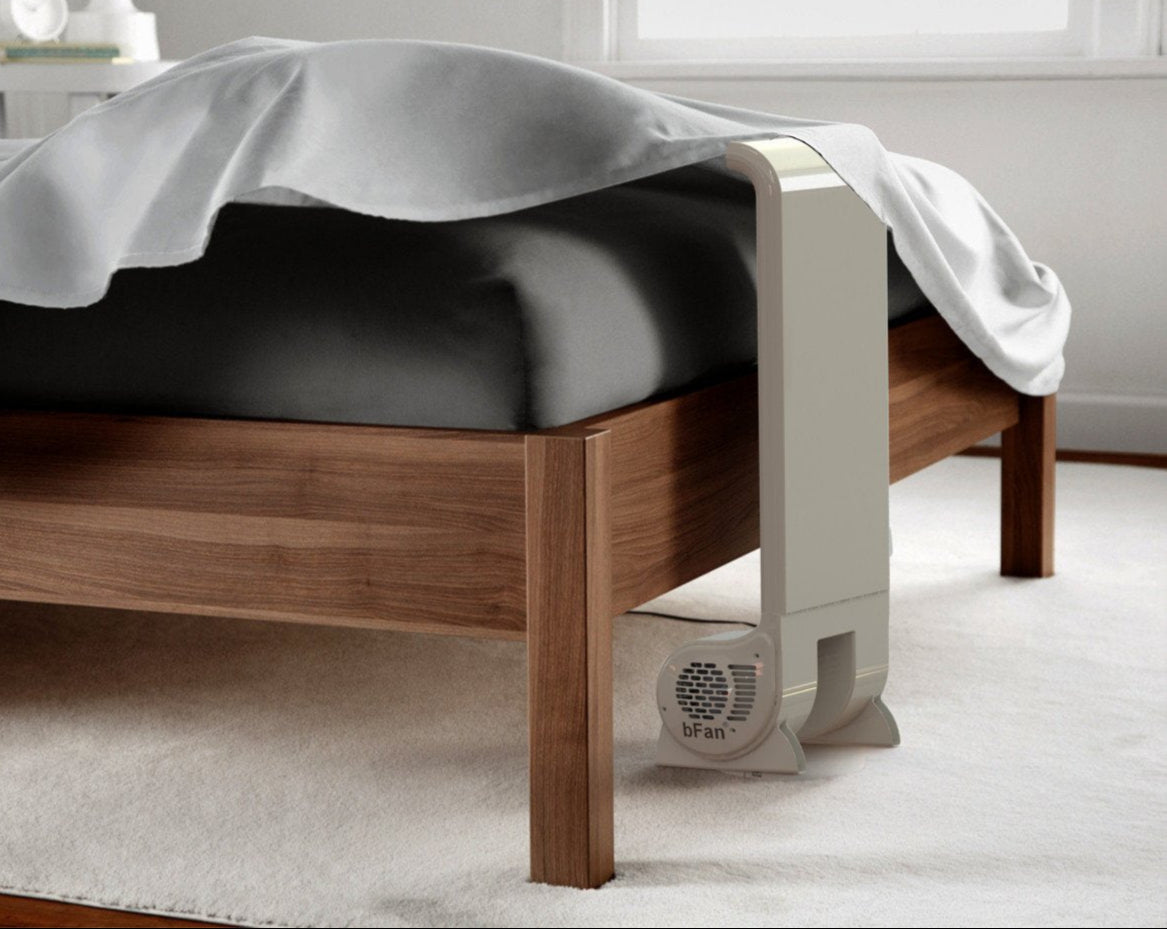
The bFan sits at the foot of the bed. The base sits under the foot of the bed and the flat duct panel rises to mattress height, sending a cooling breeze under your top bedding. The air moves across your body and exits around the shoulders, carrying trapped heat with it. It uses the air already in your room, as a BedJet does, so it works best in a bedroom that is already reasonably comfortable.
Bed fans also solve problems fabric cannot:
- Night sweats and hot flashes: airflow starts working the moment you feel warm, and the timer and remote let you adjust without getting up.
- Couples: two bFans give each sleeper a separate speed, a real dual-zone setup for couples.
- Heavy bedding: a thick comforter can stay on while the airflow keeps the bed comfortable.
- Thermostat comfort: many customers tell Bedfans USA that they raise their thermostat a little and still sleep comfortably.
How do you choose between cooling sheets and a bed fan?
Choose based on the cause of your heat, not on the label on the package. Three quick questions help.
1. When do you feel hot? If only when you first get into bed, cooling sheets may help. If you wake up overheated under the covers, airflow usually matters more. 2. How strong is the problem? Sheets are passive and a bed fan is active. If overheating is tied to menopause, medications, night sweats, or a partner who likes heavy blankets, the active option is usually the better fit. 3. What fits your habits? If you are happy to change bedding seasonally, try sheets first. If you want one setup that works night after night, a bed fan usually gives a clearer result.
A tip: do not judge a cooling sheet in the first five minutes. Many fabrics feel cool at first touch and then warm up to your skin.
Which sheets work best with a bed fan?
Tightly woven sheets work best with a bed fan. Bedfans USA recommends higher thread count, tightly woven sheets.
A tighter weave keeps the airflow under the covers instead of letting it escape through the fabric. Think of a sail: a sail holds the wind, while a loose net cannot. Percale and other crisp, tight weaves are good partners for a bed fan. Loose, gauzy bedding lets the air leak out before it reaches you, so you may need a higher fan speed to get the same result. Tuck the top bedding at the foot and sides so the air has a path across your body. For more on fabrics, see this guide to cooling sheets and moisture wicking sheets.
How do bed fans compare with BedJet systems?
Both use room air, but the bFan is the less expensive way to get airflow under the covers. At list prices, one bFan ($204.95) is less than half the price of a BedJet ($699), and two bFans for a couple are less than half the price of a dual-zone BedJet ($1,549).
Neither product makes the air colder. The original Bedfan came to market years before the BedJet, so the idea is well established: move air where heat is trapped. The bFan is also HSA and FSA eligible. Bedfans USA offers a simple process to get a letter of medical necessity, so you can pay with your HSA or FSA card in one place. See the bFan HSA and FSA payment option.
bFan at a glance
- Power: about 18 W on average and 24 W at maximum.
- Sound: about 28 to 32 dB at normal operating speed, with remote speeds from 5 to 100 percent and a sleep timer.
- Fit: mattress heights from 19 to 38 inches. The base needs about 6.75 inches of clearance under the foot of the bed. If there is not enough clearance, the base can be turned around so it sits in front of the foot of the bed instead of underneath.
- Blower: a large squirrel cage blower with higher static pressure than other bed fans, so it pushes air under the covers at any speed.
- Made in Texas: with over 80 percent American made parts, and a 30 day satisfaction guarantee.
How should you set up a bed fan for the best airflow?
Put the fan at the foot of the bed, tuck the top bedding in, and start on a low speed.
1. Place the base under the foot of the bed, centered, with the panel rising to mattress height. 2. Tuck the top bedding at the foot and sides so the air moves across your body instead of escaping. 3. Start low and adjust. Steady air movement is better than a wind tunnel.
Bed fans also beat generic room fans here. A pedestal, ceiling, or box fan moves air around the room or over your exposed skin, while a bed fan works on the warm pocket under your bedding, which is often the real problem.
Ready for better sleep?
Order the bFan from Bedfans USA and get a quiet cooling breeze under your covers, built in Texas by the company that invented the Bedfan.
Frequently Asked Questions
Are cooling sheets worth it for hot sleepers?
Cooling sheets are worth it if you want a more breathable, better feeling bed and your overheating is mild. They help with feel, moisture handling, and breathability, and a good set can last for years. They are less likely to be enough on their own if you wake up soaked, deal with night sweats or hot flashes, or sleep under a heavy comforter, because fabric cannot keep moving trapped heat out of the bed. Many hot sleepers start with better sheets and add a bed fan when they find the fabric alone is not enough.
Can I use cooling sheets and a bed fan together?
Yes, and they work well together. Tightly woven sheets help keep the airflow from a bed fan under the covers, so the fan can run at a lower, quieter speed. Percale cotton is a popular choice because it is crisp, breathable, and tightly woven. Avoid very loose, gauzy bedding with a bed fan, since air can leak through it before it reaches your body. Tuck the top sheet and blanket at the foot and sides of the bed, and you will get the most from both the fabric and the airflow.
Will cooling sheets ease night sweats?
Cooling sheets may make the bed feel less clammy, especially if they are breathable and move moisture away from skin. They do not move trapped heat out from under the covers, so heavy sweats can still wake you. Direct airflow helps stop sweat before it starts, which is why many people with night sweats add a bed fan. If your sweats are heavy or frequent, talk to a doctor about possible causes, such as hormones, medications, or infection, and use bedding and airflow as comfort measures alongside that care.
What is the best temperature regulation setup for a hot bedroom?
Start with a bedroom that is cool, quiet, and dark, then work on the bed itself. Use breathable, tightly woven sheets, a lighter top layer, and a bed fan to keep air moving under the covers. This layered approach lets you avoid overcooling the whole house for one hot sleeper. If your partner runs cold, two bed fans let each person set a separate speed. Many bFan customers tell Bedfans USA they raise their thermostat a little and still sleep comfortably, which can also cut down on air conditioning noise.
Does a bed fan beat a room fan or ceiling fan?
For heat trapped under the covers, usually yes. A ceiling or pedestal fan moves air around the room and over exposed skin, but it does very little for the warm, humid pocket of air under your blankets. A bed fan sends a cooling breeze directly under the top bedding, across your body, and out near the shoulders. It also tends to be quieter for a partner, because it runs at a lower speed than a room fan would need. Some people still like a ceiling fan for general air circulation in the room.
Resources
- PubMed: Body cooling facilitated by bedding and sleep: 2024 systematic review and meta-analysis of body cooling bedding, with low certainty results on sleep outcomes.
- Journal of Sleep Research: Sleepwear and bedding fibre types: 2024 systematic review on how fibre types affect sleep quality, with mixed and fiber specific results.
- Sleep Foundation: The Best Temperature for Sleep: Explains how a cool bedroom supports sleep.
- CDC: About Sleep: Overview of why sleep matters and how much adults need.
- MedlinePlus: Healthy Sleep: NIH information on healthy sleep habits.
- NHS: Night sweats: Common causes of night sweats and when to see a doctor.
Partager