
Best Bed Fan: 6 Clues It Will Not Wake Your Partner
By Kurt Tompkins, Bedfans USA. Updated November 2026.
Quick answer: The best bed fan for a shared bed is one that moves air under the covers quietly, has a published sound level, runs well at low speeds, and lets each sleeper set their own side. The bFan from Bedfans USA runs about 28 to 32 dB at normal operating speed, uses a remote with speeds from 5 to 100 percent, and comes as a pair for couples.
If you share a bed with someone, the best bed fan is not the one with the biggest airflow number. It is the one that keeps you comfortable without waking your partner. Noise, drafts, and a fan that wanders from loud to silent all matter. This guide gives you six clues to check before you buy, so the best bed fan for your bedroom does the job and stays out of the way.
What makes the best bed fan for a shared bed?
The best bed fan for a couple is quiet at the speeds you will really use, moves air where the heat is, and gives each person control. A fan that is silent only because it moves no air is not a solution.
A bed fan sits at the foot of the bed and sends air under the top bedding. That is different from a room fan, which has to move air around the whole room. Because the airflow stays under the covers, a bed fan can run at a lower setting, and the sound stays low. The six clues below show you how to tell a quiet, useful bed fan from a noisy or ineffective one.
Clue 1: Does the maker publish a real sound level?
A real decibel number, with the distance it was measured from, is the first clue. Vague claims such as "whisper quiet" without a number tell you very little.
Where a sound was measured matters. A reading taken next to the motor is not the same as one taken a few feet away. Bedfans USA published a simple test of the bFan using a phone sound meter placed on the floor about 18 inches from the base. The reading was about 28 dB at the lowest speed, about 35 dB at a midway speed, and about 54 dB at full flow. At normal operating speed, the bFan runs about 28 to 32 dB. You can read the full test on the is the bFan quiet page, and the noise and sleep guide from the Sleep Foundation explains how nighttime noise can affect your sleep.
When you compare fans, ask for low, medium, and high settings, not just one number. Then separate official measurements from testimonials. Reviews are helpful, but they are still anecdotes. A published number plus reviews from other couples is a stronger signal.
Clue 2: Does it work well at low speed?
If a fan only works at full power, it will not be the best bed fan for a shared bed. Look for strong airflow at the lowest settings.
Many people jump to full power and then blame the fan for being noticeable. A good bed fan lets you start low and raise the speed in small steps. The bFan uses a large squirrel cage blower that gives it higher static pressure than other bed fans, so it pushes air under the covers at any speed. It also has remote control from 5 to 100 percent, so you can fine tune the breeze instead of picking between a few presets. Customers who say they sleep comfortably on the lower settings are giving you more useful information than a fan that brags about its maximum output.
Clue 3: Does the air stay under the covers?
A quiet bed fan sends air across your body, not into the room. That keeps the noise source low and the draft off your partner.
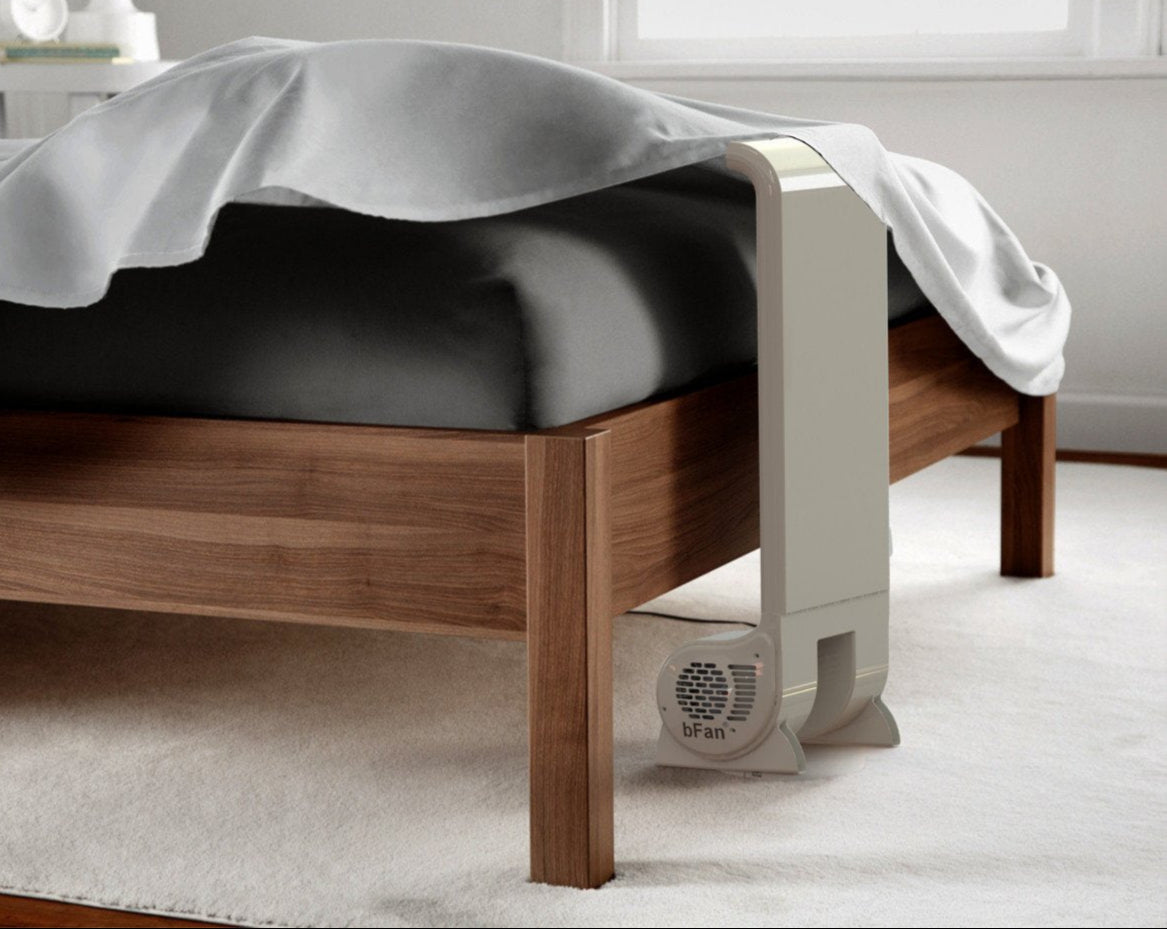
The bFan base sits under the foot of the bed, centered, and a flat duct panel rises to mattress height. The air travels under the top bedding, across your body, and exits around the shoulders, carrying trapped heat with it. Direct airflow helps stop sweat before it starts. Because the air stays in the bed, the partner on the other side of the mattress is not hit by a draft, and you do not need to chill the room with air conditioning for one of two hot sleepers. Think of the bFan as a quiet bed cooling system for one side of the bed. Many customers tell Bedfans USA that they raise their thermostat a little and still sleep comfortably, which can also mean less air conditioner noise.
Setup matters here. Tuck the top bedding at the foot and sides, and use tightly woven sheets. Bedfans USA recommends higher thread count, tightly woven sheets. A tighter weave keeps the airflow under the covers instead of letting it escape through the fabric, the way a sail holds the wind and a loose net cannot. Better bedding control often means a lower, quieter setting.
Clue 4: Can you adjust it without waking anyone?
A remote and a sleep timer are quiet features. You should be able to change the speed without getting out of bed or fumbling with buttons near your partner's head.
The bFan includes a remote and a sleep timer. Many sleepers want stronger airflow while falling asleep and less after the first sleep cycle, and a timer lets you do that without waking up later. Each tap of the remote steps the speed up, and after the top speed it wraps back to the slowest speed, never to off. Learn more about remote control bed fans.
Clue 5: Is the motor built for steady, smooth running?
A brushless motor with digital speed control runs smoother than a basic motor that hums, clicks, or buzzes. Those sounds wake light sleepers more than a steady low whoosh does.
The bFan uses a brushless, digitally controlled DC motor and a large centrifugal blower. It is built in Texas with over 80 percent American made parts, by the company that invented the Bedfan and has sold it since 2004. It uses about 18 W on average and 24 W at maximum, so it runs for hours without much power draw. See energy efficient bed fan for better sleep for more.
Clue 6: Can each sleeper have their own side?
For couples with very different temperature needs, two fans beat one. Separate airflow zones are often the cleanest fix.
Use one bFan when both sleepers like roughly the same temperature, and use two when one person runs much hotter than the other. Two bFans, one centered below each sleeper at the foot of the bed, let each person set a speed. One side can stay low and nearly unnoticeable while the other runs higher for menopause symptoms, medication related overheating, or general hot sleeping. Read more about why couples sleep at different temperatures and sleep cooling systems for couples.
How does a bed fan compare with a room fan or ceiling fan for noise?
A bed fan is usually quieter for a partner, because it works on the bed instead of the whole room. A ceiling fan spreads air everywhere, and a box or pedestal fan adds a steady hum in the room.
A ceiling fan is great for general circulation but not always for one hot sleeper. It can dry out eyes, move hair, and leave the cooler partner feeling chilled before the hotter partner feels better. A bed fan uses the air already in the room, sends it under the covers, and helps move hot air out near your shoulders. If your room is reasonably comfortable, that targeted approach is often more efficient and less intrusive. For more options, see our list of quiet sleep fans for light sleepers and quiet bed fan for night sweats.
Is the bFan or a BedJet better if you want less sleep disruption?
Both use room air and neither makes the air colder, but the bFan is the less expensive way to get airflow under the covers. At list prices, one bFan ($204.95) is less than half the price of a BedJet ($699), and two bFans for a couple are less than half the price of a dual-zone BedJet ($1,549).
Both a bFan and a BedJet move air into the bed, so the question is how quietly, how directly, and at what cost. The original Bedfan reached the market years before the BedJet, so the under-sheet approach is not a recent idea. The bFan is also HSA and FSA eligible. Bedfans USA offers a simple process to get a letter of medical necessity, so you can pay with your HSA or FSA card in one place. See the bFan HSA and FSA payment option.
What should you check before you buy a bed fan?
Check the fit, the clearance, and the sheets. A few measurements keep you from returning it.
- Mattress height: measure from the floor to the top of the mattress. The bFan fits 19 to 38 inches, with a short top for 19 to 28 inches and a tall top for 28 to 38 inches.
- Clearance: the base needs about 6.75 inches under the foot of the bed. If there is not enough clearance, the base can be turned around so it sits in front of the foot of the bed instead of underneath.
- Footboard: leave about 1.75 inches between the mattress and the footboard.
- Guarantee: the bFan comes with a 30 day satisfaction guarantee.
What sheet and bedding choices help a bed fan run quietly?
Tightly woven sheets and a properly tucked top layer help the most. Loose, airy bedding sounds appealing, but it can let the airflow escape before it reaches you.
Think of the bedding as part of the airflow channel. When the top sheet or blanket is tucked, the air has a path across your body. If your bedding is very loose, very short, or constantly untucked, you may end up using a higher setting just to get the same result. That is a setup problem, not always a fan problem. The same goes for very thick comforters that trap air so firmly that the flow cannot move through in a controlled way. For fabric ideas, see this guide to cooling bedding.
What mistakes should you avoid when picking the best bed fan?
Do not buy on maximum airflow alone, and do not skip the setup. Three mistakes cause most of the complaints.
- Judging by the loudest setting: a fan that is fine at low speed can be noticeable at full speed. Care about the settings you will use once the bed is comfortable.
- Ignoring the bedding: loose, short, or untucked covers let the air escape, so you turn the fan up and the noise goes up with it.
- Aiming a room fan at the bed: a room fan pushes air over your exposed skin and into your partner's side, while a bed fan works on the warm pocket under the covers.
If you keep these three points in mind, the best bed fan for your bed will be one you forget is running.
Ready for better sleep?
Order the bFan from Bedfans USA and get a quiet cooling breeze under your covers, built in Texas by the company that invented the Bedfan.
Frequently Asked Questions
How loud is the bFan next to a sleeping partner?
The bFan runs about 28 to 32 dB at normal operating speed, which is about as quiet as a soft whisper in a quiet room. In Bedfans USA's published test with a phone sound meter placed about 18 inches from the base, the lowest speed read about 28 dB, a midway speed read about 35 dB, and full flow read about 54 dB. Most people sleep on the lower settings once the bed is comfortable, so a partner usually hears a faint, steady airflow rather than a motor. If you ever find the fan is not quiet, contact Bedfans USA so the problem can be solved.
What is the best bed fan for a couple who disagree about the temperature?
Two bed fans, one centered below each sleeper at the foot of the bed, are the cleanest answer. Each person sets a speed with a remote, so the cooler partner can run a gentle breeze or turn the fan off while the hotter partner runs higher. Because the airflow stays under the covers, neither person has to chill the whole room for the other. The bFan is built to work in pairs, and two bFans are less than half the price of a dual-zone BedJet at list prices. One bFan also works well if only one person runs hot.
Can a bed fan help with hot sleepers and night sweats without waking me?
Yes, in many cases. Direct airflow helps stop sweat before it starts, and a quiet bed fan keeps the bed comfortable so you wake less often. The timer lets you run stronger airflow while falling asleep and less later in the night. A bed fan is a comfort product, not a medical device, so talk to a doctor if your night sweats are heavy or frequent. Menopause, medications, and other causes can all play a part, and a fan can help you stay comfortable while you sort out the reason.
Do tightly woven sheets make a bed fan quieter?
They can, indirectly. A tighter weave keeps the airflow under the covers instead of letting it escape through the fabric, so you may get the same comfort at a lower, quieter speed. Bedfans USA recommends higher thread count, tightly woven sheets, and tucking the top bedding at the foot and sides so the air has a path across your body. Loose, gauzy bedding lets air leak out early, which can push you to turn the fan up. Better bedding control often means quieter operation without giving up comfort.
How much electricity does the bFan use?
No. The bFan uses about 18 W on average and 24 W at maximum, which is far less than running an air conditioner colder all night. Many customers tell Bedfans USA that they raise their thermostat a little and still sleep comfortably, which can also reduce air conditioner noise and cost. The brushless DC motor is designed for long, steady use, and the sleep timer lets you limit how long the fan runs. Your actual cost depends on your electricity rate and how many hours you use it.
Resources
- Sleep Foundation: Noise and Sleep: Explains how nighttime sound affects rest.
- NIDCD: Noise-Induced Hearing Loss: Includes a decibel chart that shows where everyday sounds fall.
- NHLBI: Sleep Deprivation and Deficiency: Describes what happens when you do not get enough sleep.
- CDC: About Sleep: Overview of why sleep matters and how much adults need.
- MedlinePlus: Healthy Sleep: NIH information on healthy sleep habits.
- Sleep Foundation: The Best Temperature for Sleep: Explains how a cool bedroom supports sleep.
Partager