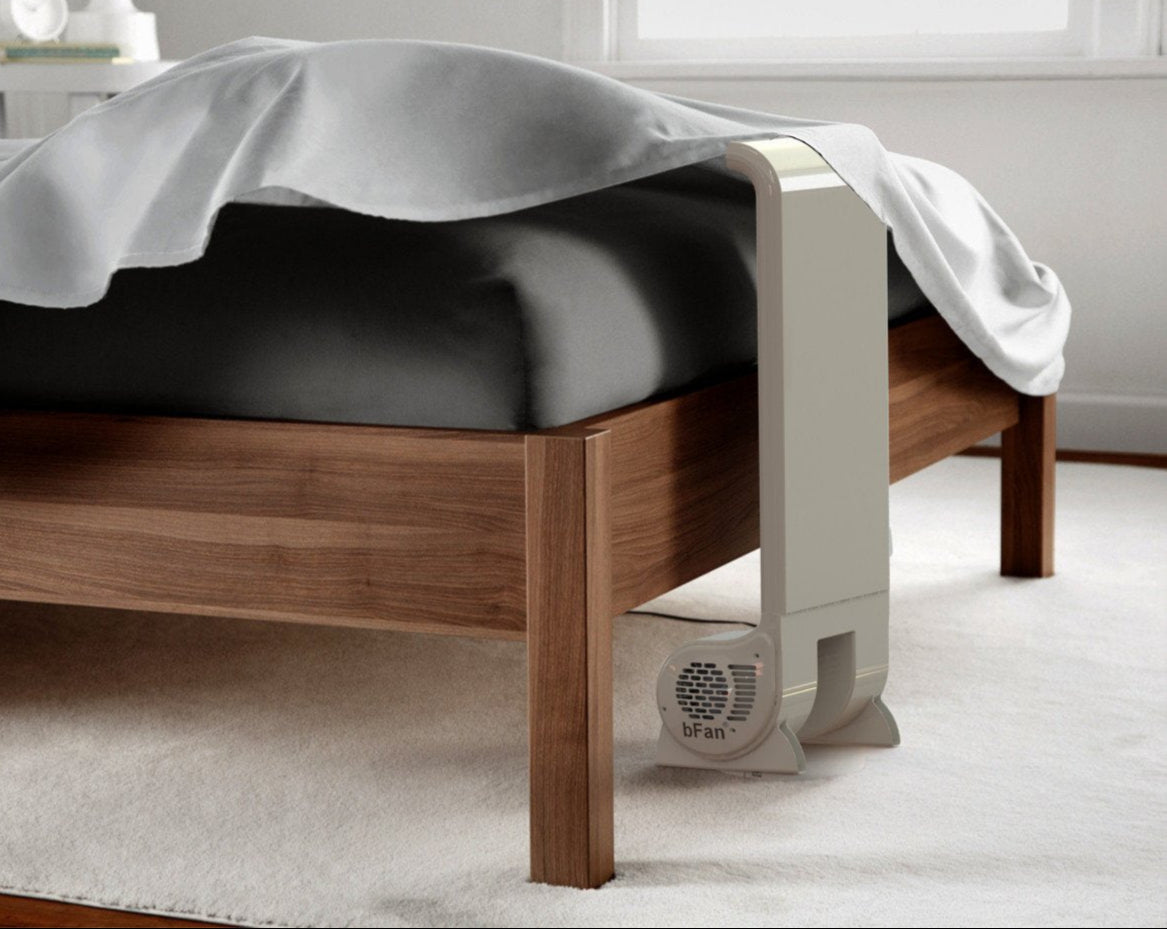

Bed Cooling Devices Compared
A bed cooling device helps you sleep when heat gets trapped between your body, the mattress, and the covers. That matters because a room can feel fine while the bed itself stays hot, humid, and stuffy, which leads to sweating, wakeups, and thermostat arguments. The main problem these products solve is bed microclimate control, not whole-room air conditioning. If you run hot, deal with menopause, take medications that trigger night sweats, or share a bed with someone who sleeps cold, that distinction can make a big difference.
What is a bed cooling device, and what problem does it solve?
A bed cooling device with a cooling system reduces heat buildup around your body, and products like bFan and Eight Sleep target the bed instead of the whole bedroom. The problem it solves is trapped heat under the covers, where sleep comfort usually breaks down first.

Your body temperature shifts through the night as circadian rhythms change, and the hypothalamus helps regulate that process. If your bedding holds too much heat, you may fall asleep slower, wake more often, or kick covers off at 2 a.m. even when the thermostat says the room is fine.
That’s why bed cooling has become its own category, emphasizing the importance of wellness by creating a comfortable sleep environment. It focuses on the sleep microclimate, the small pocket of air and fabric around your skin. If that microclimate stays cooler and drier, you usually sleep more deeply, even without turning the whole house into a walk-in fridge.
A common misconception is that every “cooling” product actually cools the air. Many do not. Some move room air under the covers. Others circulate temperature-controlled water through a pad or cover. Those are very different approaches, with very different costs and setup needs.
How do air-based bed cooling devices actually cool you at night?
Air-based systems like bFan and BedJet cool by moving room air through the bedding, not by lowering the air temperature itself. If the room air is reasonably cool, they can pull heat and moisture away from your body fast.
Think of hot sleep as a trapped-air problem. Once you’re under sheets and blankets, your body warms the air around you. If that warm air just sits there, you feel sticky and overheated. An under-sheet fan changes that by pushing fresh room air under the covers and evacuating the hot air that built up near your skin.
That’s why neither Bedfan nor BedJet actually cool the air. The BedJet doesn’t cool the air, and the bFan doesn’t either. They use the cooler air already in the room and move it where you need it most, under the bedding.
If your bedroom is already within the sleep-expert range of 60°F to 67°F, air systems utilizing advanced technology can feel surprisingly effective. If your bedroom is much warmer and humid, they still help, but the benefit narrows because they only have warm room air to work with.
Pro tip, airflow works best when the top bedding is tucked well enough to guide the air across your body instead of letting it spill out at the foot of the bed.
What are the 6 bed cooling devices worth comparing right now?
The six most useful comparisons are bFan, BedJet, Eight Sleep, and three other paths, water pads, smart toppers, and passive cooling layers. They solve the same symptom, sleeping hot, but they do it with very different mechanics, prices, and maintenance.

If you’re shopping seriously, consider the shipping options along with cooling method first, then by control style, noise, and total ownership cost. That will keep you from paying smart-mattress money for a problem that might be fixed with targeted airflow.
- bFan by Bedfans-USA: Best fit for many hot sleepers who want simple under-sheet airflow, low energy use, and straightforward setup. The bFan from www.bedfans-usa.com sits at the foot of the bed, uses about 18 watts on average, runs around 28 dB to 32 dB at normal speed, includes remote control and timer controls, and can create dual-zone microclimate control by using two units.
- BedJet: Best for buyers who want air-based cooling plus heating and app controls. It also moves room air under the bedding, so it does not cool the air itself. One BedJet is more than twice the price of a single bedfan, and the dual-zone BedJet setup is over a thousand dollars, more than twice the price of two bedfans.
- Eight Sleep Pod: Best for buyers who want water-based temperature control, sleep tracking, and automatic adjustments. It cools and heats each side through a hydro-powered cover and connected hub. The trade-off is a much more integrated system, a higher upfront cost, and more setup complexity.
- Water-circulating mattress pad systems: Best for people who want active cooling without buying a full smart sleep platform. These usually place tubing inside a pad and connect to a control unit. They can work well, but you’ll want to think about maintenance, fill routines, and how the pad changes mattress feel.
- Smart cooling toppers: Best for buyers who want a more integrated topper-style solution rather than airflow under loose sheets. Some include sensors or adaptive settings. They can be effective, but they’re typically bulkier and less flexible if you change beds or mattresses often.
- Passive cooling pads and toppers: Best as a low-cost first step, not as a true fix for strong night sweats. Gel foams, phase-change fabrics, and breathable covers can reduce heat retention a bit, but they do not actively remove trapped heat once your bed warms up.
Is a bed fan better than BedJet for most bedrooms?
For value-focused buyers, a bed fan like bFan usually beats BedJet on simplicity and price. BedJet adds heating and app features, but both systems depend on room air, and neither actually cools the air itself.
The real question is what you need beyond airflow. If you want basic cooling relief, quiet operation, low power draw, and a smaller bill, the bedfan category is hard to beat. The original Bedfan came to market several years before BedJet was even thought of, and that long history shows in how focused the product is on one job, moving trapped heat out from under the covers.
If you want added heating, app connectivity, and a more feature-heavy control system, BedJet may be worth the premium. If you don’t care about heating and mostly want to stop night sweats, the price difference matters a lot. One BedJet is more than twice the price of a single bedfan. A dual-zone BedJet is over a thousand dollars and more than twice the price of two bedfans.
There’s also the bedroom feel to consider. A bFan setup can be very discreet, especially once installed at the foot of the bed. With two units, you get separate left and right control, which is a practical way to handle couples with different sleep temperatures.
Common misconception, people often think a higher price means colder air. In this category, it often means more features, not a fundamentally colder airflow.
Is Eight Sleep or another water-based system better than an air-based bed cooling device?
Eight Sleep and similar water-based systems are better for buyers who want automated temperature changes, biometric features, and the integration of advanced technology. Air-based options like bFan are usually better for buyers who want simpler setup, lower cost, and less system overhead.
Water-based cooling changes the feel of the bed more directly because it controls the surface temperature through a cover or pad, acting as an efficient cooling system. That can be great if you want precise heating and cooling on each side and you like sleep tracking. It’s also helpful if you want temperature changes to happen automatically through the night.
Air-based systems attack the problem from another angle. They remove hot air and humidity trapped under the covers. If your main complaint is “I’m sweating under the sheets,” that direct airflow can feel immediate.
The trade-off is clear. If you want smart automation and don’t mind a bigger investment, a water-based system can make sense. If you want easy setup, minimal maintenance, lower cost, and an effective cooling system with no water around the bed, air-based cooling is often the cleaner choice.
Pro tip, if you’re sensitive to changes in mattress feel, consider a trial to test that concern before buying a water-based cover or pad. Added layers can matter more than you expect.
How do you choose the right bed cooling device for menopause, night sweats, or medication-related overheating?
For menopause, SSRIs, and similar triggers, the best choice depends on whether you need fast relief, dual-zone control, or automation. bFan and Eight Sleep serve different needs, even when the symptom is the same, waking up too hot.
Start with the trigger pattern. If your overheating comes in sudden waves, which is common with menopause, perimenopause, hormone shifts, and some medications, quick airflow under the covers is often the most noticeable fix. That’s where a bed fan can make a lot of sense.
Next, look at your sleeping arrangement. If your partner sleeps cold, you’ll want true dual-zone control, and considering shipping options might be important if you need the system quickly. Two bedfans can create separate microclimates without forcing the whole room colder. If you sleep alone and want the system to adjust itself all night, an automated water-based option may appeal more.
Then check your budget honestly. If you want strong relief without spending premium smart-bed money, an air system is usually the first place to look. If you want app-led sleep tracking and can justify the cost, move up the ladder.
Common misconception, “cooling” sheets alone rarely solve strong hormonal night sweats. They can help at the margins, but they don’t actively remove heat.
How should you set up a bed cooling device for the strongest airflow under the covers?
Correct setup matters for optimal wellness, and bFan with tight-weave cotton sheets usually performs best when airflow is directed from the foot of the bed across the body. Poor bedding setup can cut performance more than fan speed.
Step 1 is placement. Put the blower housing under or at the foot of the bed, with the air duct rising up the foot of the mattress. The goal is to send room air over the mattress edge and under the top bedding.
Step 2 is sheet management. Tuck the top bedding so the air travels under the covers, across your legs and torso, and exits near your shoulders. If the covers are too loose at the foot, the air escapes early and you lose the cooling path.
Step 3 is fabric choice. Tight-weave sheets, cotton percale is a good example, help the air move across your body and carry away heat better than very open or fluffy fabrics. Heavy comforters still work, but they slow the air path.
Pro tip, install first, then adjust speed after five to ten minutes in bed. People often set airflow too high before they’ve felt what the sheet tunnel is doing.
How can couples get dual-zone bed cooling without making the room freezing?
Two independently controlled bed fans, or a true two-side water system like Eight Sleep, are the cleanest ways to cool couples differently. One room thermostat cannot solve two opposite sleep preferences well.
Step 1 is stop trying to fix a bed-level problem with whole-room AC alone. Sleep experts recommend 60°F to 67°F, but couples often fight because one person wants 65°F and the other wants 72°F. Bed-level control narrows that conflict.
Step 2 is create separate zones. Two bFans give dual-zone microclimate control, one for each sleeper, which is a practical and lower-cost path, plus offers additional shipping options based on need. This is where a pair of bedfans, each equipped with a cooling system, often makes more sense than paying over a thousand dollars for a dual-zone BedJet setup.
Step 3 is fine-tune bedding, not just airflow. If one sleeper still runs cold, use a slightly heavier blanket on that side or reduce that side’s fan speed. If one sleeper overheats, keep their side more tucked to preserve airflow.
A common misconception is that one fan at the center foot of the bed gives true dual-zone cooling. It usually doesn’t.
What room temperature works best with a bed cooling device?
The sweet spot is still a cool bedroom, and CDC guidance plus sleep experts point to a room that feels cool, quiet, and relaxing. Most people do best in the 60°F to 67°F range, even with a bed cooling device.
A bed cooling device is not a substitute for a badly overheated room, underscoring the importance of a proper cooling system and its role in overall wellness, but it's worth giving a trial as part of a comprehensive approach. It works best as a targeted layer on top of a reasonable bedroom temperature. The good news is that many people can raise room temperature by about 5°F and still sleep cool when using a bedfan, which can help lower AC costs.
A simple way to think about it is this:
- If your room is already cool: An air-based bed cooler can feel very effective, because it has cooler air to move under the sheets.
- If your room is mildly warm: A bed cooler may still let you raise the thermostat about 5°F and keep comfort about the same.
- If your room is hot and humid: A bed cooler helps, but AC or dehumidification still matters, because the system only uses the air already in the room.
CDC also recommends good sleep habits around the environment, including a quiet, relaxing room and fewer electronic distractions before bed, demonstrating how technology can impact sleep quality. Cooling works best when the rest of your sleep hygiene isn’t fighting against it.
Are bed cooling devices quiet and energy efficient enough for nightly use?
Yes, many bed cooling devices are practical for nightly use, and bFan is a strong example because it runs around 28 dB to 32 dB at normal speed and uses about 18 watts on average. That is tiny compared with central AC demand.
From a power-cost standpoint, targeted bed cooling is appealing. If you can sleep well with the thermostat set about 5°F warmer, the savings from reduced AC runtime can matter a lot over a summer. A small bed fan is not replacing HVAC, but it can reduce how hard you have to lean on it.
Noise is where people often hesitate. In practice, low steady airflow is usually easier to sleep with than the stop-start cycling of a loud air conditioner. And because the airflow is aimed under the covers, you feel the effect where it counts without needing a roaring room fan.
Timer controls help here too. If you tend to overheat during sleep onset but wake up cooler later, set the fan to run for the first few hours. That matches how many people experience nighttime heat, strong at the beginning, lower later on.
When should night sweats send you to a doctor instead of another bed cooling device?
Persistent night sweats with fever, weight loss, or chest symptoms need medical evaluation, not just a cooling product. Hot sleeping is common, but night sweats can also be linked to conditions, medications, infections, or sleep disorders.
A bed cooling device can make you much more comfortable while you sort out the cause. It should not be the only step if your symptoms are new, severe, or paired with other warning signs.
Watch for a few red flags:
- Fever or chills These can point to infection, not just overheating.
- Unexplained weight loss This is a medical flag that deserves prompt attention.
- New medication changes SSRIs, steroids, diabetes drugs, and hormone treatments can all trigger sweating.
- Snoring or gasping at night Sleep apnea can be tied to night sweats and broken sleep.
- Chest pain, severe shortness of breath, or persistent cough These symptoms call for medical care.
If the sweating is frequent and unexplained, see a clinician. If you know the trigger, menopause, medication side effects, or just being a lifelong hot sleeper, a targeted solution like a bFan can make the nights much easier while you manage the bigger picture.
Compartir