
Best Bedside Fan for Night Sweats: 7 Options Compared
By Kurt Tompkins, Bedfans USA. Reviewed October 2026. Bedfans USA makes the bFan, so we have put our own product first, and we describe other brands only by how they work, not by specifications we could not verify.
Quick answer: The best bedside fan for night sweats is one that moves air under your covers, not just across the room. An under sheet bed fan such as the bFan from Bedfans USA sits centered at the foot of the bed, runs at about 28 to 32 dB, uses about 18 watts, and costs less than half the price of a BedJet. Room fans from brands like Vornado, Rowenta, Honeywell, and Woozoo help with general airflow and white noise but do little for heat trapped under a comforter.
Night sweats are not just about a warm room. Most of the heat and humidity that wakes you up is trapped between your body and the bedding. That is why the best bedside fan for night sweats depends on where the air goes, how quiet it runs, and how well it fits your bed. Below are seven options, ranked for night sweat comfort rather than raw fan power.
What is the best bedside fan for night sweats?
For most people, the best bedside fan for night sweats is an under sheet bed fan, because it puts air inside the bed where sweating starts. A traditional bedside fan blows across the top of the comforter, while an under sheet bed fan sends room air between the sheets.
Both types use the air already in the room. Neither a bedside fan nor a bed cooling system like the bFan or BedJet lowers the air temperature. What changes is where that air moves. When air flows under the top sheet, it pushes warm, humid air out from around your body near your shoulders. Direct airflow helps stop sweat before it starts, which is why many people with menopause hot flashes or medication related night sweats prefer airflow inside the bed.
Shopping labels add to the confusion. Retailers often call any bed fan, water pad, or climate unit a cooling system, but a cooling system that only moves air works differently from one that changes water temperature. An air based cooling system like the bFan moves room air under the sheets, while a water based cooling system like the Chilipad Dock Pro circulates temperature controlled water through a mattress pad. No fan, bedside or under sheet, makes the air colder; it moves the air you already have. Knowing which kind of cooling system you are buying helps you set fair expectations for noise, setup, and cost.
How do bedside fans help with night sweats if they do not cool the air?
Fans help by moving a cooling breeze across your skin and bedding. The Sleep Foundation puts the best bedroom temperature for most adults at about 65°F, and air movement helps you feel comfortable closer to that range.
The catch is the comforter. A room fan can make your face and arms feel better while your back and legs stay hot under the covers. Humidity matters too: trapped, humid air under bedding feels warmer than the same air moving freely. An under sheet bed fan targets that pocket directly, while a room fan improves the space above and around the bed.
The 7 best bedside fans for night sweats compared
Our ranking puts under sheet airflow first and room fans after, based on how directly each option reaches heat trapped in the bed. Prices and specifications for other brands change often, so check the manufacturer before you buy.
1. bFan by Bedfans USA: best overall for night sweats in bed
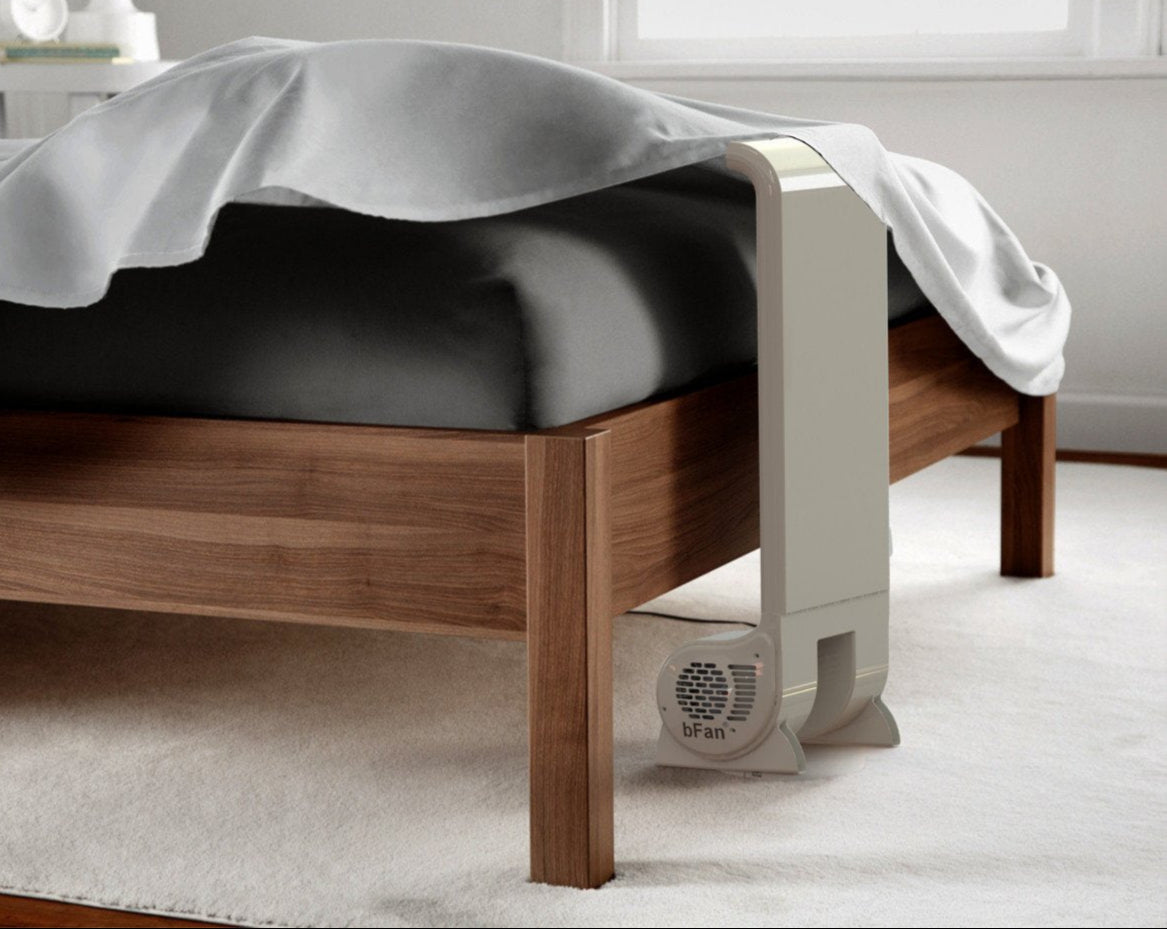
The bFan is an under sheet bed fan that sits centered at the foot of the bed. Its two drum base rests on the floor and a flat panel slides under the bedding at mattress height, so the air travels under the covers toward your shoulders. It runs at about 28 to 32 dB at normal operating speed, uses about 18 watts on average and never more than 24 watts, and has remote speed control plus a sleep timer. It fits bed heights from 18 to 38 inches, measured from the floor to the top of the mattress, and costs $204.95. If night sweats are your main problem, this is where we would start.
2. Two bFans: best for couples who sleep at different temperatures
For shared beds, a pair of bFans creates a simple dual zone setup, with one fan centered below each sleeper. Each person controls their own speed, or leaves theirs off. Two bFans cost less than half the price of a dual zone BedJet, which makes this the less expensive way to give each side its own airflow. See our guide to an energy efficient bed fan for running costs.
3. BedJet 3: best if you also want heat
BedJet 3 is a forced air bed climate system with a base unit and a hose that directs air into the bed. For cooling it uses ambient room air, like the bFan, and it adds heating modes for people who also want a warm bed in winter. One bFan costs less than half the price of a BedJet, so the main reason to choose BedJet is heat. Our BedJet alternative guide compares the two in detail.
4. Vornado air circulator: best for whole room air movement
Vornado is known for air circulators that move air around the whole room rather than blasting one spot. That can make a stuffy bedroom feel more even and help a partner who dislikes a direct breeze. It will not reach under tucked bedding, so it works best as a companion to an under sheet bed fan or for mild overheating.
5. Rowenta Turbo Silence: best room fan for light sleepers
Rowenta markets its Turbo Silence fans around quiet operation, which appeals to light sleepers who want a standard pedestal or desk fan by the bed. Like any room fan, it moves air across your exposed skin and improves airflow above the covers, but heat under a comforter stays put.
6. Honeywell QuietSet tower fan: best slim fan for tight bedside space
Tower fans such as the Honeywell QuietSet line take up little floor space and offer several speed settings, which helps in small bedrooms. They are a practical, low cost way to add room airflow and steady white noise. For soaking night sweats, expect less relief than airflow inside the bed.
7. Woozoo compact circulator: best for small rooms and nightstands
Compact circulators like Woozoo fit on a nightstand or dresser and can be aimed at the bed. They are easy to move and widely available, which makes them handy for travel or guest rooms. They are still a compromise when the real problem is trapped heat under the sheets.

How do you choose the right fan for your bed height, bedding, and sleep style?
Measure your bed, look at your bedding, and decide whether you need airflow under the covers or across the room. Those three answers narrow the choice quickly.
- Bed height: Measure from the floor to the top of your mattress. The bFan fits bed heights of 18 to 38 inches, measured from the floor to the top of the mattress, with a short top for 18 to 28 inches and a tall top for 28 to 38 inches.
- Under bed clearance: The bFan base needs about 6.75 inches under the foot of the bed. If there is not enough clearance, the base can be turned around so it sits in front of the foot of the bed instead of underneath. A footboard needs about 1.75 inches between mattress and footboard.
- Bedding: Heavy comforters and memory foam hold heat, so airflow under the sheets matters more. Tight weave sheets help that air travel the length of the bed. Our guide to sheets for hot sleepers has more detail.
- Noise tolerance: Light sleepers should look for quiet operation at the speed they will actually use, not just the lowest setting.
- Energy efficiency: A fan that uses about 18 watts on average costs pennies a night, far less than running the air conditioner several degrees colder.
- Partners: If one person sleeps hot and the other sleeps cold, separate airflow on each side avoids the thermostat battle.
Which is better for couples, one dual zone system or two bed fans?
Two bFans give couples dual zone control for less than half the price of a dual zone BedJet. Each sleeper gets a fan centered at the foot of the bed below their side, with a separate remote.
One shared system can work if both partners like the same airflow. In most homes, though, one person runs hot and the other runs cold. Two independent fans let the hot sleeper turn theirs up while the other leaves theirs off, and the airflow stays mostly on one side because it travels under that person's covers. Our article on a sleep cooling system for couples covers placement.
How should you set up a bed fan for the best results at night?
Center the base at the foot of the bed, set the panel at mattress height, and tuck the top sheet lightly over it. Setup takes a few minutes and needs no tools.
- Place the bFan base on the floor, centered at the foot of the bed.
- Adjust the top panel to your mattress height and slide it under the bedding.
- Plug in the power supply and pair the remote.
- Drape the top sheet over the panel and tuck it lightly along both sides.
- Start at a medium speed, then adjust once you are under the covers.
If the air seems to stop at your feet, the bedding is usually too loose or too heavy. A lighter top layer and a tighter sheet often fix it.
What room temperature, sheets, and timer settings help most with night sweats?
Aim for a bedroom around 65°F, use tight weave sheets, and use the sleep timer for stronger airflow early in the night. Many people sweat most in the first hours of sleep.
Many bFan customers report they can raise the thermostat up to 6°F and still sleep comfortably, which can help with energy efficiency during summer. The timer helps if you like a stronger breeze while falling asleep and less later. For more ideas, see our guide on how to sleep cooler at night.
When is a bed fan better than lowering the thermostat all night?
A bed fan is better when only one person sleeps hot, when energy costs matter, or when the room already feels fine but the bed does not. Turning the whole house colder affects everyone and costs more.
A bFan uses about 18 watts on average, so running it all night costs pennies. Air conditioning still matters in a very hot bedroom, because a fan can only move the air that is there. Many people find the best balance is a moderate thermostat plus airflow under the sheets.
Are under sheet bed fans better than BedJet for price, noise, and simplicity?
For airflow only, an under sheet bed fan like the bFan is simpler and costs less than half the price of a BedJet. BedJet makes more sense if you specifically want heated air.
The bFan has no hose, sits at the foot of the bed, and runs at about 28 to 32 dB at normal speed. The original Bedfan came to market several years before BedJet, and Bedfans USA has refined the design since 2004, building it in Texas with over 80 percent American made parts. See the new bFan for current details.
When should night sweats be checked by a doctor?
See a doctor if night sweats are heavy, frequent, new, or come with fever, weight loss, cough, or pain. A fan can make nights more comfortable, but it does not address the underlying cause.
Common causes include menopause, medications, infections, low blood sugar, anxiety, and sleep apnea. Our page on when to see a doctor for night sweats lists warning signs, and our night sweats overview covers common triggers.
Ready for better sleep?
The bFan sits at the foot of your bed and sends a quiet stream of air under your sheets. Direct airflow helps stop sweat before it starts, and one bFan costs less than half the price of one BedJet, making it the less expensive alternative. Shop the bFan at bedfans-usa.com
Frequently Asked Questions
Is it better to point a bedside fan at your face or your body for night sweats?
Pointing a bedside fan at your body usually helps night sweats more than aiming it at your face, because sweating starts where skin is covered and heat is trapped. Air on your face feels refreshing but can dry your eyes and sinuses over a long night. If you use a room fan, aim it low across the bed at torso height and use a light top layer. An under sheet bed fan solves the aiming problem by moving air directly between the sheets.
Can a bedside fan make you sick if it runs all night?
A clean fan running all night does not cause illness, but it can dry out your nose, throat, and eyes, and it can stir up dust if the blades or grille are dirty. People with allergies may notice more symptoms from circulating dust. Clean the fan every few weeks, keep the bedroom dusted, and avoid aiming strong airflow straight at your face. A fan that moves air under the covers, rather than across your face, limits that drying effect. If you wake with a dry throat, try a lower speed or a humidifier on the other side of the room.
What size bedside fan works best for a queen or king bed?
For a queen or king bed, a single room fan often leaves one side of the bed with little airflow, so placement matters more than size. A larger circulator aimed across the foot of the bed covers more width than a small desk fan. With under sheet airflow, a single bFan covers most queen beds for one sleeper, and couples in queen or king beds usually do best with two bFans, one centered below each person. Measure your bed width and note where each sleeper lies before you buy.
Do bladeless fans work better for night sweats?
Bladeless fans move air the same basic way as bladed fans, just with a different design, so they are not inherently better for night sweats. They are easier to clean and safer around children and pets, and some people prefer their smoother airflow. Like other room fans, they improve airflow above the covers but cannot push air under a tucked comforter. Compare noise at the speed you will actually use, and check the power draw. A bladeless model is a fine choice if easy cleaning matters most to you.
How much does it cost to run a bedside fan every night?
Running a small fan every night usually costs only a few dollars a month, depending on its wattage and your electricity rate. The bFan uses about 18 watts on average and never more than 24 watts, so eight hours a night uses about 0.15 kilowatt hours, which costs pennies at typical United States rates. Larger tower and pedestal fans often draw more. Check the wattage on the label and multiply by your hours of use. Low wattage models offer the best energy efficiency for all night use.
Can you use a bedside fan and an under sheet bed fan together?
Yes, using both is a common setup for very hot nights. The under sheet bed fan handles heat trapped in the bedding, while a room fan or circulator keeps the air around the bed from feeling stuffy. Run the room fan on a low setting so it adds air movement without much noise. If you share the bed, aim the room fan toward the hot sleeper's side, and let each person set their own bFan speed. Start low on both and raise one at a time.
Resources
- Sleep Foundation guide to the best temperature for sleep: explains why a bedroom around 65°F supports better sleep.
- MedlinePlus guide to hot flashes and night sweats: recommends keeping air moving with fans and wearing loose cotton clothing at night.
- National Institute on Aging advice on hot flashes: suggests layered bedding and turning on a fan to manage night sweats.
- Cleveland Clinic on night sweats causes and care: includes home tips such as using a bedroom fan and lightweight pajamas.
- Sleep Foundation on noise and sleep: explains how bedroom sound levels affect sleep, helpful when comparing fan noise.
- US Energy Information Administration electricity prices by state: lists current average residential electricity rates for estimating fan running costs.
Partager