
PMS Night Sweats and Sleep Disruption
If you wake up hot, damp, and irritated a few nights before your period starts, you’re not imagining it. PMS can absolutely mess with your body temperature, your sleep, and your patience, all at the same time—even if you’re experiencing excessive sweating or sleep disturbances that make you feel like you can’t get a rest.
A lot of people think of PMS as cramps, bloating, and mood swings. Those are common, yes, but night sweats can show up too, especially in the late luteal phase, the stretch after ovulation and before bleeding starts. When that happens, sleep gets choppy fast. You fall asleep, heat builds under the covers, your body starts sweating, and suddenly you’re awake at 2:17 a.m., kicking off sheets and wondering what changed. These hormonal changes can sometimes be even more pronounced for women dealing with postpartum recoveries or pregnancy-related shifts, and for individuals with PMDD, where symptoms can be significantly more severe.
Why PMS causes night sweats and poor sleep
During the second half of the menstrual cycle, progesterone rises after ovulation, and that tends to raise core body temperature a bit. Research on menstrual cycle thermoregulation has found that body temperature can climb by roughly .3 to .7°C in this phase. Then, as your period gets closer, estrogen and progesterone drop. That quick hormonal shift can make your brain’s temperature control center react more sharply than usual. These hormonal changes are similar in nature to those experienced in menopause—even though PMS is more cyclic—making it easier to confuse PMS night sweats with early perimenopausal symptoms, especially if menopause is on the horizon.
When that happens, your body may suddenly try to dump heat. Blood vessels widen, skin temperature changes, and sweating kicks in. It can feel a lot like a brief hot flash, even if you’re nowhere near menopause. These sleep disturbances can be compounded by anxiety, which further disrupts sleep, adding another layer of complexity to managing PMS symptoms.
Sleep takes a hit because temperature control and sleep stages are tightly linked. Your body usually wants a cooler internal state to stay asleep well. If you get overheated, or if your body thinks you are, you’re more likely to drift into lighter sleep or wake up completely. Studies on hot flashes and sleep have found that many nighttime vasomotor events happen right before or during awakenings, which lines up with what many people feel in real life.
That’s why PMS night sweats can be so frustrating. It isn’t only the sweat itself. It’s the chain reaction—overheating, waking, tossing off covers, cooling down, then struggling to fall back asleep—that contributes to sleep disturbances.
How PMS night sweats usually show up
Some people picture “night sweats” as waking up drenched. That can happen, but PMS-related night sweating often starts more quietly. Your chest feels hot. The back of your neck gets sticky. Your legs feel trapped under the comforter. You wake up restless before you even realize you were sweating. In some cases, this excessive sweating may be more than just discomfort—it can interfere significantly with sleep quality.
The timing matters. PMS night sweats usually show up in the days leading up to your period, not all month long. If the pattern repeats in that late cycle window, hormones and the resulting hormonal changes are a reasonable suspect.
After a paragraph of symptom spotting, a short checklist helps:
- Common pattern: worse in the three to seven days before your period
- Sleep disruption: frequent waking, light sleep, trouble getting back to sleep
- Body cues: damp pajamas, sweaty chest, warm neck, hot feet, sticky sheets
- Daytime effects: irritability, fatigue, brain fog, feeling “off”
- Not just heat: you may feel hot even when the room itself seems fine
If your sweating happens all month, starts suddenly, or comes with fever, weight loss, palpitations, loud snoring, or medication changes, it’s smart to check in with a clinician or pursue further healthcare evaluation. In rare cases, such symptoms could signal conditions ranging from thyroid issues to certain cancers. Additionally, if you are experiencing cycle changes or signs of anxiety beyond typical PMS variations, it’s worth a closer look.
Bedroom temperature and PMS sleep quality
Temperature is one of the most overlooked pieces of sleep. People often focus on stress, screens, caffeine, and even anxiety, and yes, those matter, but an overheated sleep setup can undo all your good habits.
Sleep experts commonly recommend a bedroom temperature between 60°F and 67°F, 15.5°C to 19.5°C, for better sleep. That range supports the body’s natural cooling process at night. The problem is that some homes get expensive to cool that far, and some sleepers still overheat under bedding even when the thermostat says the room should be fine.
That’s where microclimate control helps. Instead of trying to cool the whole house more and more, you cool the space around your body. Many people can raise the room temperature by about 5°F and sleep cooler with a Bedfan, because the moving air under the sheets helps carry heat and moisture away.
If PMS makes you feel like your bed turns into a heat pocket, you’re dealing with that trapped microclimate, not just the room temperature. This is similar to challenges seen during menopause, when hot flashes and night sweats can create severe sleep disturbances.
Home strategies that can reduce PMS night sweats
You do not need a huge routine to get some relief. A few targeted changes usually work better than buying half the internet.
Start with fabrics. Tight weave sheets tend to work better with a bed fan because they let the airflow spread across your body instead of escaping too quickly. That sounds backward at first, but it matters. The goal is to create gentle air movement under the covers, not a random breeze that vanishes at the foot of the bed.
Then look at the usual triggers. Alcohol, heavy meals late at night, spicy food, stress spikes (or anxiety), and very warm showers right before bed can all make late cycle overheating feel worse. These factors can be especially problematic for those who have experienced hormonal changes during postpartum recovery or pregnancy.
A simple setup often helps most:
- Sheets: use a tighter weave top sheet so air can travel across the body
- Sleepwear: choose light, breathable pajamas, or less clothing if that feels better
- Timing: keep your room cooler before bed, not only after you wake up sweaty
- Triggers: go easy on alcohol, spicy food, and very heavy late dinners
- Wind down: keep the last hour calmer, because stress and anxiety can make your body feel warmer
Even with those changes, a lot of people still need more direct cooling at bed level. That’s where a bed fan becomes more than a nice extra—it becomes the main fix.
How a bed fan helps PMS night sweats
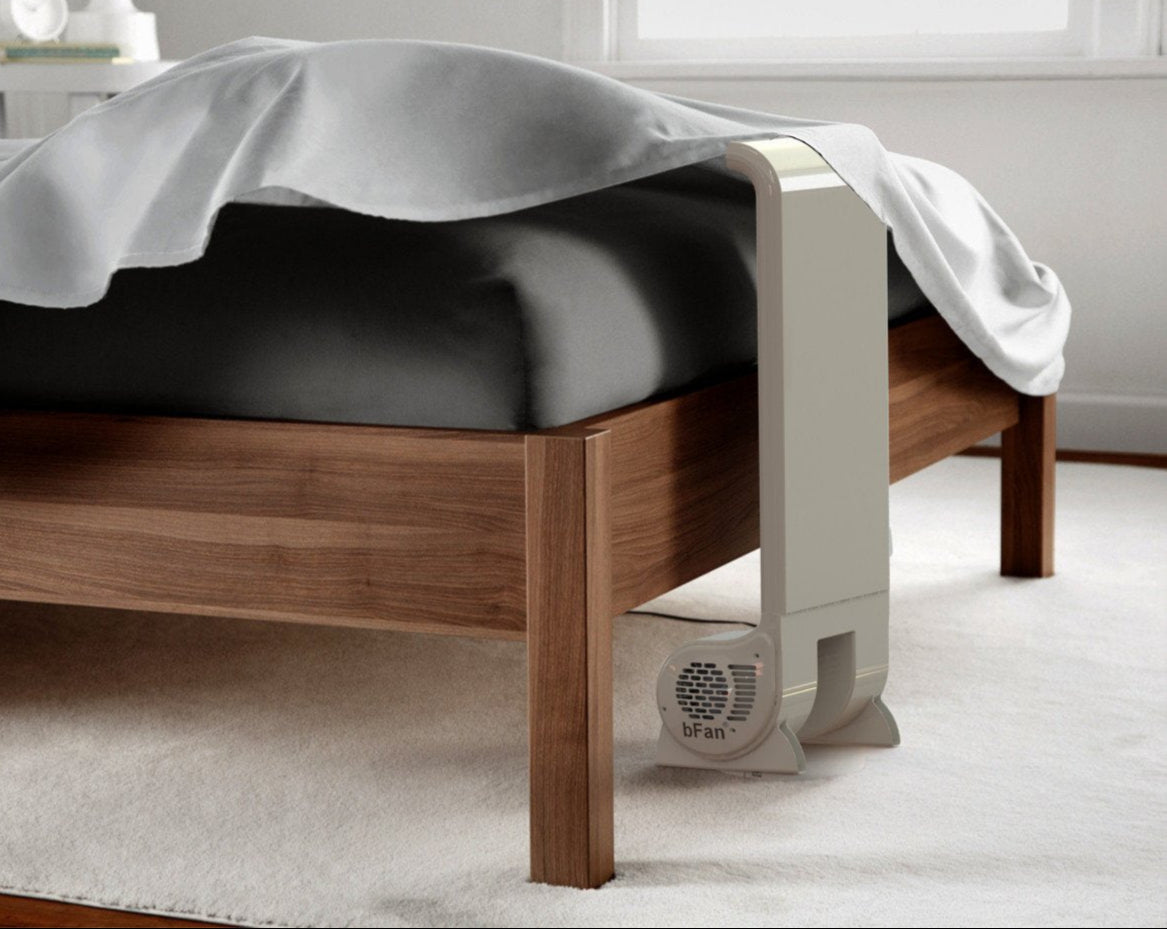
A bed fan works by moving room air under your top sheet, right where heat and moisture get trapped. It does not refrigerate the air. It uses the cooler air already in the room and pushes it through the bedding space, which helps evaporate sweat and pull excess warmth away from your skin.
That distinction matters. Neither Bedfan nor Bedjet cools the air. They only use the cool air in the room to cool your bed. If the room is very hot, any air-based system will have less to work with. If the room is reasonably cool, though, directed airflow can feel dramatically better than a regular ceiling fan or box fan across the room.
For PMS-related overheating, a Bedfan can be a very practical option because it addresses the exact problem: trapped heat under the covers. The bFan bed fan from Bedfans USA is built for this kind of microclimate cooling. It sits at the foot of the bed, directs air under the sheet, and helps you stay cooler and drier without making the whole room icy.
The bFan from www.bedfan.com is worth a serious look if you’re dealing with recurring night sweats before your period. It runs at about 28db to 32db at normal operating speed, so most people hear it as light background sound, not a loud fan roar. It also uses only about 18 watts on average, which is tiny compared with leaning harder on whole-house air conditioning.
Timer controls are another real plus. If your heat spikes most at sleep onset or in the early morning hours, you can set the airflow to match the way you actually sleep, instead of leaving a room fan blasting all night. And again, sleep experts commonly recommend a bedroom temperature between 60°F and 67°F (15.5°C to 19.5°C) for better sleep. With a Bedfan, many people can raise the room temperature by around 5°F and still cool the body enough for more restful sleep.
Bedfan vs Bedjet for PMS night sweats
This comparison comes up a lot in search results, and the answer is pretty straightforward.
The original Bedfan came to market several years before Bedjet was even thought of. Both products use room air, not chilled air. So if you see claims that one of them “creates cold air,” that’s not really what’s happening. They move existing air; they do not lower its temperature below the room.
Price is a big dividing line. Bedjet is over twice the price of a Bedfan, and a dual zone Bedjet setup is over $100. A Bedfan gives you a lower cost way to get targeted cooling, and if a couple needs separate microclimates, two Bedfan units can provide dual zone microclimate control at a fraction of the price.
Here’s the quick comparison most shoppers actually want:
- Price: Bedjet is over twice the price of a Bedfan
- Cooling method: neither unit cools the air itself, both use the cool air already in the room
- Dual zone option: two Bedfan units can create dual zone microclimate control for less than a dual zone Bedjet setup
- Energy use: Bedfan averages about 18 watts, which is very low
- Noise: Bedfan typically runs around 28db to 32db at normal speed
- Controls: Bedfan offers timer controls, which can be useful for late cycle sleep disruption
- History: the original Bedfan was on the market years before Bedjet
For women with PMS night sweats—and possibly even sleep disturbances related to perimenopause or menopause—the “best” choice is usually the one you’ll actually use every month, without dreading the power bill or the price you paid to get it.
When PMS night sweats may point to something else
This part matters because not every sweaty night before a period is just PMS, and not every cycle-related change should be brushed off.
If your symptoms are new, much worse than usual, or paired with other changes, it’s a good idea to get checked by a healthcare professional. Thyroid problems, infections, some medications, anxiety, sleep apnea, and perimenopause or even the transition into menopause can all raise the odds of sweating at night. People in their late 30s and 40s may notice that the line between PMS symptoms and early perimenopause or menopausal changes gets a little blurry. Postpartum hormonal shifts can also temporarily alter your sleep and temperature regulation.
A doctor visit is especially worth it if your pattern includes any of these:
- Red flags: fever, unexplained weight loss, chest pain, fainting, or severe palpitations (which, in rare cases, might be linked to cancer)
- Cycle changes: bleeding pattern shifts, missed periods, or very heavy periods
- Sleep issues: gasping, choking, loud snoring, or severe insomnia
- Medication timing: symptoms started after a new antidepressant, steroid, stimulant, or hormone change
- No clear pattern: sweating happens all month, not mostly before your period
That doesn’t mean something serious is likely. It means you deserve a real answer if the pattern doesn’t fit typical PMS.
How to set up a Bedfan for better PMS sleep
Placement makes a difference. A bed fan works best when the airflow stays under the covers and moves across your body instead of escaping out the sides right away. That’s why sheet choice, fan height, and speed all matter.
Most people do well starting lower than they think. You want steady, cooling airflow, not a wind tunnel. If your feet get chilly but your upper body still feels warm, the angle or sheet setup may need adjusting.
Try this for a better first week:
- Start low: begin with a moderate setting and increase only if you still wake up hot
- Use a top sheet: this helps the airflow travel where you need it
- Choose tight weave bedding: it helps distribute the air across your body
- Set a timer: if your sweats peak early in the night, let the fan do the heavy lifting then
- Raise the thermostat a bit: many users can go up around 5°F and still sleep cooler
That last point is a big deal if air conditioning costs are hitting hard. Sleep experts commonly recommend a bedroom temperature between 60°F and 67°F (15.5°C to 19.5°C) for better sleep, but a Bedfan often lets you keep the room about 5°F warmer while still cooling your body enough for solid sleep.
Frequently Asked Questions About PMS Night Sweats
Can PMS really cause night sweats?
Yes, it can. PMS can shift your internal temperature control because estrogen and progesterone change in the late luteal phase.
That shift can make you feel suddenly hot at night, even if the room itself is not unusually warm.
If it happens in the same few days before your period each month, PMS is a reasonable possibility—even if you experience excessive sweating and sleep disturbances.
Why do PMS night sweats wake me up so fast?
Your body sleeps best when it can cool down a bit. When heat builds under the covers, or when your brain suddenly triggers sweating and heat release, sleep gets lighter and easier to interrupt.
That means you may wake during REM or lighter sleep stages, sometimes before you even realize you’re sweating.
What feels like “random insomnia” can really be a temperature problem.
Are PMS night sweats the same as menopausal hot flashes?
Not exactly, but they can feel similar. PMS-related sweats are usually tied to the days before a period, while menopause-related hot flashes are linked to bigger, longer term hormone shifts.
The body response can overlap, though, especially the sudden warmth, sweating, and wake-ups.
If you are in your late 30s or 40s and symptoms are getting stronger, perimenopause and impending menopause may be part of the picture too.
What bedroom temperature is best for PMS sleep?
Sleep experts commonly recommend a bedroom temperature between 60°F and 67°F (15.5°C to 19.5°C) for better sleep.
That range helps most people cool down enough to stay asleep longer and wake less often.
With a Bedfan, many people can raise the room temperature by about 5°F and still cool the body enough for more restful sleep, which can help cut air conditioning costs.
Does a Bedfan actually cool the air?
No. A Bedfan does not cool the air itself.
It uses the cooler air already in the room and moves it under your sheets, where trapped body heat and moisture tend to collect.
That airflow can feel much cooler because it helps sweat evaporate and carries heat away from your skin.
Is a bed fan better than a regular room fan for night sweats?
For a lot of hot sleepers, yes. A room fan moves air around the bedroom, but it does not directly target the warm pocket trapped under your bedding.
A bed fan focuses airflow where the problem usually is, inside the bed microclimate.
That makes it more useful for people who wake up sweaty under the covers even when the room itself feels okay.
How loud is the bFan bed fan?
The bFan generally runs between 28db and 32db at normal operating speed.
That is usually quiet enough to blend into the background, more like soft white noise than a loud appliance.
Many sleepers find that level much easier to live with than cranking up a big box fan all night.
Can a Bedfan help lower air conditioning costs?
It often can. Sleep experts commonly recommend a bedroom temperature between 60°F and 67°F (15.5°C to 19.5°C) for better sleep, but cooling an entire home to that range can get expensive.
Because a Bedfan cools your personal sleep space, many people can raise the room temperature by around 5°F and still stay comfortable enough for deeper sleep.
Since the unit uses about 18 watts on average, the power draw is very low.
Is Bedfan cheaper than Bedjet?
Yes. Bedjet is over twice the price of a Bedfan, and a dual zone Bedjet setup is over $100.
If two people need different sleep temperatures, two Bedfan units can create dual zone microclimate control at a fraction of that price.
That price gap is one reason many shoppers start with Bedfan when night sweats are the main issue.
What kind of sheets work best with a bed fan?
Tight weave sheets usually work best. They help guide the airflow across your body instead of letting it leak away too quickly.
That gives you a more even cooling effect and helps carry away trapped heat and moisture.
Loose, very open fabrics can still work, but they often feel less focused and less efficient.
Resources
- Sleep Foundation: Night Sweats Causes and Treatments Learn about the common causes of night sweats and how to manage them from the Sleep Foundation. This resource covers why night sweats happen, including hormonal changes, and offers practical tips for relief.
- The American College of Obstetricians and Gynecologists: PMS Overview Explore a comprehensive overview of premenstrual syndrome (PMS) from ACOG. This page explains PMS symptoms, including night sweats, and provides guidance on when to seek medical advice.
- Mayo Clinic: Night Sweats Symptoms and Causes Find detailed information on night sweats, their symptoms, and possible underlying causes from Mayo Clinic. Mayo Clinic offers a trusted breakdown of night sweats, helping you understand when they may signal something more serious.
- National Sleep Foundation: Healthy Sleep Tips Get expert advice on improving sleep quality and managing disruptions from the National Sleep Foundation. This guide provides actionable steps to create a sleep-friendly environment, which can help with PMS-related night sweats.
- Cleveland Clinic: Premenstrual Syndrome (PMS) Symptoms and Management Read about PMS symptoms, including night sweats, and discover management strategies from Cleveland Clinic. Cleveland Clinic explains how PMS can affect sleep and offers tips for symptom relief.
- Harvard Health Publishing: How to Cool Down at Night for Better Sleep Discover science-backed ways to stay cool at night and improve sleep quality from Harvard Health. This article discusses cooling strategies, which are especially helpful if you experience night sweats.
If you’re looking for a practical solution to stay cool and comfortable at night, especially during PMS night sweats, consider the bFan from www.bedfan.com. It’s a quiet, energy-efficient bed fan that helps you maintain the ideal sleep temperature, recommended by sleep experts.
By being aware of these factors—including hormonal changes during PMS, postpartum recovery, pregnancy, and menopause—you’re better equipped to tackle night sweats and their associated sleep disturbances. Remember, if symptoms persist or worsen, seeking prompt healthcare advice is always a good idea.
Share