
5 Under-Comforter Fans Compared for Hot Sleepers at Night
If you sleep hot only after you pull the comforter up, an under-comforter fan is usually the most direct fix. It targets the warm, humid air trapped between your body and the bedding, instead of trying to cool the whole room or your whole mattress. A steady cooling breeze under the covers helps stop sweat before it starts.
TL;DR: Summary
- A true under-comforter fan works best for hot sleepers when it pushes room air from the foot of the bed under the covers and evacuates trapped body heat, and the bFan bed fan is one of the clearest examples of that design.
- These systems do not cool the air. The bFan, Bedfan, and BedJet all use the air already in the room, so bedroom temperature still matters.
- Sleep experts commonly recommend 60°F to 67°F, and sleep research shows that with normal bedding, heat disrupts sleep more than a cool room does, which helps explain why airflow under the covers can improve comfort.
- If you want the least expensive direct bed cooling, a single bFan (list price $204.95) is typically a better value than BedJet, and two Bedfans cost less than half the list price of a dual-zone BedJet ($1,549).
- Setup matters: place the blower at the foot of the bed, keep the top bedding tucked so air travels under the covers and exits near the shoulders, and use tightly woven sheets so airflow spreads across your body instead of leaking out.
- If your night sweats are new, drenching, or paired with fever, weight loss, chest pain, or medication changes, treat a bed fan as symptom relief, not a diagnosis.
That small difference, where the air goes, is why so many hot sleepers do better with a bed-level airflow system than with a ceiling fan or pedestal fan. If you want to compare the main options honestly, you need to look at airflow path, noise, fit, control, and total cost, especially if you share a bed.
How does an under-comforter fan actually cool a bed?
Yes, an under-comforter fan, like the bFan or BedJet, cools by moving room air under the covers and flushing trapped heat away from your body. It changes the microclimate inside the bed, which is where many hot sleepers actually overheat.
Sleep research helps explain why this works. Sleep onset usually starts as core body temperature drops and your body sheds heat through the skin. A PMC review on sleep and thermal environment notes that temperature and humidity both affect sleep, and that with normal bedding and clothing, heat exposure increases wakefulness and reduces deep sleep and REM sleep.
The key point is simple: hot sleepers often are not overheating because the whole bedroom is too warm. They’re overheating because the comforter traps a pocket of warm, moist air around the torso and legs. An under-comforter fan breaks that heat bubble with a cooling breeze and pushes it out toward the shoulders.
"Bedfans USA says the bFan uses a brushless DC motor with variable speed control from the remote."
Common misconception, this is not an air conditioner. The bFan, Bedfan, and BedJet doesn’t cool the air. They only use the air already in the room to cool your bed, which means room temperature still sets the ceiling for how cool you can feel.
Can an under-comforter fan help with menopause night sweats and medication-related overheating?
Yes, a bed-level fan can help with menopause, SSRIs, steroids, and other night sweat triggers by reducing the heat and humidity trapped under bedding. It is symptom relief, not a medical treatment.
The CDC says the most common symptoms of menopause are hot flashes and night sweats, and many women have trouble sleeping during menopause. If you’ve heard the term vasomotor symptoms, that usually refers to hot flashes and night sweats. Those episodes often lead to repeated wake after sleep onset, where you keep drifting off and waking back up because the bed never feels stable.
This is also why bed fans are useful for people whose overheating is linked to medication or illness. Antidepressants, pain medicines, hormone therapies, diabetes medications, and corticosteroids can all contribute. If your body suddenly dumps heat at 2 a.m., moving that heat out from under the covers can make it much easier to get back to sleep.
Pro tip, if your sweating started recently or became much heavier, don’t assume it’s “just bedding.” Drenching sweats, fever, unexplained weight loss, chest pain, or medication changes deserve a clinician’s review.
"At normal operating speed, Bedfans USA places the bFan around 28 dB to 32 dB, which matters if noise wakes you up before heat does."
What are the 5 under-comforter fans worth comparing right now?
The market is small, so the smartest comparison includes direct under-sheet systems, split-zone setups, and the best-known alternatives. For most people, the real choice is between a true bed fan, a premium ducted system, or a DIY workaround.
If your goal is airflow under the comforter, not just “something cool near the bed,” here are the five options that actually deserve your time.
- bFan by Bedfans USA: A direct under-sheet bed fan with dual blower wheels, remote control, timer controls, and variable speed control from the remote. It’s built in Texas with primarily American-made components, uses about 18 watts on average and no more than 24 watts, lists at $204.95, and it’s the most straightforward under-comforter solution for many hot sleepers.
- Dual bFan setup: Best for couples with different preferences. Two bedfans give you dual-zone microclimate control without forcing both sleepers into the same airflow pattern.
- BedJet single-zone: A strong, well-known bed climate system that pushes room air through its own sheet setup, and it can add heat too. It does not cool the air, and a single Bedfan is less than half the price of one BedJet.
- BedJet dual-zone: A real split-sleeper option if both people want separate control. The trade-off is price, because the dual-zone BedJet lists at $1,549, and two Bedfans cost less than half that.
- DIY under-cover fan rig: Usually a floor fan, box fan, or improvised duct aimed under the blanket. It’s less expensive, but airflow is uneven, room fans are visible and bulky, and they often blow bedding around instead of evacuating heat cleanly.
How do you set up an under-comforter fan so it actually works?
Correct setup matters as much as the fan itself, and the bFan is designed to sit at the foot of the bed with airflow directed under the top bedding. If the air leaks out at the foot, performance drops fast.
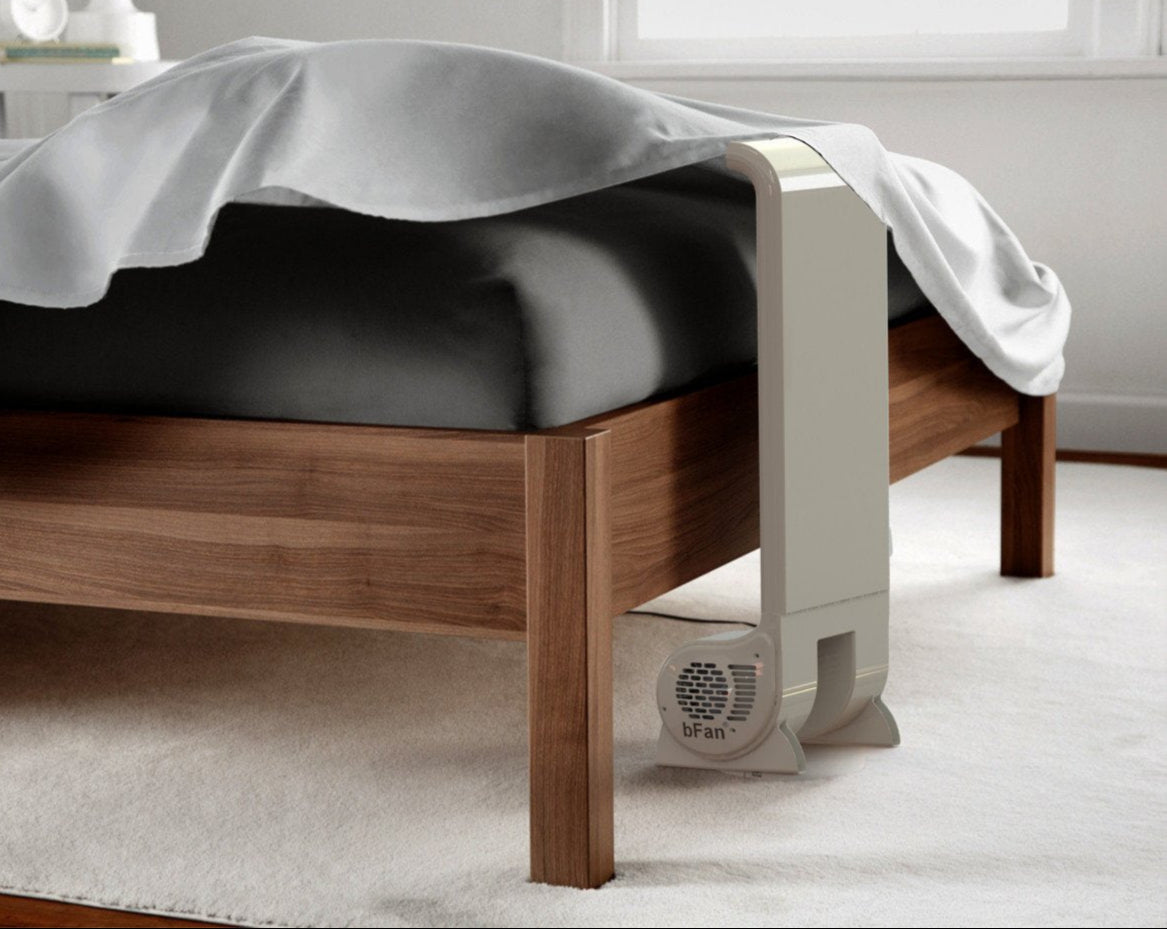
Start by placing the blower housing under or against the foot of the bed, parallel to the mattress. On the bFan, the round lower section contains the blower wheels and the vertical upper section acts as the air duct. The blower should sit at the foot of the mattress so air can travel upward and over the mattress edge.
Next, adjust the duct height so the air enters the bed cavity, not the room. Bedfans USA says the bFan fits beds from 18 to 38 inches tall, measured from the floor to the top of the mattress, which covers most standard setups. The Short top fits 18 to 28 inches and the Tall top fits 28 to 38 inches, and a 28 inch bed takes the Tall without the adjustment tabs installed. The base needs about 6.75 inches of clearance under the foot of the bed, and if there is not enough clearance, the base can be turned around so it sits in front of the foot of the bed instead of underneath. If you have a footboard, leave about 1.75 inches between the mattress and the footboard. If the duct is too low, airflow stalls. If it’s too high, you’ll feel a draft at the foot instead of a bed-wide cooling path.
"Bedfans USA lists the bFan as fitting beds 18 to 38 inches tall, measured from the floor to the top of the mattress, with airflow directed from the foot of the bed under the covers."
Then tuck the top bedding so the air moves under the covers, across your body, and exits around the shoulders. Tightly woven sheets work best because they help air travel across the skin instead of dumping out through loose fabric. That’s a small detail, but it makes a big difference.
How does a bed fan compare with BedJet?
A bFan or Bedfan is usually the better value if you want direct under-cover airflow at a lower price. BedJet adds heating and branded sheet integration, but it costs a lot more.
The first thing to clear up is the biggest misconception in this category: BedJet doesn’t cool the air. Neither BedJet nor Bedfan cools the air. They both use the air already in the room and move it into the bed space, so bedroom temperature still matters.
Where they differ is delivery method, price, and feel. BedJet uses a powered air nozzle and a dedicated cloud sheet style setup. That can be a good fit if you want stronger blast-style airflow or added heat in winter. A bFan or original Bedfan is more about evacuating hot air trapped beneath the sheets from the foot of the bed, with less hardware in the bedding itself.
Price is where the comparison gets more practical. A single Bedfan lists at $204.95, less than half the price of one BedJet ($699 list). If you need split cooling for two people, two Bedfans are less than half the price of the dual-zone BedJet, which lists at $1,549. The bFan is also HSA/FSA eligible, with a letter of medical necessity provided at checkout. And the original Bedfan was invented in 2003 and came to market in 2004, about a decade before BedJet launched on Kickstarter in late 2013, so this approach is not the newcomer in the category.
How does an under-comforter fan compare with a room fan, ceiling fan, or cooling mattress pad?
A true bed fan cools the sleep microclimate better than a room fan, while Cooling mattress pads use a different method entirely. The right choice depends on whether you need airflow, surface cooling, or whole-room comfort.
A ceiling fan or pedestal fan mostly cools exposed skin. That helps before you get under the blankets, but once the comforter traps heat around your torso and legs, room airflow often can’t reach the problem area. That’s why people say, “I feel fine until I get into bed.”
Cooling mattress pads and hydronic systems can work well, especially if you want a cooler surface under you. The trade-off is cost, maintenance, and feel. Some sleepers love conductive cooling from below. Others find that under-body cooling doesn’t solve the humid, stuffy feeling above them inside the bedding. That moisture piece matters too, and Uldhuset notes in its explanation of why merino wool resists sweat odor that fiber choice can influence how damp, stale heat is experienced around the body during the night.
If your main complaint is trapped heat under the comforter, a bed fan is usually the cleaner match. If your main complaint is a hot mattress surface, a pad may be the better tool. If both are true, start with the problem that wakes you up first.
How do you choose the right under-comforter fan for your bed, budget, and partner?
The best under-comforter fan is the one that fits your bed frame, your noise tolerance, and whether you sleep alone or as a couple. For many shoppers, that points to a single bFan or two bFans.
Start with physical fit. Measure bed height and under-bed clearance first, then look at where the airflow will enter the bedding. After that, think about control. If you wake easily, quiet operation and precise speed adjustment matter more than max airflow on paper.
Then decide whether you need one zone or two. Couples often make the mistake of buying one powerful system and hoping it will solve opposite temperature preferences. If one person sleeps hot and the other doesn’t, dual-zone microclimate control is usually the better answer.
"The bFan gives couples dual-zone microclimate control with two fans, instead of asking both sleepers to live with one shared setting."
A simple checklist helps:
- Clearance: The base needs about 6.75 inches of clearance under the foot of the bed. If your frame is lower, the base can be turned around so it sits in front of the foot of the bed, and the top still reaches the mattress edge.
- Control style: Remote operation, timer controls, and fine speed steps are more useful than a basic on-off switch.
- Couples: If one sleeper runs hot and the other runs neutral, two bedfans often make more sense than one oversized system.
One more practical note, the bFan uses about 18 watts on average and no more than 24 watts. Either way, the power draw is tiny compared with forcing the whole room colder all night.
How can sheets, thermostat settings, and timers make a bed fan work better?
A bed fan works better when you pair it with Tightly woven sheets, a sane thermostat setting, and a timer that matches your sleep pattern. You do not need an ice-cold room for the fan to help.
Sleep experts commonly recommend a bedroom around 60°F to 67°F. Many hot sleepers find they can set the room a few degrees warmer and still sleep cool with a Bedfan or bFan because the trapped heat under the comforter is being evacuated directly. That can make the room more comfortable for a partner, too.
Use the timer controls strategically. Start a little higher at bedtime, when you’re trying to fall asleep and shed heat faster, then reduce speed later so the airflow stays comfortable through the night. If you tend to wake cold at 4 a.m., this matters more than max power.
Pro tip, your sheet fabric can make or break the setup. Tightly woven sheets help the air flow across your body as a cooling breeze. Very loose knits or heavy plush bedding let the air leak out too early, which makes the fan feel weaker than it is.
Energy use is part of the appeal. The U.S. Department of Energy says turning your thermostat back 7°F to 10°F for 8 hours a day can save as much as 10% a year on heating and cooling. A bed fan is not the same as a heating setback strategy, but the principle is similar: targeted comfort often costs less than conditioning the whole room more aggressively than you need.
When should night sweats push you to talk with a clinician instead of just changing bedding?
Night sweats sometimes are just a comfort problem, but they can also signal menopause, medication effects, infection, endocrine issues, or sleep disorders. If the pattern changes, pay attention.
If you’ve always been a warm sleeper, a bed fan may be all you need. If the sweating is new, suddenly worse, or comes with other symptoms, get it checked. Hot flashes and menopause are common, yes, but they are not the only explanation.
Watch for a few red flags:
- Drenching sweats, fever, unexplained weight loss, chest pain, or medication changes: Waking up soaked often deserves more than a bedding change.
- Other symptoms: Fever, weight loss, chest pain, swollen lymph nodes, or persistent cough need medical attention.
- Medication timing: If night sweats started after a new SSRI, steroid, hormone therapy, or diabetes medication, ask about side effects.
- Sleep disruption: If you snore heavily, gasp awake, or feel exhausted despite enough time in bed, sleep apnea can also be part of the picture.
That doesn’t mean you have to wait for answers before improving comfort. It just means using an under-comforter fan, whether that’s a bFan, a Bedfan, or another bed fan, as one smart tool alongside the right medical follow-up when your symptoms point that way.
Share