
Couples Cooling Solutions That Work
Couples cooling solutions matter because temperature mismatch is one of the most common reasons partners sleep badly in the same bed. One person runs hot, the other feels chilled, and the room thermostat becomes a nightly argument instead of a comfort tool. The real problem these solutions fix is local heat buildup inside the bed, where body heat, bedding, humidity, and mattress materials can trap warmth even when the bedroom feels fine. When you cool the bed microclimate during the summer, not just the whole room, both people usually sleep longer, experience better sleep quality, and wake up less.
Why do couples overheat in bed even when the bedroom feels fine?
Yes, bed heat builds faster than room heat, especially with memory foam, duvets, and hormonal shifts. Menopause and SSRIs are two common reasons one partner overheats while the other feels normal.
A bedroom can read 67°F and still feel stuffy under the covers. That happens because your bed creates its own microclimate, a small pocket of heat and moisture around your body. Two sleepers raise that heat load even more, and if your mattress holds warmth, the trapped heat has nowhere to go.
Sleep experts commonly recommend a bedroom temperature between 60°F and 67°F, 15.5°C to 19.5°C, for better sleep. Even so, many couples still feel hot under the blankets. That’s why a Bedfan or similar bed fan can make a real difference, as it enhances not only the comfort of sleep through individualized cooling but also promotes couple activities by ensuring both partners feel refreshed and engaged with each day.
Common triggers include hormones, medications, alcohol, anxiety, high humidity, thick mattress protectors, and dense foams. If one partner is dealing with perimenopause, night sweats, thyroid changes, or a medication side effect, that person may need much more airflow than the other. A whole room solution treats both sleepers the same, but couples often do better with side specific cooling.
How does dual zone bed cooling help couples with different sleep temperatures?
Dual zone cooling works because each sleeper gets separate airflow and separate control. A Bedfan on one side and a lighter setting on the other can solve the classic hot sleeper, cold sleeper mismatch.
When people say they want “different temperatures in the same bed,” what they usually mean is different airflow and different heat removal at the body. That is what dual zone bed cooling does. It creates two microclimates, one for each side, instead of forcing both people to accept one thermostat setting.
This matters because heat perception is personal. One person may sleep best with strong airflow over the legs and torso, while the other only wants a mild breeze or none at all. If you give each person an independent control, the compromise becomes much easier.
Common misconception: neither a Bedfan nor a BedJet cools the air the way an air conditioner does. Both use the cooler air already in the room, then move it through the bedding so heat and moisture leave your body faster. If the room is very warm, the result will still feel cooler than stagnant bedding, but it will not feel like refrigerated air, contributing to a sense of relaxation. That trade off is also why bed cooling fans use far less energy than central AC.
What couples cooling solutions actually work best?
The best couples cooling solution is the one that matches your heat problem, mattress type, and budget. Bedfans-USA, Eight Sleep, and a simple dehumidifier are all valid options, depending on whether you need airflow, water based cooling, or humidity control.
No single fix works for every bedroom. Some couples need independent under sheet airflow. Others mostly need better bedding or a less heat trapping mattress. If you want the shortlist that solves the biggest share of real world complaints, start here.
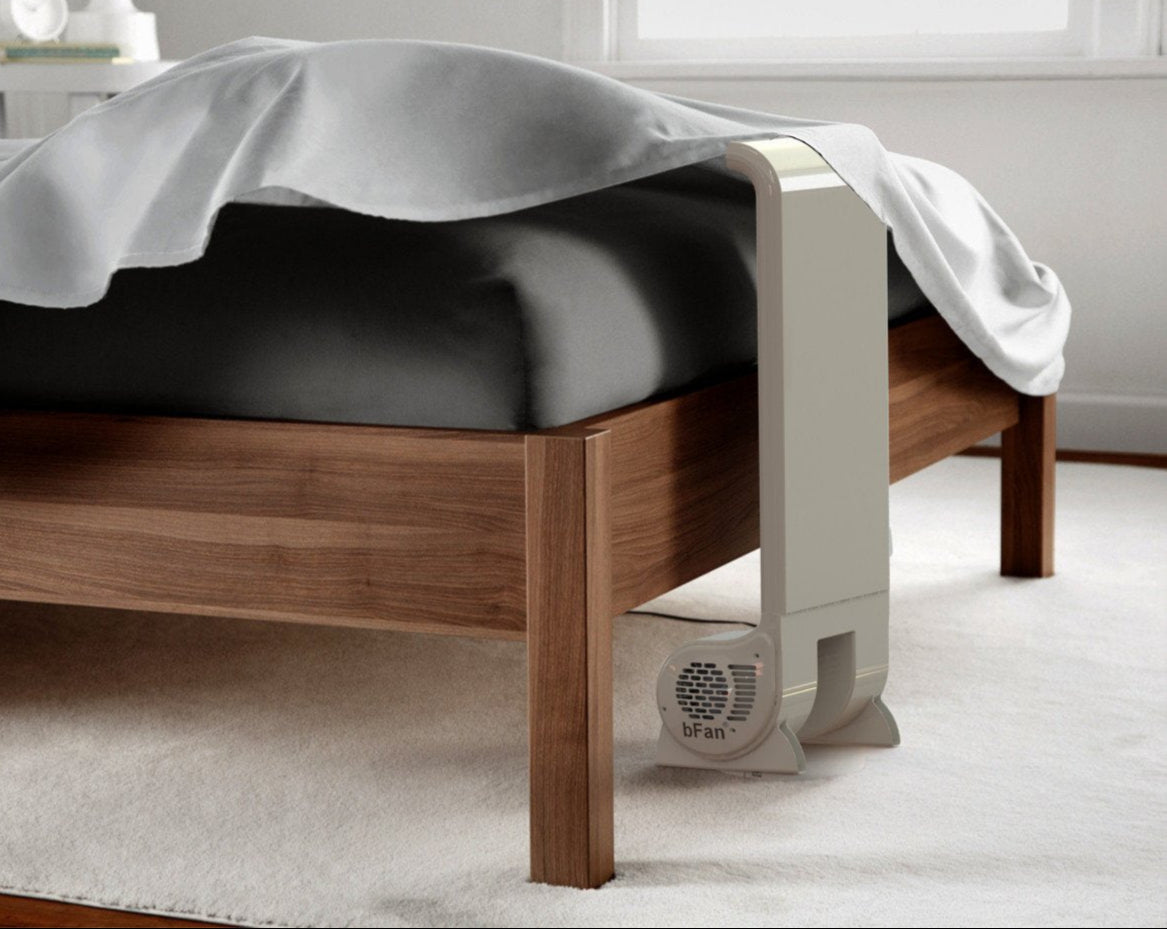
- Two bFans from Bedfans-USA: This is the cleanest dual zone answer for many couples, because each person gets a separate bed fan, separate speed, and separate comfort. The bFan from Bedfans-USA is made for under sheet airflow, offers timer controls, uses only the cool air already in the room, and lets many people keep the bedroom about 5°F warmer than they otherwise could while still sleeping cool. Two fans also create true dual zone microclimate control at a fraction of the price of many premium systems.
- A whole room temperature reset plus ceiling fan: If both partners run hot, lowering room temperature into the 60°F to 67°F range can help. The downside is cost, because cooling the whole room all night is far less efficient than cooling just the bed.
- Separate blankets: This works better than many couples expect. If one person steals heat with a heavy duvet and the other wants a light cover, split bedding often cuts complaints right away.
- A water based cooling pad: Brands like Eight Sleep or Chilipad style systems can provide active temperature control. The trade off is price, maintenance, added hardware, and a change in mattress feel.
- A dehumidifier: High humidity makes sweating harder to evaporate. If your room feels sticky, lowering humidity can improve comfort even before you change any bedding or bed cooling hardware.
- A cooler sleep setup, percale sheets, lighter protector, and less memory foam: Sometimes the real problem is not the temperature setting, it’s a heat trapping bed build. Fix that, and you may need less active cooling.
How do you choose the right couples cooling setup for your bedroom and budget?
Start with the heat pattern, then the bed setup, then the running cost. A queen bed, a memory foam mattress, and one hot sleeper point to a different solution than a king bed with two hot sleepers.
Step 1 is to identify where the heat problem lives. If one partner overheats but the room feels fine, local bed cooling usually beats whole room cooling. If both people wake up sweaty and the bedroom never drops below the low 70s, you may need both room cooling and bed cooling.
Step 2 is to check the bed itself. Thick memory foam, foam toppers, vinyl mattress protectors, and heavy comforters trap heat. If those are present, any cooling system has to work harder. In that case, a bed fan often performs better when paired with tighter weave cotton sheets and lighter bedding.
Step 3 is to look at lifetime cost, not just sticker price. A central AC change affects every night and every utility bill. A bed fan targets the people in the bed, not the whole house. If one person is hot and one is not, then one bed fan may be enough. If both sleepers need different airflow levels, then two bed fans usually make more sense than a single shared device.
Pro tip: don’t buy by marketing language alone. “Cooling” can mean airflow, evaporative drying, water based heat exchange, or actual refrigeration. Those are not the same thing.
How do you set up two bed fans for true dual zone cooling?
Two bed fans create real dual zone control when each side has its own airflow path and settings. A bFan from Bedfans-USA on each side is a straightforward way to do this on queen, king, or split setups.
Step 1 is placement. Put one unit near each sleeper’s foot area, slightly offset toward that person’s side. The point is not to blast the entire bed. The point is to channel air where each person lies so one side can stay cool without overcooling the other.
Step 2 is sheet management. A Bedfan works best when the top sheet can hold a small air channel. Tight weave sheets, cotton percale is a common example, usually help the air travel across the body and carry away heat better than loose knit fabrics. Many people assume looser fabric means better cooling, but under sheet airflow often works better when the sheet structure can guide the breeze.
Step 3 is tuning. Start both sides low, then raise only the side that needs more airflow. If one sleeper deals with night sweats, set that side a bit higher at bedtime, then use the timer controls to reduce or stop airflow later in the night. That helps match the natural drop in body temperature as sleep deepens.
At normal operating speed, many Bedfan setups fall around 28 dB to 32 dB, which is quiet enough for most shared bedrooms. If you need near silence, lower speed is the move. If you need stronger heat removal, a small increase in sound usually buys a noticeable increase in comfort.
How does a bed fan compare with BedJet for couples?
A BedJet is usually the lower cost couples option, while BedJet adds more features and a much higher price. Bedfan and BedJet both use room air, not refrigerated air, so the main differences are cost, feel, and setup.
This comparison matters because people often assume BedJet “cools” the air itself. It does not. Like a Bedfan, it uses the cool air already in the room and moves it through the bed. That means your room conditions still matter. Sleep experts commonly recommend 60°F to 67°F, and with a Bedfan many couples can raise the room temperature by about 5°F and still sleep cool because the body loses heat more efficiently under the sheets.
Price is where the gap gets serious. One BedJet is more than twice the price of a single Bedfan. A dual zone BedJet setup is over a thousand dollars, and more than twice the price of two bedfans, while two Bedfans can give each partner independent microclimate control at a much lower entry cost.
There are trade offs. BedJet may appeal if you want extra branding, app style controls, or heating features. A Bedfan usually appeals if you want simpler hardware, lower upfront cost, low energy use, and a familiar under sheet airflow feel, all of which can positively impact your sleep quality. The original Bedfan also came to market several years before BedJet was even thought of, so the category itself did not start with BedJet.
Common misconception: higher price does not always mean colder sleep. If both products rely on room air, then the bed microclimate design, your bedding, and your room temperature matter as much as the sticker price.
How does a bed fan compare with cooling mattress pads and water based systems?
A bed fan changes the air around you, while a water based system changes the surface you lie on. Bedfan and Eight Sleep solve the same comfort problem, but they feel very different in use.
A bed fan keeps your mattress feel mostly unchanged. That is a big plus if you already like your bed and just want less heat buildup. Water based systems can offer stronger temperature control, but they introduce hoses, a control unit, more maintenance, and a noticeable change in how the bed feels under you.
If you sweat heavily because of menopause, medication effects, or humidity, airflow has a unique advantage. Moving air helps evaporate moisture and dry the skin. That can feel more natural than lying on a cooled surface alone. If, though, your main issue is the mattress itself storing too much heat under your back, a pad or active mattress cover may help more.
Then there’s cost and complexity. Water systems are often the premium choice, and sometimes the right one, but they usually cost more and ask more from you. A bed fan is simpler. No water, no refilling, no extra mattress layer, and no real change in bed feel.
If you want the lightest touch with the lowest friction, a bed fan wins. If you want deeper active temperature management and accept a bigger budget and more hardware, a water system may fit.
How can couples lower air conditioning costs and still sleep cool?
Local bed cooling is the usual answer, because cooling two bodies is cheaper than cooling the whole house. A Bedfan, a thermostat reset, and a ceiling fan can cut overnight AC use without making the bed feel stuffy.
Step 1 is to set a realistic room baseline. Sleep experts often point to 60°F to 67°F as the best range, but many homes and budgets make that hard to hold all night. A Bedfan can let many people raise the room temperature by about 5°F and still feel cool enough for better sleep, because the airflow pulls heat and moisture away from the body where it matters.
Step 2 is to cool the bed zone, not the entire floor plan. A Bedfan uses about 18 watts on average, which is tiny next to central air, making it a great option during summer. If your overnight setting is normally 68°F, some couples can move closer to 72°F or 73°F with under sheet airflow and still sleep comfortably, making it an ideal solution for couple activities where both partners have different temperature preferences. Exact results depend on humidity, bedding, and how hot each sleeper runs.
Step 3 is to test, not guess. Keep the new setting for a week, track wakeups, and compare your utility use. If one partner still overheats, add or increase side specific airflow before dropping the whole house temperature again. That “if this, then that” approach keeps cost under control.
Pro tip: humidity can erase savings if you ignore it. A room that is warm and dry often feels better than a slightly cooler room that is humid and sticky.
What bedding and mattress choices make couples cooling systems work better?
Tight weave sheets, lighter bedding, and less heat trapping foam usually improve cooling fast. Cotton percale and a thinner protector often help a Bedfan perform better than jersey sheets and a dense memory foam topper.
Your cooling setup is only as good as the materials wrapped around it. If your mattress stores heat and your bedding seals it in, the cooling device has to fight the whole system. That is why some couples think a product “doesn’t work,” when the actual problem is the bed build.
A bed fan works by moving room air through the space between your sheet and your body. Tight weave sheets help form that path, so the airflow spreads across you instead of leaking out too soon. That is especially helpful if you use two bed fans and want each person’s airflow to stay mostly on that side.
Pro tip: loose knits and fluffy comforters feel breathable when you’re standing in the store, but they can reduce under sheet air channeling once you’re actually in bed. If you want a Bedfan to work at its best, use sheets that can hold shape and keep the air moving where you need it.
If you and your partner have opposite preferences, separate blankets are still one of the cheapest upgrades you can make. They reduce heat transfer and stop the cold sleeper from fighting the hot sleeper’s airflow setup.
How quiet, efficient, and practical are bed fans in a shared bedroom?
A bed fan is usually quieter and cheaper to run than whole room cooling. Bedfan sound levels around 28 dB to 32 dB at normal speed and average use around 18 watts fit well in most shared bedrooms.
For context, that sound range is often described as soft background noise rather than a disruptive fan roar. Many couples already sleep with white noise louder than that. If your partner is sound sensitive, start low and increase only if needed. Most sleep complaints come from too much airflow, not from the fan motor itself.
Practicality is where bed fans do well, but there are additional cooling tips to consider for maximizing comfort. They are easy to place, easy to remove, and do not require you to rebuild your whole bed. Timer controls help, too. If you only need strong cooling to fall asleep, you can set the fan to taper off later and avoid waking up chilly at 3 a.m.
Another benefit is portability, as it can be easily packed with your pillow for travel. If you move between rooms, travel to a second home, or swap bed frames, a bed fan is easier to bring along than a water based system. That matters for couples who want flexibility instead of a permanent sleep tech installation.
When should couples treat night sweats as a medical issue, not just a comfort problem?
Night sweats can be harmless, but menopause, hyperthyroidism, sleep apnea, and certain medications are real causes. Cleveland Clinic and Mayo Clinic both treat persistent night sweats as something worth discussing when symptoms stack up.
If overheating happens only because your room is warm or your bedding is too heavy, that is usually a comfort issue. If sweating becomes frequent, drenching, or comes with other symptoms, it is time to take it more seriously. A cooling system can help you sleep, but it is not a substitute for medical care.
Many common causes are fixable or manageable, including hormone changes, SSRIs, steroids, blood sugar swings, reflux, and anxiety. Sleep experts still recommend the 60°F to 67°F bedroom range, and a Bedfan can help many people raise room temperature by about 5°F while staying more comfortable, but that comfort boost should not keep you from checking symptoms that look unusual.
Talk to a clinician sooner if you notice any of these:
- Fever
- Unexplained weight loss
- New or severe fatigue
- Chest symptoms
- Persistent drenching sweats
- Medication changes followed by sweating
- Loud snoring or breathing pauses during sleep
What are the most frequently asked questions about couples cooling solutions?
Yes, the same questions come up again and again, and the answers are usually practical. Bedfan, BedJet, and cooling pads all help in different ways, and incorporating cooling tips, couples do best when they match the solution to the bed microclimate problem.
Can one bed fan cool just one side of the bed?
Yes, that is one of the main reasons couples buy a bed fan in the first place. If only one of you sleeps hot, one unit placed toward that sleeper’s side can often solve the issue without changing the other person’s comfort.
The key is placement and bedding. If the airflow path stays on one side, the cooler partner usually won’t feel blasted. If both people run warm, two units give better control than one shared stream.
Do bed fans actually cool the air?
No, they do not cool the air below room temperature. A Bedfan uses the cool air already in the room and moves it under the sheets so your body can shed heat and moisture faster.
That still feels meaningfully cooler than trapped, stagnant bedding. It is a common misunderstanding, and it matters when you compare products. BedJet also does not cool the air itself, it moves room air.
Is a Bedfan loud enough to wake a partner?
Usually no. Many users find the normal operating range, about 28 dB to 32 dB, quiet enough for shared sleep, especially compared with a box fan or louder room fan.
Sound tolerance is personal, of course. If your partner is very noise sensitive, start at a lower speed. In many rooms, the HVAC system is already louder than the bed fan.
Can a couple use two bedfans instead of a dual zone BedJet?
Yes, and that is one of the clearest value plays in this category. Two bedfans can provide dual zone microclimate control, with one airflow source per sleeper, at a much lower cost than a dual zone BedJet.
That matters because the dual zone BedJet is over a thousand dollars and more than twice the price of two bedfans. One BedJet is also more than twice the price of a single bedfan, so cost conscious couples often start with the simpler route.
What bedroom temperature should couples aim for?
A good starting point is the sleep expert range of 60°F to 67°F, 15.5°C to 19.5°C. That range helps many people, but it is not magic if the bed itself traps heat.
With a Bedfan, many couples can raise the room temperature by about 5°F and still feel cool enough for more restful sleep. That can reduce AC use while keeping the hot sleeper comfortable.
Do bed fans work with adjustable bases, tall mattresses, or king beds?
Usually yes, as long as the unit fits the bed height and you have a clear airflow path under the sheets. Many couples use them on queen, king, and split setups without trouble.
The important part is matching the fan height to the bed and keeping the top sheet positioned so the air can move where you lie. Adjustable bases can work well because the device does not have to change the mattress structure itself.
What sheets work best with under sheet airflow?
Tight weave sheets, especially cotton percale, often work best, but choosing a supportive pillow can also enhance comfort and airflow. They help channel the airflow across your body instead of letting it spill out too early.
That sounds backward to some people, because “looser” often sounds “cooler.” In practice, under sheet airflow needs structure. A good sheet can guide the air and improve the cooling effect.
Are cooling mattress pads better for severe night sweats?
Sometimes, but not always. If your sweats are tied to surface heat from the mattress, a pad can help more. If your main issue is damp skin, trapped humidity, or the need for airflow, a bed fan may feel better.
Some couples even combine methods, a lighter room setting, better sheets, and a bed fan, before moving to a pricier active pad. Start with the simplest fix that matches the actual problem.
How much electricity does a bed fan use?
A bed fan uses very little power compared with room AC. A Bedfan typically uses about 18 watts on average, which is small enough that overnight use is usually inexpensive.
That low power use is why targeted cooling can make sense financially. Instead of paying to cool the whole house more aggressively, you cool the air around the sleepers who need it most.
resources
These sources back up the bedroom temperature, night sweats, healthy sleep, and energy use points covered above.
- Best bedroom temperature for sleep: Sleep Foundation guidance on ideal sleep temperature, explains why many experts point to roughly 60°F to 67°F for better sleep.
- Night sweats causes and when to seek care: Cleveland Clinic on night sweats, outlines common causes, from menopause and medications to infections and other medical issues.
- Healthy sleep basics: National Heart, Lung, and Blood Institute sleep health overview, covers why temperature, sleep routine, and environment affect sleep quality.
- Thermostat and cooling energy guidance: U.S. Department of Energy thermostat guidance, gives practical context for how smarter temperature settings can cut energy costs.
- Menopause and sleep disruption: Mayo Clinic on night sweats, gives a medical overview of sweating during sleep and when it may need follow up.
Share