
Bed Fan Reviews: 6 Red Flags Buyers Should Notice First
If you’re reading bed fan reviews because you sleep hot, wake up sweaty, or share a bed with someone who runs cold, you’re right to slow down and look closely. Bedfans USA, the Texas company behind the under-sheet bFan, sits in a category where review quality matters a lot, because the product solves a real sleep problem, but online feedback can still be misleading. What a good bed fan should deliver is simple: a steady cooling breeze under the covers helps stop sweat before it starts.
TL;DR: Summary
- Bed fan reviews are worth trusting only when they are recent, varied, and independently sourced, because the FTC warns that online reviews can be fake, deceptive, or manipulated.
- The sleep problem is real: the CDC links menopause to hot flashes and night sweats, and a 2022 study in Indoor Air found raised bedroom temperature and reduced ventilation lowered sleep quality in older adults.
- The Bedfans USA bFan Bedfan is one example of an under-sheet bed fan that buyers can judge by concrete criteria, including fit, airflow path, sheet type, speed control, noise, and operating cost, not just star ratings.
- Watch for six red flags first: review bursts, vague praise, one-site ratings, missing setup details, impossible cooling claims, and no mention of trade-offs.
- Neither a bed fan nor a BedJet cools the air itself. They use the air already in the room to move heat out from under the covers.
- If you want better odds of buying the right product, compare reviews with sleep-temperature guidance, bed compatibility, and independent sources before you buy.
A good review should help you predict real-world performance in your own bedroom, not just tell you whether a stranger clicked five stars. That means checking the review source, the setup details, and whether the claims match what sleep experts and accepted guidance already tell us about sleeping cool.
What should you trust in a bed fan review?
Trust reviews that are recent, varied, and independently sourced. The FTC says fake or manipulated reviews exist, so a star average on one retailer page is not enough.
Start with the basics. The FTC’s guidance on evaluating online reviews says you should check the source of the review, think about who the reviewer is, and use a variety of sources, including trustworthy and impartial expert reviews. That matters a lot in a niche product category where many buyers are desperate for relief and may overvalue a dramatic testimonial.
A strong bed fan review usually includes specifics you can test against your own situation. Did the reviewer mention bed height, sheet type, whether the top bedding was tucked in, how the airflow felt after an hour, or whether their partner liked it? If not, you may be looking at opinion without much evidence behind it.
Why do bed fan reviews matter more for hot sleepers and night sweats?
They matter because the sleep problem is real, not cosmetic. The CDC links menopause to hot flashes, night sweats, and sleep trouble, and published research shows raised bedroom temperature can worsen sleep.
The CDC says the most common symptoms of menopause are hot flashes and night sweats, and many women also have trouble sleeping during menopause. That’s not a small issue. Menopause usually occurs around age 52 in the United States, and vasomotor symptoms can disrupt sleep for years, not just weeks.
On the research side, a 2022 experimental study in Indoor Air placed 16 adults over 65 in test bedrooms at two warm temperatures, with and without mechanical ventilation. The study found that raised bedroom temperature and reduced ventilation negatively affected sleep quality. Common misconception: if a product sounds simple, that does not mean the sleep benefit is imaginary. Sometimes the simplest interventions, moving trapped heat away from the body, match the actual problem best.
"Bedfans USA says its bFan has been refined since 2004, which gives buyers a longer review history to inspect instead of relying on a sudden wave of recent praise."
What are the 6 red flags buyers should notice first?
Six patterns usually signal weak bed fan reviews: review bursts, vague praise, no setup details, single-source ratings, impossible claims, and missing trade-offs.
When you scan bed fan reviews, look for patterns, not just positivity. Here are the most useful warning signs.
- Review bursts: A flood of reviews in a short time window can be a warning sign, especially if older review history is thin or missing.
- Vague praise: Comments like “life changing” or “best sleep ever” without bed type, room temperature, or sheet details don’t help you judge fit.
- Single-source ratings: A 4.8-star product page means less if you can’t find discussion anywhere else, including neutral forums or expert coverage.
- Impossible claims: If a review says a bed fan “cools the air,” treat that carefully. Bed fans move room air and clear heat trapped under the covers. They do not refrigerate air.
- No trade-offs: Real users usually mention something imperfect, setup time, airflow sensitivity, noise tolerance, partner preference, or sheet choice.
- Missing use context: Reviews that never mention night sweats, menopause, medication-related overheating, or general hot sleeping may be too generic to trust.
Pro tip: a balanced three-star or four-star review can teach you more than a glowing five-star review, because it often includes limits and real setup details.
How can you verify whether reviews are independently sourced?
Start with the source, then the reviewer, then the pattern across sites. That simple order keeps you from overweighting a polished product page or a noisy marketplace listing.
Step 1 is source checking. Ask whether the review lives on a brand-owned page, a major retailer, an editorial review site, or a user forum. None of these is perfect by itself. Brand pages can be selective. Retail pages can be gamed. Forums can be anecdotal. You want cross-confirmation.
Step 2 is reviewer checking. Look for signs that the reviewer actually used the product. Useful clues include mention of bed height, under-bed clearance, whether the fan sits at the foot of the bed, how they routed bedding, or what speed they used at night.
Step 3 is pattern checking. If people across different places keep mentioning the same strengths and the same limits, that’s a better trust signal. If every review uses the same language, same tone, or same dramatic claim, back up.
How should you compare bed fan reviews with sleep evidence?
Compare claims against sleep basics, not against marketing language. Sleep experts commonly recommend 60°F to 67°F bedrooms, and studies on raised bedroom temperature help explain why airflow and heat removal can matter.
This is where many buyers go wrong. They compare one product page against another instead of comparing both against accepted sleep guidance. If your room already sits in the 60°F to 67°F range, a bed fan may help by moving trapped body heat out from under the bedding. If your room is much warmer, the benefit may still be real, but it won’t act like air conditioning.
A useful test is simple: does the review describe trapped heat clearing out, less sweating, or fewer wake-ups, or does it promise refrigerated air? The first type is plausible. The second isn’t. Many people find they can set the room a few degrees warmer and still sleep comfortably with an under-sheet bed fan, which is why these products can help with comfort and AC costs at the same time.
Common mistake: treating a sleep-cooling product like a room-cooling product. They solve different problems.
How does a bed fan compare with BedJet or lowering the whole room temperature?
For many buyers, the bFan from Bedfans USA is the less expensive, lower-energy option, while BedJet and whole-room AC change the economics and airflow pattern.
Here’s the straight answer. Neither a bed fan nor a BedJet cools the air. Both use the air already in the room. The difference is how they deliver that air, how much you pay upfront, and how targeted the breeze feels under the covers. Lowering the thermostat cools the whole room, which can work well, but it usually costs more over time and may make your partner uncomfortable.
If you want a direct under-sheet solution, the bFan from Bedfans USA is a practical option to consider, and it moves air with higher static pressure than other bed fans. A single Bedfan lists at $204.95, less than half the price of one BedJet 3 ($699 list). If you need split cooling for two people, two Bedfans are less than half the price of the dual-zone BedJet, which lists at $1,549. The bFan is also HSA/FSA eligible, with a letter of medical necessity provided at checkout. If you sleep next to a partner with different temperature needs, two separate under-sheet fans can create dual-zone microclimate control, side by side, without cooling the whole room.
"Bedfans USA says the bFan uses about 18 watts on average and no more than 24 watts, with variable speed control from the remote, useful details when you compare operating cost, control, and overnight comfort."
How can you tell if a review reflects your actual bed setup?
Fit and airflow decide whether a bed fan works in your room. Bed height, sheet weave, tucked bedding, and partner preferences matter more than generic comments like “works great.”
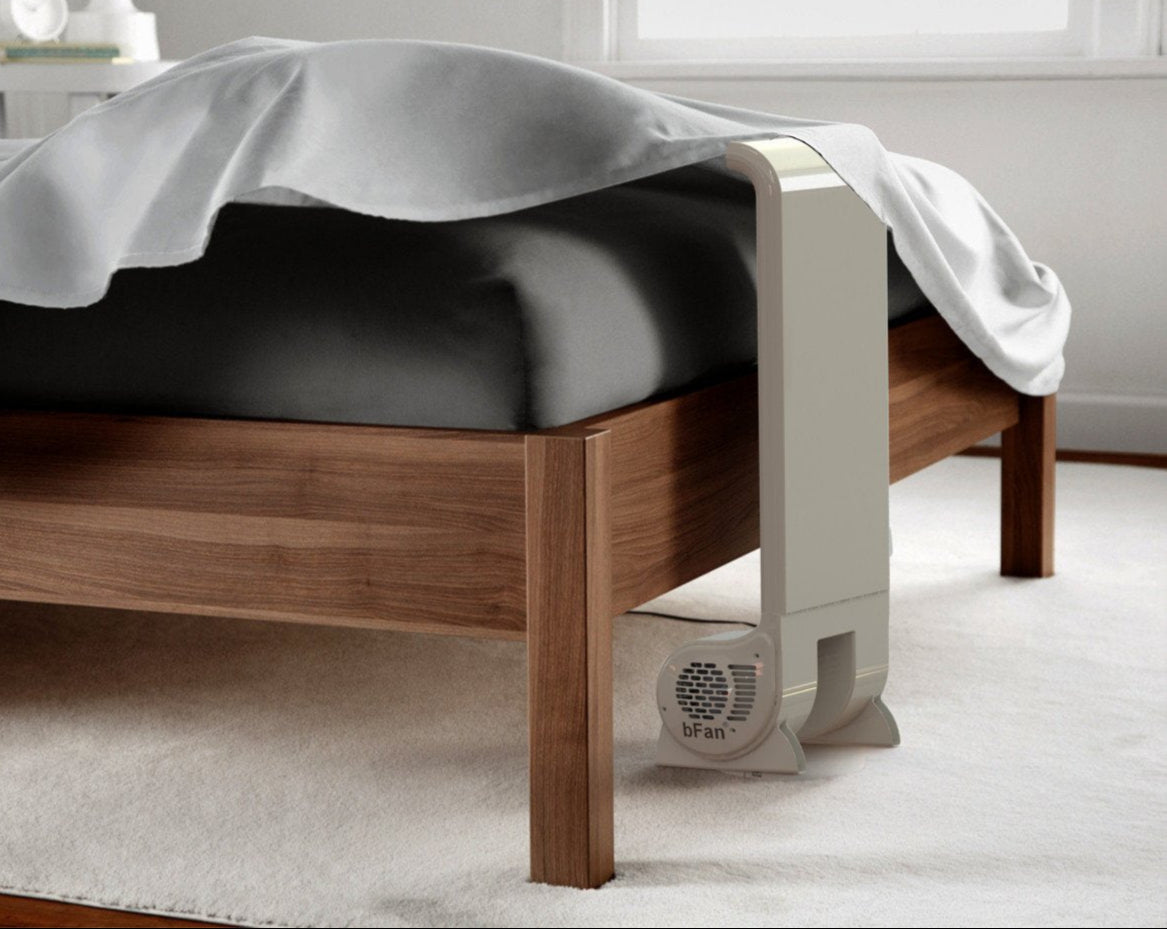
Step 1 is measuring the bed. Under-sheet airflow products depend on physical fit. If a review never mentions bed height or under-bed clearance, it may not transfer well to your room. The bFan fits beds from 18 to 38 inches tall, measured from the floor to the top of the mattress. The Short top fits 18 to 28 inches and the Tall top fits 28 to 38 inches, and a 28 inch bed takes the Tall without the adjustment tabs installed. The base needs about 6.75 inches of clearance under the foot of the bed, and if there is not enough clearance, the base can be turned around so it sits in front of the foot of the bed instead of underneath. If you have a footboard, leave about 1.75 inches between the mattress and the footboard. Also check whether the reviewer uses a thick mattress, adjustable base, or deep bedding, because all of that changes airflow.
Step 2 is matching the sheet setup. Tightly woven sheets help guide air across the body instead of letting it spill out too fast. Several customer testimonials mention that tightly woven sheets made the airflow work better. You do not need luxury bedding, but you do want a sheet set that can carry air under the covers.
Step 3 is thinking about sleep style. Back sleepers, side sleepers, couples, and people who tuck blankets differently can all get different results. If a reviewer sleeps uncovered half the night, their experience may not help you much if you prefer tightly tucked bedding.
What setup details do honest bed fan reviews usually mention?
Honest reviews talk about installation, noise, sheets, and body coverage. If a reviewer never mentions those basics, they may not have used the product long enough to judge it.
The most useful reviews usually mention a few practical things that casual reviewers skip. They tell you whether the blower sits under the foot of the bed, whether the duct sends air up under the top bedding, and whether the covers stay tucked enough to carry airflow across the body and let heat exit near the shoulders.
They also talk about comfort details. A realistic review might say the airflow felt strongest on the legs at first, that the top sheet mattered more than expected, or that a partner preferred a lower setting.
Look for these specifics:
- Noise level: Is it quiet enough for a light sleeper, or do you hear airflow and motor sound at normal speed, often around 28 dB to 32 dB?
- Sheet behavior: Did tightly woven sheets help keep air moving across the body instead of leaking out?
- Body coverage: Did the user feel the breeze only at the feet, or across the legs, torso, and chest under tucked bedding?
- Adjustment range: Did the reviewer need one fixed speed, or did they change settings across seasons and sleep stages?
Pro tip: the best review often includes one sentence about what took a night or two to dial in. Instant perfection sounds nice, but real sleep products usually need minor adjustment.
How should you use a bed fan for more comfortable sleep?
With Bedfans USA’s bFan, start by sending airflow under the covers, not at your face, then fine-tune speed over several nights.
First, set up the unit so room air travels from the foot of the bed under the top bedding. The goal is to clear hot air trapped between the sheets, not blast your skin like a room fan. That’s a big distinction, and it’s why tucked bedding matters.
Next, start in the middle of the speed range and adjust gradually. If you feel too much direct airflow, lower it. If you still wake warm, raise it a bit. Timer controls can help you match the cooler part of the night and support the sleep temperature range experts usually recommend.
Last, judge performance over three to five nights, not one. Your bedding, room temperature, and body temperature all change during the week. Common misconception: if the device doesn’t feel icy on night one, it isn’t working. In practice, many people notice the win as fewer sweaty wake-ups and the ability to keep the thermostat a few degrees higher while still sleeping comfortably.
Which buyers should be extra careful before relying on reviews alone?
People with menopause, medication-related sweating, sleep apnea symptoms, or unexplained night sweats should use reviews as shopping input, not medical advice.
Reviews can help you choose a product, but they cannot tell you why you’re overheating. Night sweats can be linked to menopause, medications, infections, endocrine problems, anxiety, sleep apnea, and other medical issues. If your sweating is new, severe, or paired with weight loss, fever, chest symptoms, or daytime exhaustion, talk with a clinician.
This matters for shopping, too. If your heat problem comes mostly from bedding microclimate, an under-sheet bed fan may help a lot, and bed fan reviews from people with a similar setup become far more useful. If the issue is a warm room, alcohol, untreated sleep apnea, or medication timing, product reviews will only tell part of the story. The smartest buyers use reviews to screen products, then match those findings to their actual sleep environment and health context.
Compartir