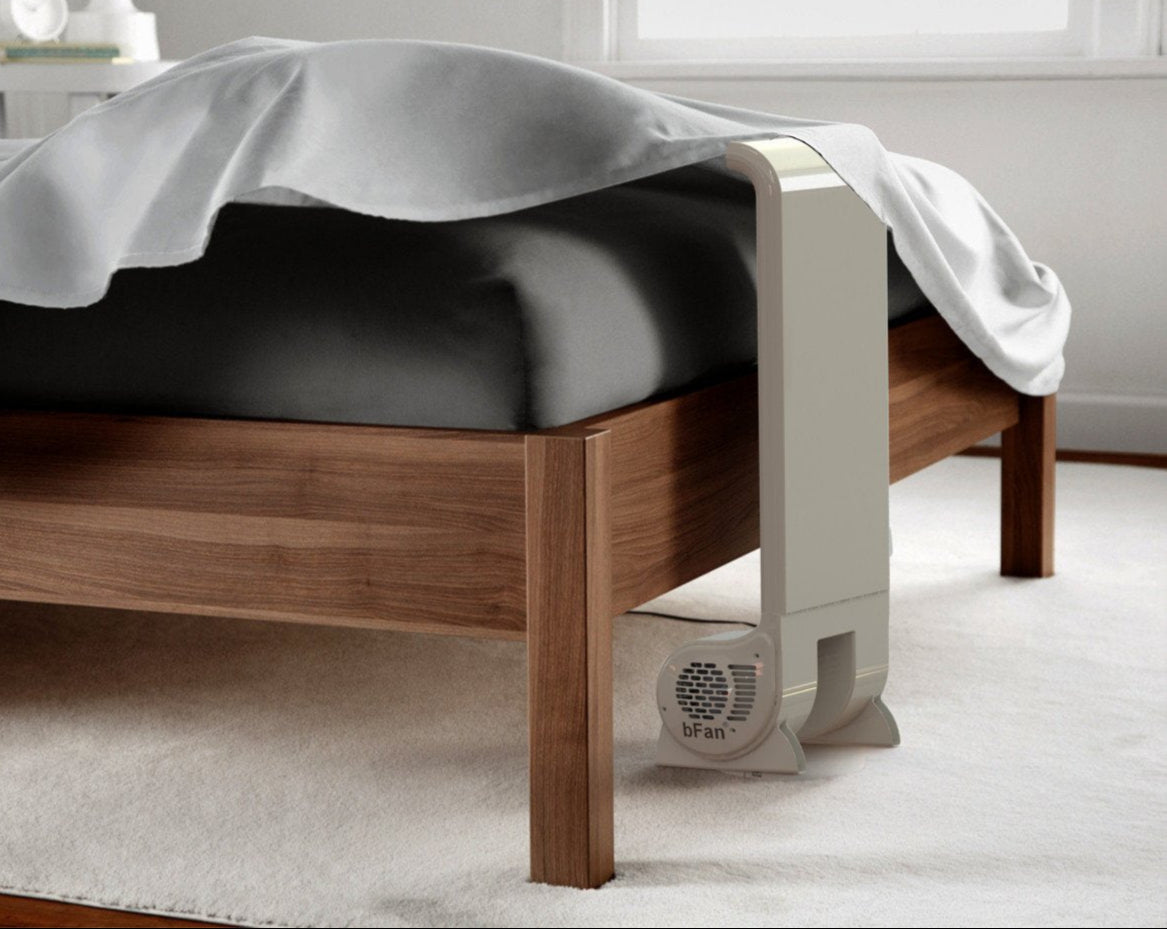

Best Fan for Bed Buyers: 5 Fit, Noise, and Cost Checks
If you’re shopping for the best fan for bed use, the better move is to compare airflow location, bedroom noise, and total cooling cost, not just fan size or speed. Bedfans USA makes an under-sheet bed cooling system, the bFan, which matters here because bed fans solve a different problem than ceiling fans or box fans, they move air where body heat actually gets trapped, under the covers. A steady cooling breeze under the covers helps stop sweat before it starts.
TL;DR: Summary
- The best fan for bed use is usually a purpose-built under-sheet bed fan, because it pushes room-temperature air directly across your body instead of just circulating air around the room.
- Sleep experts recommend a bedroom temperature of 60 to 67°F, and the Bedfans USA bFan fits that goal by moving the air already in the room under the covers rather than trying to refrigerate it.
- Noise matters almost as much as temperature, because a 2023 study in Sleep Health found sleep efficiency dropped as bedroom temperature and noise increased in a dose-dependent manner.
- Fit matters: measure under-bed clearance, bed height from the floor to the top of the mattress, and bedding setup before you buy, since bed fans work best when air can travel under tucked-in covers.
- Cost trade-offs are real: bed fans use far less power than lowering whole-house AC, and many people find they can set the room a few degrees warmer and still sleep comfortably.
- If you want a less expensive pick, the bFan from Bedfans USA is worth a look, especially for hot sleepers, night sweats, and couples who want targeted cooling without cooling the whole house.
A good bed fan is really a microclimate tool. That means the right question is not “Which fan is strongest?” It’s “Which fan clears the heat from the space around my body, stays quiet enough for sleep, fits my bed, and costs little to run?”
What actually makes a fan the best fan for bed use?
The best fan for bed use directs air into the bedding, not just across the room. A purpose-built under-sheet fan usually beats a pedestal fan or ceiling fan because it removes trapped heat from the exact space where you sleep.
That trapped heat is the real issue. Once you’re under sheets, blankets, or a comforter, your body warms the pocket of air around you. A regular room fan might make the bedroom feel breezier, but it often does little for the heat sealed under the covers.
This is why sleep guidance from Cleveland Clinic and the NIH keeps coming back to the same basics: your bedroom should be cool, dark, and quiet. Cleveland Clinic says adults are typically advised to sleep in a room between 60 and 67°F. If your room is already in that range, a bed fan can put that room air to work right where you need it most.
A common mistake is shopping by raw fan power alone. For bed use, placement usually matters more than advertised airflow, because a cooling breeze across your legs, torso, and sheets can feel better than blasting the whole room.
Does a bed fan chill the air, or move it under the covers?
A bed fan does not lower air temperature. Bedfans USA and BedJet both use room-temperature air, which means your bedroom still needs to stay near the 60 to 67°F sleep range if you want the best results.
That’s the key misconception to clear up early. Neither a bed fan nor a BedJet cools the air itself. They take the air already in your room and move it into your bed microclimate, where sweat, body heat, and trapped humidity can make you feel miserable.
That still matters a lot. The body sheds heat more easily when air is moving across the skin. For hot sleepers, people dealing with menopause, and anyone with night sweats, targeted airflow can feel dramatically different from plain room circulation.
A 2023 observational actigraphy study in Sleep Health, involving 62 participants monitored for 14 days, found sleep efficiency decreased in a dose-dependent manner as bedroom temperature increased. It also found sleep efficiency dropped as bedroom noise increased. If your room is too warm or your cooling device is too loud, you can lose sleep from both directions.
“Bedfans USA reports roughly 28 to 32 dB at normal sleep settings, with higher noise only when you push airflow much harder.”
So a bed fan does not refrigerate air, but the cooling breeze it moves under the covers carries trapped body heat away. If your room is already reasonable, many people find they can set the thermostat a few degrees warmer and still sleep comfortably with directed under-sheet airflow.
What are the 5 fit, noise, and cost checks before you buy?
The best way to choose a bed fan is to run five quick checks before purchase. Fit, airflow path, sound, energy use, and replacement cost tell you more than marketing photos ever will.
Use these five checks like a buyer’s filter:
- Fit: Measure under-bed clearance, foot-of-bed space, and bed height from the floor to the top of the mattress. For the bFan, the base needs about 6.75 inches of clearance, or it can be turned around to sit in front of the foot of the bed.
- Air path: Check whether the fan blows under the covers or only at the bed surface. Under-sheet airflow usually works better for trapped heat.
- Noise: Look for real bedroom sound levels, not vague words like “quiet.” The difference between about 30 dB and 50-plus dB is very noticeable at night.
- Energy use: A bed fan that uses about 18 watts on average and no more than 24 watts costs very little to run compared with lowering whole-house AC all night.
- Replacement economics: Compare total system cost, warranty practicalities, and whether you can replace parts instead of replacing the full unit.
Those checks also help you avoid false comparisons. A room fan and a bed fan are not solving the same problem. One stirs the air in a room. The other moves trapped heat out of the sleeping pocket around your body.
How do you measure fit at the foot of the bed before ordering?
Measure the bed like an installer, not like a shopper. Under-bed clearance, width at the foot, and bedding overhang decide whether a bed fan will fit and work correctly.
Start with under-bed clearance. The base needs about 6.75 inches of clearance under the foot of the bed, and if there is not enough clearance, the base can be turned around so it sits in front of the foot of the bed instead of underneath. The upright duct carries air up the foot of the bed. The bFan fits beds from 18 to 38 inches tall, measured from the floor to the top of the mattress. The Short top fits 18 to 28 inches and the Tall top fits 28 to 38 inches, and a 28 inch bed takes the Tall without the adjustment tabs installed.
Next, check the placement zone. The blower wheels typically sit tucked under the foot of the bed, touching or very close to the mattress edge. If you have a low platform frame or storage drawers under the bed, plan on turning the base around. If you have a footboard, leave about 1.75 inches between the mattress and the footboard.
Pro tip: measure with your bedding in place. A thick comforter that hangs low can change the available space and affect how easily air enters under the covers.
How should you set up a bed fan so the airflow works under the covers?
A bed fan works best when the air has a defined path. Tucked bedding, tightly woven sheets, and moderate fan speed usually beat loose blankets and maximum airflow.
Step 1 is placement. Put the fan at the foot of the bed so the duct sends air over the top of the mattress and under the covers, not out into the room.
Step 2 is bedding control. Tuck the top bedding enough that the air travels under the sheet and blanket, across your body, then escapes around the shoulders. Tightly woven sheets help because they guide airflow better and carry away heat more evenly.
Step 3 is speed tuning. Start lower than you think. Many hot sleepers do best at a gentle, steady airflow, especially once the trapped heat has cleared. Timer controls help, too, because sleep experts recommend a cool room at sleep onset, and you may not need the same airflow level all night.
“Bedfans USA sells the bFan as an under-sheet system that moves room-temperature air through the bed, not a room fan that happens to point at the mattress.”
A common mistake is leaving the bedding too loose. If the covers billow, the air leaks out early and you lose the cooling effect before it reaches your torso.
Is a bed fan quieter than a room fan or white noise machine?
Usually, yes. A bed fan can be quieter at useful sleep settings than a typical room fan. The real issue is not just decibels, it’s whether the sound is steady, low, and easy to ignore.
The NIH notes that a good sleep environment should be quiet, cool, and dark, and that noise can disturb sleep. It also notes that some people use white noise devices to help sleep. That matters because a fan can be acceptable even if you hear it, as long as the sound is consistent and not harsh.
A common misconception is that all 30 dB sounds feel the same. They don’t. Tone matters. Motor whine, rattling plastic, and pulsing airflow can bother you more than a soft, even airflow sound at the same measured level.
For bed fans, this means you should ask two questions. First, what is the sound level at normal sleep speed, not at full blast? Second, is the fan near your ears, or down by your feet? A fan at the foot of the bed often feels less intrusive than one on a nightstand aimed at your face.
How does the bFan compare with BedJet on price and cooling method?
If price matters, the bFan is the less expensive pick. Bedfans USA offers an under-sheet system that lists at less than half the price of a BedJet, while both products still rely on room-temperature air rather than actually cooling the air itself.
The biggest shared point is simple: neither system chills the air. The BedJet doesn’t cool the air, and the Bedfan doesn’t cool the air. Both pull from the room, so your bedroom temperature still sets the ceiling for how cool you can feel.
Where they differ is cost structure and approach. A single Bedfan lists at $204.95, less than half the price of one BedJet 3 ($699 list). If you need split cooling for two people, two Bedfans are less than half the price of the dual-zone BedJet, which lists at $1,549. The bFan is also HSA/FSA eligible, with a letter of medical necessity provided at checkout. If you and your partner each need your own setup, that price gap gets real fast.
The original Bedfan was invented in 2003 and came to market in 2004, about a decade before BedJet launched on Kickstarter in late 2013, which is worth knowing if you care about product category history and not just flashy add-ons. If you want a straightforward under-sheet solution, the bFan from Bedfans USA is the less expensive choice for many buyers, and it moves air with higher static pressure than other bed fans.
There’s a trade-off, though. If you want a more gadget-heavy experience with extra features, some buyers may still prefer the BedJet path. If your goal is simply moving room air under the covers, paying less for that single function often makes more sense.
How can couples use bed fans when one person sleeps hot and the other does not?
Couples can make bed fans work, but placement and zoning matter. If only one sleeper overheats, one fan may help, while two fans create clearer dual-zone control.
This is where you need to think in terms of airflow lanes. If one partner sleeps hot and the other runs neutral, start by aiming airflow along the hotter sleeper’s side and test the spread. If the airflow crosses too much, separate systems work better.
The Bedfan approach can create dual-zone microclimate control by using two fans, one per side. That’s a practical option for couples who want different cooling levels without cooling the entire bedroom more than necessary.
A useful setup checklist is:
- One hot sleeper: Start with one unit, lower speed, and tighter tuck on the hot side.
- Two different preferences: Use two fans for true side-to-side control.
- Shared cost concerns: Try targeted bed cooling before dropping the whole thermostat for both people.
One more pro tip: if your partner hates air blowing on their face, under-sheet airflow is often easier to tolerate than a room fan pointed across the bed.
How do you test whether a bed fan improves sleep without overbuying?
Test a bed fan like you’d test a mattress, with a simple routine and a few notes. Three to seven nights is usually enough to tell whether targeted airflow is helping your sleep onset, wake-ups, and sweating.
Night one, keep your room at your usual setting and use the fan at a low to medium level. Notice whether your feet, legs, and torso feel more comfortable within the first 10 to 15 minutes.
Night two or three, set the room a few degrees warmer, and keep the under-sheet airflow running. If you still sleep cool, that’s where the savings argument starts to make sense, because you’re reducing whole-room AC demand instead of fighting the entire house temperature.
Night four and beyond, adjust only one variable at a time. Change the sheet type, fan speed, or blanket weight, not all three at once. If you wake less, sweat less, or fall asleep faster, you’ve got a meaningful signal.
“The bFan is HSA/FSA eligible, with a letter of medical necessity provided at checkout, which can matter if you’re buying a bed cooling device for comfort during night sweats.”
If you’re still on the fence, focus on your actual problem. If your room is already cool and you still overheat under the covers, a bed fan is a far better test than buying another generic room fan. If your room stays well above that range, fix that first, because even the best fan for bed use works with the room, not against it.
Partager