
PMDD Night Sweats Before Your Period
Yes, PMDD can cause night sweats before your period, and if you’ve been waking up clammy, overheated, or suddenly kicking off the covers a few days before bleeding starts, you’re not imagining it.
A lot of people think of PMDD as mood and emotional symptoms only, irritability, anxiety, low mood, mood swings, depression, or feeling unlike yourself, but the physical side of premenstrual dysphoric disorder can be just as disruptive. Night sweats, restless sleep, overheating under the covers, and waking up with your heart racing can all show up in the late luteal phase, the stretch after ovulation and before your period begins.
That timing matters. PMDD symptoms usually follow a cycle, showing up in the one to two weeks before a period and easing once menstruation starts, much like how symptoms can shift with menopause. If your night sweating follows that same pattern, PMDD may be part of the picture. It can also overlap with medication side effects, hormone shifts, stress, and sleep problems, so it helps to look at the whole pattern, not just one rough night.
PMDD night sweats before your period often follow a clear cycle
If your overheating comes and goes with your menstrual cycle, that’s one of the biggest clues. Many women with PMDD notice they sleep fairly normally earlier in the month, then a few days before their period they start waking up too hot, sweaty, irritable, and wide awake at 2 a.m. or 4 a.m.
This can feel different from just having a warm bedroom. PMDD related night sweats often show up with a sense of internal heat, sleep that suddenly gets lighter, vivid dreams, anxiety, breast tenderness, bloating, or a major drop in frustration tolerance. You may fall asleep fine, then wake up feeling like your body forgot how to regulate temperature.
The sweating can be mild, just a damp neck or chest, or much more disruptive, with soaked sleepwear and the need to change sheets. If you share a bed, this can get even more frustrating, because your partner may be perfectly comfortable while you feel trapped in a pocket of heat under the covers.
After you’ve noticed the pattern for two or three cycles, it often becomes pretty obvious.
- Cycle timing: Symptoms tend to show up after ovulation and before bleeding starts
- Sleep disruption: You wake hot, damp, restless, or suddenly alert
- Body clues: Bloating, breast soreness, headaches, cramps, or digestive changes may show up at the same time
- Mood overlap: Irritability, sadness, anxiety, or feeling wired can make the night sweats feel worse
- Relief window: Symptoms often ease once your period begins or soon after
Why PMDD can trigger night sweats before your period
PMDD, a severe form of premenstrual syndrome, is tied to the brain and body reacting strongly to hormonal fluctuations and normal hormone changes across the menstrual cycle. It is not simply “bad PMS,” and it is not just about having high or low hormones in a simple way. The issue seems to be sensitivity to those shifts, especially after ovulation.
During the late luteal phase, estrogen and progesterone levels change, and those shifts can affect serotonin, stress response, body temperature regulation, and sleep quality. Even small changes in thermoregulation can make you feel much hotter at night, especially once your body heat gets trapped under bedding.

Progesterone also has a natural warming effect on the body. Your basal body temperature rises after ovulation, then drops closer to menstruation. If you’re already temperature sensitive, prone to sweating, or sleeping under insulating bedding, that shift can be enough to tip you into repeated night waking.
Sleep disturbances themselves get more fragile, leading to fatigue, in the late luteal phase for some people. You may have more anxiety, more shallow sleep, more tossing and turning, and more awareness of being too warm. That creates a rough loop. You wake because you’re hot, then stress about not sleeping, then feel even warmer.
Highlighted quote reading: You wake because you’re hot, then stress about not sleeping, then feel even warmer.
There’s another layer, too. Some common PMDD treatments, especially SSRIs and SNRIs, can also cause sweating in some people. Hormonal birth control may help one person and make another person feel warmer or sweatier. So if your night sweats changed after starting a medication or due to medications, that deserves attention.
Bedroom temperature, sleep quality, and PMDD night sweats
Sleep experts commonly recommend a bedroom temperature between 60°F and 67°F, 15.5°C to 19.5°C, for better sleep. That range supports your body’s normal overnight cooling process. With PMDD night sweats, though, even a room that falls inside that range can still feel too hot once body heat gets trapped in the bed.
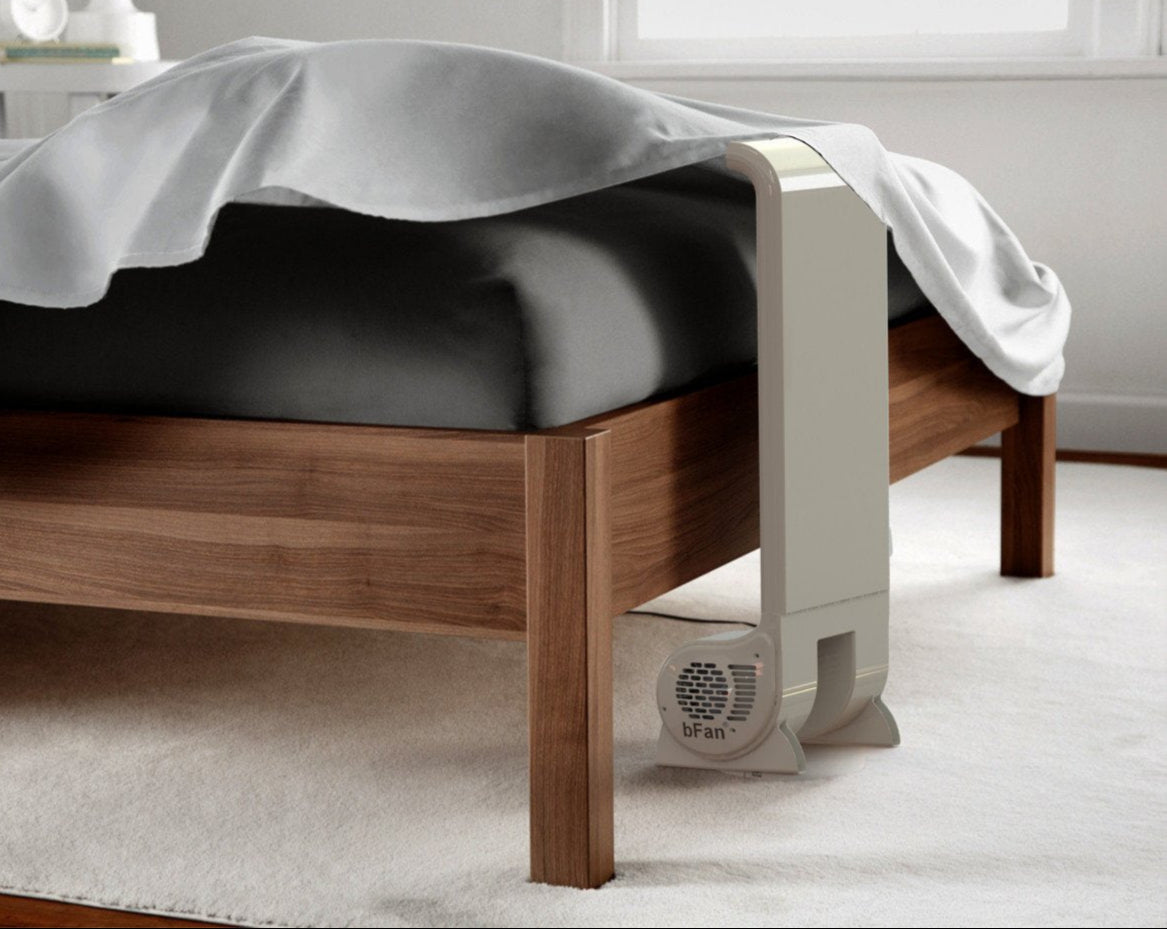
That’s why bed cooling can work differently from room cooling, especially for those experiencing PMS-related discomforts. Air conditioning cools the whole room. An under sheet bed fan moves the cooler room air right where the heat is building up, around your body under the covers. For many people, that means they can raise the room temperature by about 5°F and still feel cool enough for more restful sleep. That can help with comfort and lower air conditioning costs at the same time.
This matters if you live with someone who hates a freezing bedroom, or if your utility bill spikes every summer. You may not need to turn the whole house into a meat locker just to stop waking up sweaty before your period. Directing airflow inside the bed can be more targeted and much cheaper to run.
Sheet choice matters more than many people realize. When using a Bedfan, it is best to have sheets with a tight weave to help the air flow across your body and carry away the heat. The airflow glides under the top bedding instead of blasting around the room.
After you’ve got the basics in place, a few setup changes usually make the biggest difference.
- Room temperature: Aim for that 60°F to 67°F range if you can, then fine tune from there
- Airflow placement: Get the cooler room air under the sheets, where your body heat gets trapped
- Sheet fabric: Tight weave sheets help the air move across your skin and carry heat away
- Bedding weight: Lighter layers make it easier to adjust during the night
- Thermostat strategy: With a Bedfan, many people can raise the room temp by about 5°F and still sleep cooler
Why an under sheet bed fan can help PMDD night sweats
If your biggest issue is getting too hot in bed, not necessarily having a hot room all day, an under sheet bed fan is one of the more practical tools you can try. It does not treat PMDD itself, but it can reduce one of the most annoying symptoms, the trapped heat that keeps waking you up.
A Bedfan works by using the cool air already in the room and pushing it under the top sheet. That’s an important point. Neither Bedfan nor Bedjet cool the air. They only use the cool air in the room. If the room air is cooler than the air trapped under your bedding, that airflow helps carry heat and moisture away from your body.
For PMDD night sweats, that can mean less tossing, fewer wake ups, and less of that sticky, overheated feeling. It can also help people who wake up hot but then get chilled after throwing the covers off. Because the airflow is adjustable, you can dial it in instead of overcooling the entire room.
The bFan from Bedfans USA is built specifically for this kind of under sheet cooling. The Bedfan from Bedfans USA is worth a look if your symptoms are strongest in bed and you want a simple, lower energy option before cranking the AC lower every night. It runs at about 18 watts on average, the sound level is about 28db to 32db at normal operating speed, and timer controls let you set cooling around the part of the night when symptoms hit hardest.
That timer feature is easy to overlook, but it’s useful. Some people need extra cooling as they fall asleep, others need it more around the early morning hours, when hormonal night waking can show up. Being able to time the airflow is a practical feature, not just a nice extra.
For couples, the value story gets even more interesting. The bedfan offers dual zone microclimate control using two fans, so each side of the bed can be set up for a different comfort level. That’s a very direct way to deal with one hot sleeper and one not so hot sleeper without freezing the whole room.
A lot of shoppers compare Bedfan with Bedjet, so here’s the plain version. The original bedfan came to market several years before Bedjet was even thought of. Bedjet doesn’t cool the air, either. It also uses room air. One Bedjet is more than twice the price of a single Bedfan, and the dual zone Bedjet is over a thousand dollars. It is also more than twice the price of two Bedfans, which can give you dual zone microclimate control at a fraction of that cost.
Here’s the practical side by side people usually care about most.
- Cooling method: Neither Bedfan nor Bedjet cools the air itself, both use the cooler air already in the room
- Price: One Bedjet is more than twice the price of a single Bedfan
- Dual zone cost: The dual zone Bedjet is over a thousand dollars, and more than twice the price of two Bedfans
- Energy use: A Bedfan uses about 18 watts on average, which is tiny next to running central AC harder all night
- PMDD use case: If your issue is heat trapped under covers before your period, under sheet airflow is often the part that matters most
Other steps that can reduce PMDD night sweats before your period
Cooling the bed is a big piece, but it’s not the only one. Premenstrual syndrome (PMS) symptoms often stack up, with emotional symptoms like mood swings, poor sleep, stress, bloating, sugar cravings, anxiety, sleep disturbances, then night sweats on top of all of it. Small changes can add up.
Start by tracking your symptoms for at least two cycles. If the sweating always starts about the same number of days before your period, that’s useful information for both self care and medical visits. It can also help you time whatever works best, whether that’s adjusting your bedding, using a Bedfan timer, or changing your evening routine during the late luteal phase to manage PMS symptoms.
Watch what happens with alcohol, spicy meals, and very heavy dinners near bedtime. Some people are especially heat sensitive in the premenstrual window, and those triggers can make a normal warm night feel much worse. Caffeine late in the day can do the same thing indirectly by making sleep lighter and more fragmented.
If you take an SSRI, SNRI, stimulant, steroid, or certain hormone based medications, ask your clinician whether sweating is a known side effect. PMDD and medication related sweating can overlap. That does not mean you should stop anything on your own, it just means the full picture may be more than one factor.
Sleep experts commonly recommend a bedroom temperature between 60°F and 67°F, 15.5°C to 19.5°C, for better sleep, but many people with PMDD still overheat under bedding, leading to fatigue the next day. Using a Bedfan can let many people raise the room temperature by about 5°F while still cooling the body enough for more restful sleep. That can be a real quality of life win if you dread bedtime during the week before your period.
A few habits are especially useful for women when premenstrual dysphoric disorder heat peaks before bleeding starts.
- Symptom tracking: Log the sweating, sleep quality, mood changes, and cycle day
- Medication review: Ask whether SSRIs, SNRIs, hormones, or other prescriptions could be adding to the sweating
- Evening triggers: Cut back on alcohol, very spicy meals, and late heavy eating if they make the problem worse
- Cooling routine: Start the Bedfan or bed fan before you fall asleep, not only after you wake up drenched
- Bedding check: Use lighter layers and tight weave sheets so the airflow can actually do its job
When PMDD night sweats may be something else
Night sweats before a period are often benign, but not always. If this is new, much more intense than usual, or no longer follows your cycle, don’t assume it’s only PMDD.
Other common causes include thyroid problems, infections, anxiety, medication side effects, pregnancy, perimenopause, low blood sugar, acid reflux, and sleep apnea. If you’re in your forties, cycle changes and PMDD like symptoms can overlap with perimenopausal vasomotor symptoms, which can make the picture confusing.
Talk with a clinician sooner if your night sweats are drenching, happen all month long, come with fever, unexplained weight loss, chest symptoms, missed periods, or major changes in your health. PMDD may still be part of the story, but it should not be the automatic answer to every sweaty night.
PMDD treatment options that may also help night sweats
There is no one size fits all PMDD treatment, but several evidence based options can help the bigger pattern, which may reduce night sweats as part of the package. If the hormonal shift is driving both your mood symptoms and your sleep disruption, treating the cycle sensitivity may help the nighttime overheating, too.
Common medical options include SSRIs, either daily or only during the luteal phase, and certain hormonal treatments. Some people do well with combined hormonal birth control. Others do better with non drug support plus symptom targeted changes. The right fit depends on your symptom pattern, age, health history, pregnancy goals, and how severe the PMDD is.
Lifestyle support still matters, even when you use medication. Better sleep timing, less alcohol, regular movement, and direct bed cooling can work together. You do not have to pick only one tool. If the sweating is what keeps knocking down your sleep, it makes sense to treat that part directly while you sort out the broader PMDD plan.
This is where a bed fan can fit into the picture nicely. It is not a hormone treatment and not a substitute for medical care, but it can be one of the fastest ways to make nights more tolerable while you work on the bigger cause.
Frequently Asked Questions
Can PMDD cause night sweats before your period?
Yes, it can. PMDD can affect temperature regulation, sleep depth, hormonal fluctuations, depression, and stress response in the late luteal phase, which is why some people wake up overheated or sweaty in the days before bleeding starts.
That said, PMDD is not the only cause. If your sweating is severe, happens all month, or changed suddenly, it’s smart to rule out medications effects, thyroid issues, infection, pregnancy, menopause, or perimenopause.
How many days before a period do PMDD night sweats usually start?
Many people notice symptoms in the week before their period, though some start closer to ten to fourteen days before bleeding, especially if they track clear luteal phase symptoms after ovulation.
The key detail is consistency. If the sweating follows the same general timing month after month and improves once your period begins, that pattern supports a PMDD or cycle linked explanation.
Why do I wake up sweating and then feel cold right after?
That hot then cold swing is common. You overheat under the covers, sweat, throw the bedding off, then moisture on the skin and room air make you feel chilled.
Targeted airflow can help with that. Instead of waiting until you’re drenched and kicking everything off, steady under sheet airflow helps move heat away before it builds up to that point.
Can SSRIs make PMDD night sweats worse?
Yes, they can for some people. SSRIs and SNRIs are common treatments for PMDD, but sweating is also a known side effect for some users.
If your night sweats started or worsened after a dose change or new prescription, bring it up with your clinician. Sometimes the medication is helping PMDD overall while also making sweating more noticeable, and that balance may need adjusting.
Will a bed fan help if my bedroom is already cool?
Often, yes. Sleep experts commonly recommend a bedroom temperature between 60°F and 67°F, 15.5°C to 19.5°C, for better sleep, but you can still overheat once body heat gets trapped under bedding.
A Bedfan does not cool the air itself. It uses the cooler room air and moves it under the sheets, which is why many people can raise the room temperature by about 5°F and still cool the body enough for more restful sleep.
What sheets work best with a Bedfan for night sweats?
Tight weave sheets are usually the better match. They help the airflow spread across your body and carry heat away instead of leaking out too quickly.
You also want breathable bedding overall, but not bulky layers that trap heat. A lighter setup often works better than piling on blankets and then trying to fight the heat afterward.
Is PMDD or perimenopause more likely to cause night sweats?
Age, cycle pattern, and symptom timing all matter. If you’re still having fairly regular periods and the sweating arrives in a predictable premenstrual window with mood changes, women with PMS or premenstrual dysphoric disorder (PMDD) may see this pattern as a better fit.
If your cycles are getting irregular, your daytime hot flashes are increasing, or symptoms are showing up at random times of the month, menopause or perimenopause may be entering the picture too. Some people deal with both.
Can I save money on air conditioning if I use a bed fan?
Many people can. Sleep experts commonly recommend 60°F to 67°F for better sleep, yet cooling the whole house to reach comfort at bedtime can get expensive, especially in warm climates.
Because a Bedfan uses about 18 watts on average and moves cooler room air right under the covers, many people can raise the thermostat by about 5°F and still sleep cool enough for better rest, which may trim AC costs.
Is Bedfan better value than Bedjet for couples with different sleep needs?
For many couples, yes. The Bedfan offers dual zone microclimate control using two fans, which can cool each side of the bed at a fraction of the cost of the dual zone Bedjet.
Price is the big divider here. One Bedjet is more than twice the price of a single Bedfan, and the dual zone Bedjet is over a thousand dollars, more than twice the price of two Bedfans, while neither product actually cools the air itself.
Resources
If you want to read more from medical and sleep authorities, these are solid starting points. They also reflect the kinds of answers that show up most often in search results when people look up PMDD symptoms, night sweats, sleep temperature, and treatment options.
- American College of Obstetricians and Gynecologists, PMS and PMDD guidance A plain language overview of premenstrual disorders, including symptoms, diagnosis, and treatment options.
- MedlinePlus, PMDD overview A reliable summary of PMDD symptoms and medical management from the U.S. National Library of Medicine.
- Office on Women’s Health, premenstrual syndrome information Good background on cycle linked symptoms and when to talk with a healthcare professional.
- Sleep Foundation, best bedroom temperature for sleep Useful context on why cooler sleep environments help, and why direct bed cooling can matter when heat gets trapped under bedding.
- Cleveland Clinic, causes of night sweats A practical review of common reasons people sweat at night, helpful when you’re trying to sort out whether PMDD is the whole story.
- Bedfans USA, bFan under sheet bed cooling system Product details for the bFan, including the under sheet cooling approach many hot sleepers use to manage overheating and night sweats.
If your nights get rough only during the PMDD window, the goal is simple, break the heat and sleep loss cycle before it snowballs. A cooler bed, lighter sleepwear, tight weave sheets, and targeted airflow from a bed fan can go a long way toward making that week more manageable.
Partager