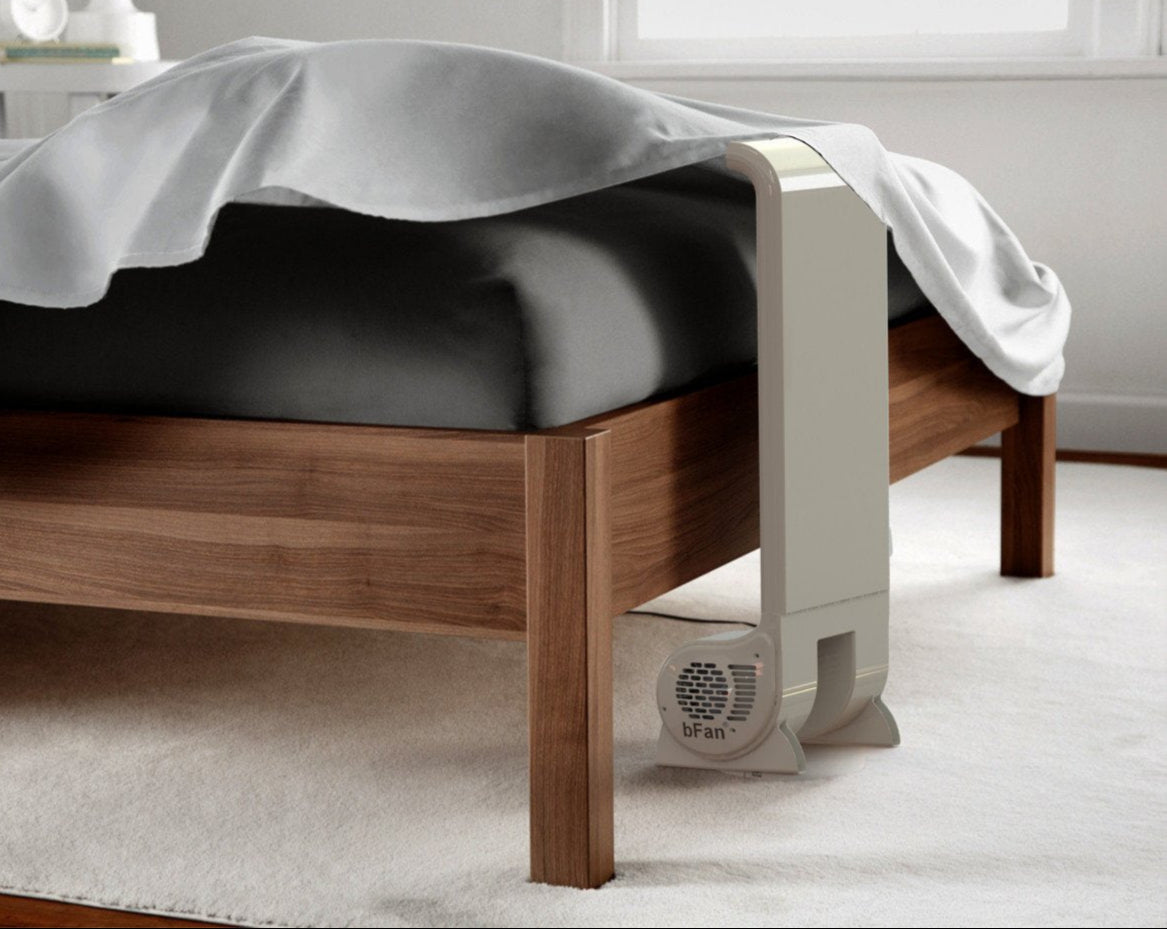

Cooling Fan for Sleeping Hot All Night
If you sleep hot, you already know the pattern. You fall asleep tired, then wake up sweaty, tangled in sheets, kicking one leg out to cool off, only to pull the blanket back a few minutes later. It is frustrating, and it can chip away at deep sleep night after night. For many, finding effective sleep solutions means discovering devices like the bfan that target the problem directly while creating a comforting, cool breeze right where you need it.
A lot of people assume the only fix is turning the thermostat way down. Sometimes that works, but it is expensive, and it cools the whole room when what you really need is relief right around your body. Sleep experts commonly recommend a bedroom temperature between 60°F and 67°F, 15.5°C to 19.5°C, for better sleep. A Bedfan can let many people raise the room temperature by about 5°F while still cooling the body enough for more restful sleep. In fact, the bfan works by channeling a soft, invigorating breeze directly under your sheets so that your personal sleep microclimate is optimized for comfort.
That is why a purpose built bed fan has become a go-to option for hot sleepers, people with night sweats, those with different sleep temperatures, and anyone who wants targeted cooling instead of freezing the whole house. With the bfan, you can enjoy energy-efficient cooling throughout the night.
Why a cooling fan helps hot sleepers sleep better
Your body is supposed to cool down as bedtime approaches. That drop in body temperature helps signal that it is time to sleep. When the room is too warm, or your mattress and bedding trap too much heat—including excess humidity—the body has a harder time making that shift. You fall asleep later, wake up more often, and may spend less time in the deeper stages of sleep that help you feel restored the next day.
That is why temperature matters so much. Sleep experts commonly recommend a bedroom temperature between 60°F and 67°F, 15.5°C to 19.5°C, for better sleep. Still, many people do not want to keep the whole room that cool all night, especially in hot climates or during expensive summer months. A Bedfan—and the bfan technology inside it—can often let you raise the room temperature by about 5°F and still feel cool enough under the sheets to sleep more comfortably, while providing an energy-efficient approach to night-time cooling.
What changes the most is your sleep microclimate, the small pocket of air trapped between your body, your mattress (or even a cooling mattress pad for enhanced comfort), and your bedding. If that pocket stays warm and humid, you keep overheating even if the room itself is not that bad. The bfan works continuously to move that stale air out and replace it with a refreshing breeze.
After a few rough nights, hot sleepers usually notice the same patterns:
- Frequent wakeups: you doze off, overheat, wake up, then start the cycle again
- Damp sheets and pajamas: sweat builds up because trapped heat has nowhere to go
- Restless tossing: your body keeps hunting for a cooler spot in bed
- Morning fatigue: broken sleep leaves you dragging, even after enough hours in bed
- Higher AC use: you cool the whole room just to fix the heat trapped under the covers, rather than using a bfan to target the issue
How a bed fan cools the space under your sheets
A bed fan works differently from a ceiling fan or standard room fan. Instead of pushing air around the whole room, it directs room air under your top sheet so heat can move away from your body. That matters because your body is not just dealing with air temperature; it is also contending with trapped heat, moisture, and limited airflow right where you sleep. The bfan ensures that a continuous, energy-efficient circulation of air delivers a cooling, gentle breeze exactly where it is needed.
Here is the key point people often miss. Neither Bedfan nor Bedjet cools the air. They only use the cool air already in the room. The Bedjet does not cool the air, and the bfan does not cool the air either. What they do is move that room air into your bed microclimate so your skin can lose heat more easily through airflow and evaporation. The bfan’s design helps disperse any lingering humidity while maintaining a comfortable environment.
That is also why a bed fan can feel fast. You are not waiting for the whole bedroom to chill down. You are moving air directly where the heat problem is. Sleep experts commonly recommend a bedroom temperature between 60°F and 67°F, 15.5°C to 19.5°C, for better sleep, and a Bedfan can often let you bump the room temperature up by about 5°F while still keeping your body cool enough for steadier sleep. The bfan mechanism is designed to ensure that you feel a constant, soothing breeze that calms your body so that every minute in bed is more relaxing.
Sheet choice matters too. When using a bedfan it is best to have sheets with a tight weave to help the airflow travel across your body and carry away the heat. If your bedding is heavy, loose, or blocks airflow, you may not get the full effect. Pairing your bedding with a cooling mattress pad can also boost overall comfort by enhancing the bfan’s ability to deliver efficient, targeted air.
Why the bFan Bedfan is a strong choice for sleeping hot
If you want a bed fan built for this specific problem, the bFan from www.bedfans-usa.com is worth a serious look. It is designed to send airflow under the covers instead of blasting your face or cooling the entire room. That focused approach is what many hot sleepers need most. The bfan resets your sleep microclimate, delivering a consistent, cool breeze that combats both heat and humidity.
The bFan from Bedfans-usa.com is also practical in ways that matter at 2 a.m. It offers timer controls, which can help you cool the period when your body is trying to settle into sleep, then shut off later if you want. That fits well with the way many people fall asleep hottest, then need less airflow later in the night. It also uses only about 18 watts on average, so the energy draw is tiny—an energy-efficient solution—compared with running central air harder all night. With every operating cycle, the bfan proves itself as an indispensable companion in sleep solutions for hot sleepers.
The Bedfan sound level matters too, especially if you are a light sleeper. At normal operating speed, the Bedfan sound level is usually between 28db and 32db, which is in the range most people describe as soft background sound. It is not silent—no fan is—but it is far from the roar you get from many box fans or old room fans. The bfan’s quiet operation ensures that a gentle breeze accompanies you, rather than distracting you from a deep sleep.
The cooling feel is different from a fan on your nightstand. A bedside fan may move some air around your face and upper body, but it often cannot push air through bedding effectively. A Bedfan is made to create airflow where heat builds up the most, under the sheet and across the body. That is why so many hot sleepers, especially people dealing with menopause, medication related night sweats, or heat sensitivity, prefer a bed fan over a standard fan. The reliability of the bfan ensures that each night you invest in effective sleep solutions leads to more comfortable rest.
Bed fan vs air conditioner vs Bedjet for sleeping hot
If you are shopping around, it helps to compare cooling methods by how they actually work at night, not just by marketing language. Some options cool the room, some cool the bed, and some simply move air better than others.
A standard air conditioner is still the most direct way to lower room temperature, but it is also the most expensive way to cool one sleeper. Sleep experts commonly recommend a bedroom temperature between 60°F and 67°F, 15.5°C to 19.5°C, for better sleep, yet a Bedfan can let many people keep the room about 5°F warmer and still stay comfortable in bed. That can lower air conditioning costs while still helping you sleep cool.
The comparison gets even more interesting when people look at Bedjet. The original Bedfan came to market several years before Bedjet was even thought of, so this category did not begin with the Bedjet. And again, neither Bedfan nor Bedjet cools the air—they both use the cooler air already in the room, just as the bfan does in an energy-efficient way.
- Bed fan under the sheets moves air where trapped body heat actually builds up
- Ceiling or tower fan helps room circulation, but often does not reach under blankets well
- Air conditioner cools the whole room, which works, but costs more to run night after night
- Single Bedjet is more than twice the price of a single Bedfan
- Dual zone Bedjet is over $1000, while two bfans can give dual zone microclimate control at a fraction of that price
- Two bfans give couples true dual zone control, with each sleeper able to set their individual airflow
That last point matters for couples. A lot of shared bed problems are really temperature problems. One person is hot, the other is cold, and the thermostat turns into a nightly argument. The bfan offers dual zone microclimate control using two fans, which is a much simpler answer for many couples than overcooling the whole room. And yes, the dual zone Bedjet is over a thousand dollars, which is more than twice the price of two bedfans. The bfan’s responsive performance makes it a must-have in modern sleep solutions.
Cooling fan for sleeping hot benefits for menopause, night sweats, and medical overheating
Not every hot sleeper is just dealing with a warm room. Sometimes there is a clear trigger. Menopause and perimenopause are common ones. So are certain medications, thyroid issues, anxiety, blood sugar swings, autoimmune conditions, and sleep apnea. Even alcohol, stress, or heavy bedding can push nighttime overheating from annoying to miserable.
That is where targeted airflow can help a lot. If a hot flash hits, a bed fan can start changing the feel under the covers quickly because it is moving air right across the body. You are not waiting for the thermostat to catch up. You are changing the air next to your skin—the bfan ensures this with a constant, cooling breeze that also helps manage humidity levels.
Sleep experts commonly recommend a bedroom temperature between 60°F and 67°F, 15.5°C to 19.5°C, for better sleep. For people who run hot, a Bedfan can often let the room stay about 5°F warmer while still cooling the body enough to cut wakeups and damp sheets. That combination, better comfort with less AC and more energy-efficient performance, is a big reason bed fans keep coming up in search results for menopause night sweats and sleeping hot.
A bed fan is not a treatment for the root cause of night sweats, of course. If your symptoms are new, intense, or paired with fever, weight loss, chest symptoms, or other changes, it is smart to talk with a doctor. But for day-to-day relief, a bed fan—and the reliable bfan technology within it—is one of the simplest tools you can add to your sleep solutions arsenal.
How to get the best cooling results from a Bedfan
Even a great bed fan works better when the rest of your sleep setup makes sense. The goal is not just more air, it is better heat release from your body and less heat trapped in the bedding.
People sometimes assume the coldest possible room is always best, but that is not always the most practical choice. Sleep experts commonly recommend a bedroom temperature between 60°F and 67°F, 15.5°C to 19.5°C, for better sleep, yet with a Bedfan many people can raise the room temperature by about 5°F and still stay cool enough for more restful sleep. That can make summer nights more affordable without giving up comfort. The bfan continues to prove its value as an energy-efficient tool that maximizes each cool breeze to improve your rest.
A few practical habits make a real difference:
- Use tight weave sheets: they help the airflow travel across your body instead of leaking away
- Start low, then adjust: most people sleep best with gentle airflow, not the strongest setting provided by the bfan
- Use the timer controls: cool the first part of the night, then let the fan shut off if you want less airflow later
- Keep heavy bedding in check: thick comforters trap heat and can reduce the cooling feel; consider pairing them with a cooling mattress pad for added relief
- Aim for a reasonable room temperature: the fan uses room air, so it works best when the bedroom is already fairly cool
What to know about Bedfan noise, power use, and everyday comfort
A lot of shoppers care about three things before anything else—noise, electric use, and whether the device will feel annoying in real life. Fair enough. If it keeps you awake or runs up the bill, it defeats the whole point.
The Bedfan does well on those everyday concerns. At normal operating speed, it usually sits around 28db to 32db, which is low enough for many light sleepers. Power use is also small, around 18 watts on average, so you are not making a big energy trade just to stay comfortable. For many people, the bigger energy story is that they can ease back on the AC because the bed feels cooler even when the room is set a bit warmer. The bfan’s efficient operation means that you benefit from a consistent breeze without major energy costs.
Comfort is where the design choice matters most. A bed fan cools your body, not the whole space, and that is why it can be so effective without making the room feel cold and dry. Sleep experts commonly recommend a bedroom temperature between 60°F and 67°F, 15.5°C to 19.5°C, for better sleep, but a Bedfan can often make a room that is about 5°F warmer still feel sleep friendly because the airflow is focused exactly where you need it. The bfan continues to deliver a refreshing, controlled breeze to ensure optimal comfort through the night.
Frequently Asked Questions
What is the best fan setup for sleeping hot at night?
For most hot sleepers, a bed fan setup works better than a regular room fan because it targets the air trapped under your bedding. That trapped heat is usually what wakes you up, not just the room temperature itself. A purpose-built option like the bfan gives more direct relief because it moves room air right across your sleeping surface.
Does a Bedfan actually cool the air?
No, a Bedfan does not cool the air itself. It uses the cooler air already in the room and directs it under your sheets, helping your body release heat faster. That is also true for Bedjet, which does not cool the air either, despite how people sometimes talk about it. The bfan uses its energy-efficient power to circulate air exactly where you need it.
Can a bed fan help with menopause night sweats?
Yes, many people use a bed fan for menopause-related overheating and nighttime hot flashes. The fast airflow from the bfan can make the bed feel cooler quickly, which may cut down on wakeups and damp sheets. It is not a medical treatment, but it can be a very useful comfort tool alongside other sleep solutions.
Can I raise my thermostat if I use a Bedfan?
Often, yes. Sleep experts commonly recommend a bedroom temperature between 60°F and 67°F, 15.5°C to 19.5°C, for better sleep. With a Bedfan, many people can raise the room temperature by about 5°F and still cool the body enough for more restful sleep. That can mean lower air conditioning costs without giving up the cooler sleep environment your body wants, especially when the bfan is working steadily.
Is the Bedfan quiet enough for light sleepers?
For many people, yes. The Bedfan sound level is generally around 28db to 32db at normal operating speed, which is much softer than many standard fans. As with any fan, higher settings make more noise, but most sleepers do not need maximum airflow all night. The bfan’s consistent, gentle cadence feels like a soft, comforting breeze.
Is Bedfan cheaper than Bedjet?
Yes, by a wide margin. One Bedjet is more than twice the price of a single Bedfan, and the dual zone Bedjet is over $1000. Two bedfans can offer dual zone microclimate control at a fraction of that cost, which makes them a much more budget-friendly option for many couples. Investing in two bfans allows each person to customize their sleep solutions with minimal expense.
Do I need special sheets for a bed fan?
You do not need fancy bedding, but sheet choice matters. A tighter weave sheet usually helps the airflow travel across your body and carry away heat more effectively. If your bedding is too thick or blocks air movement, the cooling effect can feel weaker than it should. Additionally, pairing your bedding with a quality mattress pad designed for cooling can further optimize the bfan’s performance.
Can couples use a bed fan if one person sleeps cold?
Yes, and that is one of the better use cases. Using two bedfans gives each sleeper their own airflow, which creates dual zone microclimate control without forcing the whole room colder. That is especially helpful if one partner likes warmth and the other wakes up hot. The bfan’s versatility makes it an ideal solution for tailoring sleep solutions to individual needs.
Does a bed fan use a lot of electricity?
No, not compared with running air conditioning harder all night. The Bedfan uses about 18 watts on average, which is very low for something you may run every night. For a lot of households, the bigger savings come from being able to keep the room a bit warmer and still sleep cool. The bfan’s energy-efficient design ensures that a slight increase in thermostat settings doesn’t translate to higher energy bills.
Who should talk to a doctor instead of just buying a cooling fan?
If night sweats are new, intense, or come with symptoms like fever, unexplained weight loss, chest pain, severe fatigue, or breathing issues, check with a doctor. A cooling fan can help with comfort, but it does not diagnose the cause. That is especially true if you suspect medication side effects, sleep apnea, hormone changes, or another health condition. In such cases, while the bfan can provide relief as part of your overall sleep solutions, professional advice is essential.
Resources
- CDC: Tips for Better Sleep The Centers for Disease Control and Prevention offers practical advice on improving sleep hygiene and creating a restful environment. CDC Sleep Hygiene Tips
- Sleep Foundation: Bedroom Environment Recommendations The Sleep Foundation provides detailed guidance on optimizing your bedroom environment for cooler, more comfortable sleep. Sleep Foundation Bedroom Environment
- National Institutes of Health: Why Sleep Matters The NIH explains the science behind sleep, its health benefits, and how temperature affects sleep quality. NIH Why Sleep Matters
- Energy.gov: Tips for Reducing Home Cooling Costs The U.S. Department of Energy shares strategies for keeping your home cool efficiently, which can help you maintain a comfortable bedroom temperature. Energy.gov Home Cooling Tips
- Harvard Health: The Importance of Sleep Temperature Harvard Medical School discusses how bedroom temperature impacts sleep and offers tips for staying cool at night. Harvard Health Sleep Temperature
Share