
Innovative Menopause Cooling Products for Comfort
Menopause can turn bedtime into a cycle of overheating, sweating, waking up, then feeling chilled a few minutes later, potentially due to changes in the hypothalamus. That broken sleep affects mood, focus, patience, and recovery the next day. Bed cooling products provide effective cooling solutions by reducing trapped heat and moisture around your body when hot flashes hit at night. The catch is that many products only feel cool at first, while a smaller group can keep working for hours, so choosing the right type matters a lot.
Why do menopause night sweats make bed cooling products so useful?
Yes. Menopause and vasomotor symptoms, often influenced by changes in estrogen levels, raise skin heat and sweating at night, a pattern described by The Menopause Society and Cleveland Clinic. Bed cooling products change the bed microclimate, not your hormones.
Up to 80% of women experience hot flashes during the menopause transition, including the perimenopause stage, and many of those episodes show up at night. What wakes you is not just heat. It is heat trapped under bedding, sweat that cannot evaporate well, and the sudden shift from too hot to too cold once moisture sits on the skin.
That is why bed cooling products can feel more helpful than a simple room fan, especially when dealing with hot flashes. They target the space that matters most, the air and fabric right around your body. If your mattress holds heat, your blanket traps moisture, or your partner likes a warmer room, the bed microclimate can stay uncomfortable even when the bedroom itself is not very hot.
A common misconception is that night sweats mean you need an ice cold room. Sometimes you do not. Sometimes you need better airflow and better moisture handling around the body you actually sleep in, under the covers, on top of a heat holding mattress.
Pro tip, if you wake sweaty and then chilly, the issue is often poor evaporation under the bedding, not just a thermostat that is set too high.
What bedroom temperature supports better sleep during menopause?
A bedroom between 60°F and 67°F is the usual target, according to sleep experts and Cleveland Clinic. A Bedfan often lets many people raise the room by about 5°F and still cool the body under the covers.
Sleep experts commonly recommend a bedroom temperature between 60°F and 67°F, 15.5°C to 19.5°C, for better sleep. That range helps the body shed heat and move into sleep more easily. Menopause makes that harder because hot flashes can spike skin temperature even when the room is technically within the recommended range, and supplements like black cohosh might offer relief for some women.
This is where targeted bed cooling, combined with melatonin supplements, becomes useful for enhancing wellness during menopause. A bed fan does not need to cool the whole room to help you sleep. By pushing room air through the bedding, it can carry heat and moisture away from your skin. In real life, many people can keep the thermostat about 5°F warmer with a Bedfan and still feel cool enough for more restful sleep. That can make a difference if your partner dislikes a cold room or if your air conditioning bill is creeping up.
If you try to solve everything by dropping the thermostat lower and lower, you may end up with a cold room, a freezing partner, and still wake up sweaty under heavy bedding. If that sounds familiar, the fix is often a better bed setup, not just more air conditioning.
What are the best bed cooling products for menopause relief?
The best options combine continuous cooling with moisture control. Bedfans USA products and PubMed backed mattress cooling studies both suggest active systems outperform cool touch fabrics alone for many hot sleepers.
Most people do better when they think in layers. Start with the product that solves the biggest problem, trapped heat, sweaty skin, a heat retaining mattress, or a partner mismatch. Then use simpler bedding to support it.
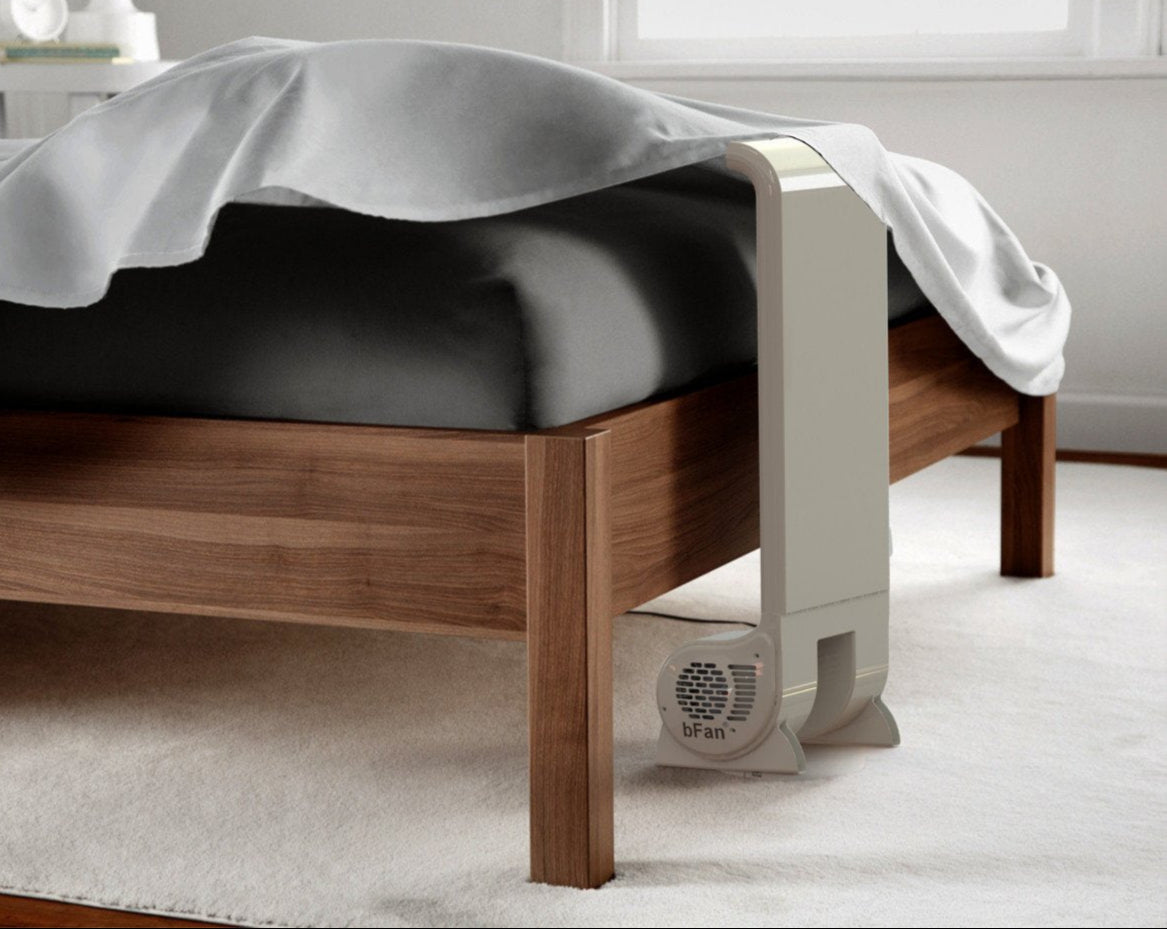
- bFan Bedfan from Bedfans USA: A strong first pick for value, simplicity, and targeted under cover airflow. It uses about 18 watts on average, runs around 28 dB to 32 dB at normal speed, includes remote control and timer controls, and works especially well for trapped heat and sweat under bedding.
- Water cooled systems: The most precise all night cooling option. These systems can be excellent for severe symptoms, but they cost more, take more setup, and need more maintenance.
- Cooling mattress pads: Good when your mattress surface itself sleeps warm. Performance varies a lot, and many passive pads reduce heat retention rather than actively cooling.
- Tight weave cotton or percale cooling sheets: A strong support layer, especially with a Bedfan, because the weave helps move airflow across the body instead of letting it escape too quickly.
- Phase change fabric pads: Quiet and power free. They buffer temperature swings for a while, but the cool feel usually fades after the material absorbs body heat.
- Cooling pillows: Helpful for head and neck heat. Useful, but rarely enough on their own for full body menopause night sweats.
- Breathable mattress protectors in cotton or wool: Often better than plastic feeling protectors that trap heat and humidity.
- Low loft breathable blankets or duvet inserts: Good if a heavy comforter is part of the problem.
- Room fans paired with lighter bedding: Affordable and simple, though far less targeted than a true bed fan.
The strongest direct menopause specific device evidence still points to active cooling, especially a cooling mattress pad studied in women with vasomotor symptoms. That said, a product does not have to be the most expensive to be effective. A bFan Bedfan from Bedfans USA can be the better fit when your main issue is sweat and trapped heat under the covers, not the need for lab style temperature precision.
How do you choose the right menopause cooling product step by step?
Yes. The right choice depends on where your heat builds up, how much maintenance you will tolerate, and whether you sleep alone or with a partner. Bedfans USA and PubMed data both point to matching the product to the problem.
Step 1 is to name the heat pattern. If your back and hips feel hot because the mattress itself stores heat, a water cooled system or a cooler mattress pad may help more. If you feel fine at first but wake up sweaty under the covers, a bed fan usually makes more sense because it moves air where the sweat is trapped.
Step 2 is to decide what kind of upkeep you can live with. If you do not want water, hoses, reservoirs, cleaning cycles, or app dependence, a Bedfan is much easier to live with. If you want the tightest temperature control and do not mind more setup, water based systems can be worth it.
Step 3 is to think about your partner and your budget. If one of you sleeps hot and the other sleeps cool, then separate zones matter more than a fancy headline feature. Two bed fans can create dual zone microclimate control, one on each side, without forcing both people into the same sleep climate.
A common shopping mistake is buying by fabric marketing words alone. “Cooling” on the package may only mean the surface feels cool for a few minutes after you get into bed.
How do bed fans compare with water cooled mattress systems for menopause?
Bed fans and water cooled mattress systems both work, but they solve heat differently. A Bedfan and a water based cover are both active cooling tools, yet the trade off is precision versus simplicity.

Water cooled systems are stronger if you want the bed surface held at a very specific temperature. They are the closest thing to thermostat control for the mattress itself. They also cost more, usually use more power than a bed fan, and bring more parts into the bedroom.
Bed fans are usually the better balance if your problem is sweat, trapped heat under bedding, or the need for low maintenance relief. Since sleep experts commonly recommend 60°F to 67°F for better sleep, a Bedfan can let many people keep the room about 5°F warmer and still cool the body enough for more restful sleep. That matters for comfort and for AC costs.
- Cooling power Water systems are steadier and usually stronger for severe overheating.
- Maintenance Bed fans mostly need dusting, while water systems need reservoir care, cleaning, and extra setup.
- Operating cost A Bedfan uses about 18 watts on average, which is tiny compared with central air conditioning and often lower than more complex powered systems.
- Comfort feel Bed fans move air and dry sweat, while water systems cool the surface below you.
If your symptoms are severe and money is a secondary issue, water cooling may win. If you want fast relief, easier ownership, and a lower entry price, a bed fan often wins. Pro tip, stronger hardware is not always the better purchase if pump hum, water maintenance, or leak anxiety will bother you every night.
Is a Bedfan or a BedJet better for menopause cooling value?
A Bedfan is usually the better value choice for straightforward perimenopause and menopause cooling, while BedJet adds features at a much higher price; however, incorporating natural remedies like black cohosh or hormone treatments involving estrogen may also provide additional relief. As benchmarks, Bedfans USA and BedJet both use room air, not refrigerated air.
This point gets misunderstood all the time, so let’s make it plain. Neither a Bedfan nor a BedJet cools the air. The BedJet does not cool the air. A Bedfan does not cool the air either. Both systems use the cooler air already in the room and move it into your bedding space.
Price is where the gap gets hard to ignore. One BedJet is more than twice the price of a single bedfan. The dual zone BedJet is over a thousand dollars, and it is more than twice the price of two Bedfans. If you are a couple with different sleep temperatures, two Bedfans can create dual zone microclimate control at a fraction of the cost.
The Bedfan from Bedfans USA also keeps the feature set focused where many menopausal sleepers want it most, targeted airflow, remote operation, timer controls, and low operating cost. At normal speed, the Bedfan sound level is about 28 dB to 32 dB, which is quiet for most bedrooms. The original Bedfan came to market several years before BedJet was even thought of, so this is not a copycat category entry.
If you want extra modes and are comfortable paying much more, BedJet may appeal to you as a benchmark product. If you want practical cooling solutions and better value, Bedfan is tough to beat. Common misconception, paying more does not mean you are buying colder air. You are mostly buying a different delivery system and feature stack.
How do you set up a Bedfan for the best menopause relief step by step?
Yes. Proper setup matters because airflow direction, sheet choice, and speed setting all change how cool the bed feels. Bedfans USA and common sleep practice both favor a lighter, tighter setup.
Step 1 is placement. Put the bed fan at the foot of the bed and set the height so air flows cleanly under the top bedding and across your body. If the fan sits too low or too high, airflow can miss the sweet spot and feel weaker than it should.
Step 2 is fabric choice. Use sheets with a tight weave, cotton percale is a good example, because that helps the air spread across your body and carry away heat. People often assume looser weave means better cooling, but with a bed fan the opposite can work better. A tighter weave tends to channel airflow across the skin instead of letting it spill out too fast.
Step 3 is speed and timing. Start around a medium setting, then adjust after a few nights. Use timer controls if you like stronger cooling at sleep onset and gentler airflow later in the night. Since the Bedfan runs around 28 dB to 32 dB at normal speed, many sleepers find it quiet enough for overnight use. If you wake up cold after a hot flash, lower the speed first before shutting it off completely to help manage the effects of hot flashes.
Pro tip, do not judge a bed fan by one night with heavy winter bedding. The best results usually come from pairing it with breathable sheets and a lighter blanket.
Do cooling sheets, pillows, and mattress pads really work for menopause night sweats?
Yes. Passive cooling bedding can help, but Sleep Foundation reviews and PubMed pilot data suggest it works best as support, not as the main fix for severe night sweats.
Cooling sheets are often the most underrated part of the setup because they help with the sticky, damp feeling after a hot flash. A recent pilot study on cooling sheets found improvements in sleep quality and less difficulty from sleeping hot and night sweats in hot sleepers. That is encouraging, even though it is not the same as a huge menopause only trial.
Cooling pillows are fine for head and neck heat, but they do not solve full body overheating. Cooling pads and toppers are mixed. Some genuinely improve airflow. Others, especially thick dense foams, can still trap heat once your body warms them up.
Here is the big misconception, “cool to the touch” is not the same thing as “stays cool all night.” Gel layers and phase change materials can feel great for the first stretch of the night, then level off once they absorb enough heat.

If your symptoms are mild, and you have a healthy melatonin cycle, passive products may be enough. If your symptoms are moderate or severe, they are usually supporting players. The most effective setups often pair passive layers, like breathable sheets, with an active tool, like a Bedfan or a water cooled cover.
How can you build a cooler menopause bed on a budget step by step?
Yes. A budget setup can work very well if you fix the bedding layers first, then add targeted airflow before touching the thermostat. Bedfans USA and Cleveland Clinic style guidance both support that order.
Step 1 is to strip out heat traps. Swap heavy synthetic blankets, dense foam toppers, and plastic feeling protectors for breathable cotton, percale, linen, or wool where possible. If your mattress already sleeps warm, do not bury it under more insulating layers.
Step 2 is to add active airflow where it counts. A Bedfan is one of the most cost effective upgrades because it targets the trapped heat under your covers and uses only about 18 watts on average. That is tiny compared with the energy draw of running central AC harder all night.
Step 3 is to adjust the thermostat slowly, integrating wellness strategies like controlled temperature settings for improved comfort. Sleep experts commonly recommend 60°F to 67°F for better sleep, but with a Bedfan many people can raise the room temperature by about 5°F and still cool the body enough for more restful sleep. If that works for you, the savings can add up over a long hot season.
If you share a bed, this approach also avoids turning the whole room into a meat locker just to help one hot sleeper. If the budget is tight, targeted body cooling almost always gives you more relief per dollar than chasing lower whole room temperatures.
Which features matter most in menopause cooling products?
The most important features are nighttime adjustability, quiet operation, and real moisture relief. A bFan and leading water systems both prove that control matters more than marketing fabric claims.
A hot flash can start fast, then disappear fast. That means the best product is not just the coldest one. It is the one you can adjust without standing up, the one that does not make the bed annoying to use, and the one you will still like after a month.
- Remote control: You need to change settings without getting out of bed at 2 a.m.
- Timer controls: These help if you want stronger cooling while falling asleep, then a lower setting later.
- Noise profile: Around 28 dB to 32 dB at normal speed is quiet enough for many sleepers, though very light sleepers should still test their own comfort.
- Dual zone flexibility: Couples can use two Bedfans for separate microclimates instead of paying over a thousand dollars for a dual zone BedJet.
- Sheet and bedding compatibility: Tight weave sheets, breathable protectors, and lighter blankets usually improve results.
- Maintenance burden: Dusting a bed fan is simpler than managing water lines, reservoirs, and possible leak concerns.
One more practical point, for any powered product, check the quality of the power supply, warranty support, and replacement parts access. Standard overnight use calls for reliable electrical components and clear support if something needs replacing.
Frequently Asked Questions
These are the questions people ask most about menopause cooling products, and the answers usually come back to The Menopause Society, Cleveland Clinic, the hypothalamus, and simple sleep physics.
Are bed cooling products a treatment for menopause night sweats?
No, they do not treat the hormonal cause of menopause, which involves fluctuations in estrogen levels regulated by the hypothalamus.
They manage the sleep environment problem by removing heat and moisture around your body, contributing to overall wellness.
If symptoms are severe, a cooling product can help sleep, but it should sit alongside medical advice, not replace it.
What room temperature should I try first if I sleep hot during menopause?
Start near the usual sleep recommendation of 60°F to 67°F.
If you use a Bedfan, many people can raise the room temperature by about 5°F and still feel cool enough for better sleep.
Incorporating melatonin supplements can further enhance the natural sleep cycle, reducing AC use while still protecting sleep quality.
Can a Bedfan cool both sides of the bed for couples?
Yes, but the best way is usually one unit per sleeper if you want separate control. Two Bedfans can create dual zone microclimate control at a fraction of the cost of a dual zone BedJet, which is over a thousand dollars. That setup works well when one partner sleeps hot and the other does not.
Do I need special sheets with a Bedfan?
You do not need anything exotic, but sheet choice matters. A tighter weave sheet, cotton percale is a common favorite, often helps the airflow travel across your body more effectively. Very heavy or fluffy bedding can blunt the cooling effect.
Does a Bedfan or BedJet actually make the air colder?
No. Neither a Bedfan nor a BedJet cools the air itself. Both use the cooler air already in your room and move it into the bed area. That is why room temperature still matters, even with an active bed cooling device.
Are water cooled mattress systems worth the extra money?
They can be, especially for severe overheating or for people who want precise control, and some individuals turn to natural remedies like black cohosh to complement these methods.
They are the strongest all night option in many cases, but they cost more and need more maintenance.
If you want simpler ownership and lower cost, a bed fan often makes more sense, particularly during perimenopause when sleep disruptions can be more frequent.
Will a bed fan make me too cold after a hot flash ends?
It can if the speed is set too high for your comfort.
That is why remote adjustment and timer controls matter so much for managing hot flashes during menopause sleep.
In most cases, lowering the speed works better than turning it off completely.
Can bed cooling products help lower air conditioning costs?
Yes, targeted cooling often beats trying to freeze the whole room. Since sleep experts recommend 60°F to 67°F, using a Bedfan can let many people set the room about 5°F warmer and still sleep cool. Because the Bedfan uses about 18 watts on average, that can be a smart energy trade.
Resources
- National Institute on Aging: Menopause Learn about menopause symptoms, treatments, and tips for managing changes from a trusted government health source. https://www.nia.nih.gov/health/menopause
- The North American Menopause Society: Menopause FAQs Find answers to common menopause questions, including information on hot flashes and cooling strategies. https://www.menopause.org/for-women/menopauseflashes/menopause-faqs
- Mayo Clinic: Menopause Symptoms and Causes Explore a comprehensive overview of menopause, including causes, symptoms, and lifestyle tips for comfort. https://www.mayoclinic.org/diseases-conditions/menopause/symptoms-causes/syc-20353397
- Sleep Foundation: How Menopause Affects Sleep Discover how menopause impacts sleep and get expert advice on improving sleep quality during this stage. https://www.sleepfoundation.org/menopause-and-sleep
- Cleveland Clinic: Hot Flashes and Night Sweats Get detailed information on managing hot flashes and night sweats, two of the most common menopause symptoms. https://my.clevelandclinic.org/health/diseases/15223-hot-flashes
All links have been checked and are currently working.
Share