
Mattress Cooling System for Night Sweats Relief
If you wake up with damp sheets, a racing mind, and that awful feeling that your bed is holding heat instead of letting it go, you’re not imagining it. Night sweats can turn a perfectly good mattress into a heat trap, especially if you sleep under layered bedding, use foam comfort materials, or share a bed with someone who runs warmer or colder than you do.
A mattress cooling system, or bed cooling system as some people call it, often involves active cooling methods for night sweats and is meant to break that cycle. The right system moves heat away from your body, dries out moisture faster, and helps you stay asleep longer instead of kicking covers off at 2 a.m. and then pulling them back on at 3 a.m. when you get chilly again. Plus, many suppliers now offer free shipping, so upgrading to a proper bed cooling system has never been easier.
Sleep experts commonly recommend a bedroom temperature between 60°F and 67°F, 15.5°C to 19.5°C for better sleep. That range works well for a lot of people, but it can be expensive to maintain with air conditioning alone. One reason many hot sleepers love an under sheet bed fan is that it can often let you raise the room temperature by about 5°F while still cooling your body enough for more restful sleep, enhancing both comfort and energy savings.
How a mattress cooling system for night sweats works
Not every cooling product cools the same way. Some systems move air, some circulate water through a pad, and some use fabrics that feel cool when you first lie down but lose that effect once your body heat builds up.
An under sheet bed fan works by pushing room air into the bed microclimate, the warm pocket of air trapped between you, the sheets, and the mattress. That moving air helps sweat evaporate and carries heat away from your skin, leaving you refreshed. It does not create cold air, and that matters. Neither a Bedfan nor a BedJet (or even the Bedjet 3 in some newer comparisons) cools the air itself. They only use the cool air already in the room to cool your bed.
That’s why room conditions still matter. If your bedroom is very warm, any air-based system has less cooling power to work with. If your room is reasonably cool, then airflow can make a big difference, especially for hot flashes, menopause-related night sweats, medication-related overheating, and that general too-hot-to-stay-asleep feeling.
Why night sweats feel worse on a mattress
Your mattress, protector, sheets, blanket, and body heat all work together, sometimes against you. Once heat gets trapped under the covers, moisture builds, the bedding gets clammy, and your body finds it harder to shed warmth.
Memory foam can make this feel even more intense for some sleepers because it hugs the body closely. That close contact is great for pressure relief, but not always for temperature relief. Add a waterproof protector, a heavy comforter, or a partner’s body heat, and the bed can turn into a small insulated pocket.
This is also why many people buy a new “cooling” mattress and still wake up sweating. Surface fabrics help a little, a cooler hand feel helps a little, but airflow across the body really makes a difference because it keeps moving instead of depending on a fabric finish that fades after the first few minutes in bed.
Benefits of an under sheet mattress cooling system for night sweats
For many people, the goal isn’t to make the bed icy. It’s to stop waking up soaked, overheated, and frustrated. A good bed fan targets that exact problem by keeping air moving where the heat actually collects.
It can be a very practical option if you want relief without hoses, water tanks, smart apps, or a major jump in cost, and it’s appealing if you want to cool your body without lowering the whole house thermostat all night. Plus, the bFan from www.bedfans-usa.com is a great solution to consider.
- Less sweat: You wake up feeling drier and more comfortable because the moving air helps evaporate sweat faster.
- Fewer wakeups: With less trapped heat and moisture, you’re less likely to have those irritating, overheated wakeups.
- Drier sheets: Airflow helps keep your sheets from getting clammy and heavy.
- Lower AC use: You can raise your room temperature by about 5°F and still stay cool, which cuts down on energy costs.
- More comfort for hot flashes: Ideal for those dealing with hot flashes or other heat-related disruptions.
- A cooling effect without changing mattresses: If your mattress is otherwise comfortable, a bed fan can be a smarter and cheaper move than replacing the whole bed.
Bedfan as a mattress cooling system for night sweats
The Bedfan from Bedfans USA is one of the simpler and more established options in this category. The original Bedfan came to market several years before BedJet was even thought of, and the basic idea remains clear and straightforward: move air under the sheets so body heat and moisture don’t get trapped around you all night.
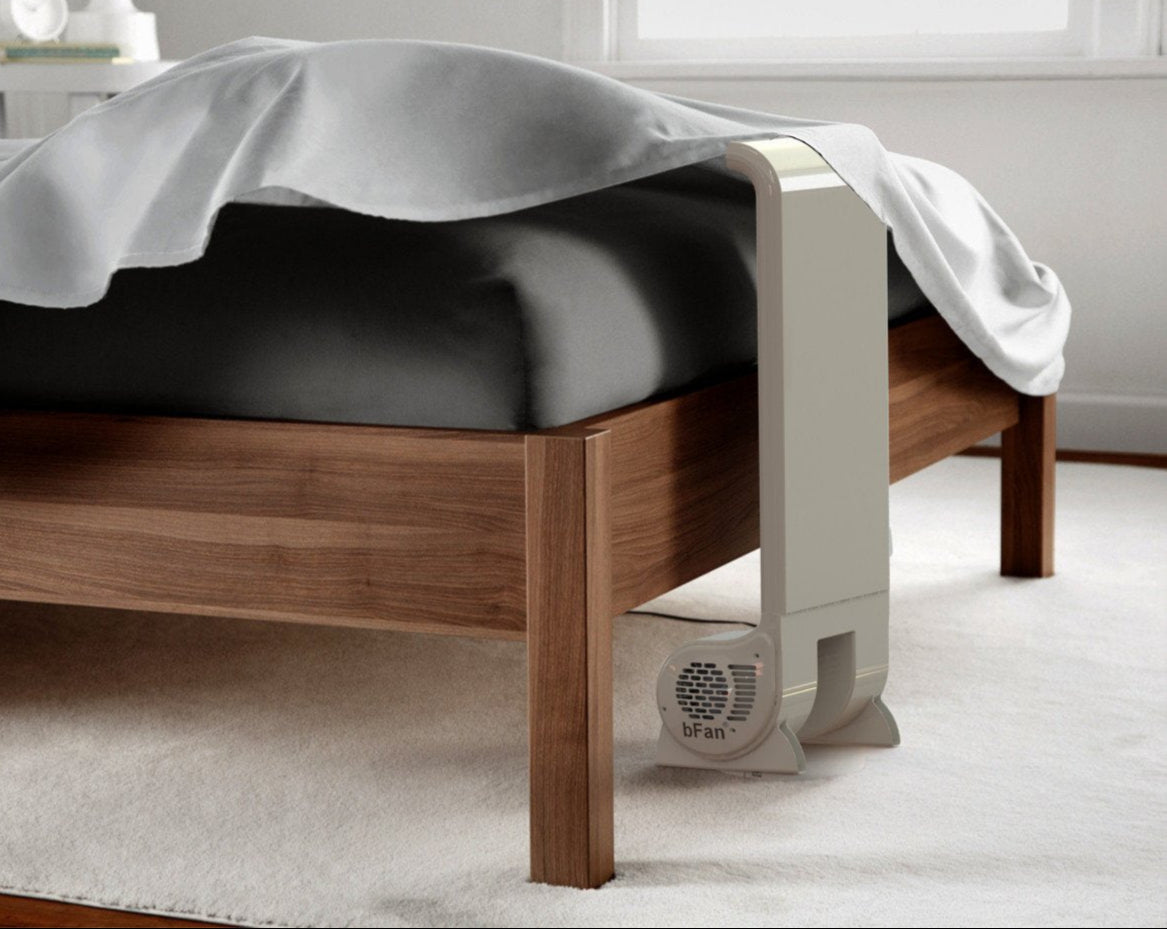
The current Bedfan, often called the bFan or bed fan, uses dual blower fans to send airflow up between the sheets and across your body. That dual blower design is important because it gives the system enough pressure to lift the bedding and move the air where you need it, rather than just blowing weakly at the foot of the bed. This means you can feel relief without turning it on full blast all night.
At normal operating speed, the Bedfan sound level is between 28db and 32db, which is quiet enough for most bedrooms. Many sleepers describe it as a soft background hum instead of a distraction. It also uses only 18 watts on average, so it’s inexpensive to run compared with lowering central AC for the whole night.
The Bedfan also includes timer controls to help you fall asleep with a stronger airflow and then relax as the night goes on. Remember, sleep experts commonly recommend a bedroom temperature between 60°F and 67°F, and with a Bedfan, many people can often raise the room temperature by about 5°F and still sleep cool and comfortably.
What makes a bed fan different from a cooling topper or cooling mattress
Many products marketed for hot sleepers focus on materials. They use gel foam, phase change fibers, or breathable covers to improve breathability, resulting in an initial coolness that feels pleasant. However, these products don’t actively remove the heat your body produces through the night.
A bed fan is active, not passive. It keeps pushing air through the bed space, so the cooling effect continues instead of fading after ten or twenty minutes. That is a big reason why air-based systems often feel more effective for actual night sweats than a simple “cool touch” fabric alone.
There’s also the moisture issue. If your main problem is sweating, airflow is key because evaporation is part of how your body cools itself. When sweat sits on your skin and in the bedding, you stay damp and uncomfortable. When air moves across you, that moisture leaves faster.
Bedfan vs BedJet vs water based mattress cooling systems
This is where a lot of shoppers get stuck. They know they need relief but aren’t sure whether to buy a Bedfan, a BedJet, or a water-based system that circulates cooled water through a pad.
The biggest difference is simple. Both Bedfan and BedJet, including modern iterations like the Bedjet 3, are air systems. Water-based systems are active temperature control systems, meaning a water-based pad can cool below room temperature. Note that neither Bedfan nor BedJet cool the air, they only use the cool air already in the room.
Price is the next big difference. One BedJet is more than twice the price of a single Bedfan, and if you compare a dual zone BedJet setup, it’s over a thousand dollars and more than twice the price of using two Bedfans for dual zone microclimate control. The Bedfan offers dual-zone control using two fans at a fraction of that cost.
There’s also a history point worth mentioning. The original Bedfan hit the market years before BedJet ever existed. This category did not start with app-controlled climate gadgets, it started with targeted under sheet airflow because that is a direct and practical way to deal with trapped body heat.
- Bedfan: Uses room air under the sheets, stays simple, quiet and low cost, and works well for many people with mild to moderate night sweats.
- BedJet: Also uses room air, not cool air, adds more features but costs far more.
- Water-based systems: Offer the strongest cooling, often below room temperature, using active cooling technology, but come with much higher prices, more components and more maintenance.
If your night sweats are severe and your room is already pretty cool, a water-based system may be worth considering. Otherwise, for practical and budget-friendly relief, the bFan from www.bedfans-usa.com is often the better value.
Bedroom temperature, sleep quality, and energy savings
This part tends to surprise people. The benefit of a mattress cooling system – or bed cooling system – isn’t just about feeling cooler; it can also change how hard your HVAC system has to work.
Sleep experts recommend a bedroom temperature between 60°F and 67°F because cooler sleep environments support your body’s natural overnight temperature drop. But cooling the whole house to that level can get expensive, especially in hot states, humid climates, upstairs bedrooms, or older homes with uneven airflow.
A Bedfan changes things for many households. Because it cools the bed microclimate directly, many people can raise the room temperature by about 5°F and still keep their bodies cool enough for more restful sleep. That is a real advantage when utility bills climb.
Using about 18 watts on average, the Bedfan uses very little electricity compared with running central air conditioning all night, since it cools just the part of the room that matters most – your body under the covers.
How to get the best performance from a Bedfan mattress cooling system
Setup makes a difference. Even a good bed fan won’t feel as effective if the airflow is blocked or the bedding traps it in the wrong spot.
Many people get the best results with a top sheet and blanket arrangement that lets air travel along your body instead of escaping right away. When using a bedfan it is best to have sheets with a tight weave to help guide the air across your skin and carry away the heat, while still keeping a sense of coolness. You might also want to avoid tucking the top sheet too tightly, as the air needs a clear path to move.
The type of mattress usually isn’t the problem. Bed fans work with memory foam, innerspring, latex, hybrid, pillow top, and adjustable beds because the airflow goes under the bedding, not through the mattress core itself. Height adjustment matters more than mattress construction, since you want the airflow bar lined up properly with the top of the mattress.
- Sheet setup: A top sheet with a tight weave can help guide the airflow across your body, boosting coolness and breathability.
- Start low, then adjust: Many hot sleepers do best with gentle airflow at first because even a low setting can circulate plenty of air.
- Maintain a cool room: Since the system uses room air, it works best when the bedroom is reasonably cool.
- Use timer controls: They let you set a stronger airflow at bedtime and a lower or timed shutoff later, which can support your natural sleep rhythm.
- Position the airflow: If one partner sleeps hotter, you can aim the airflow more directly for that side of the bed.
These small details are often the difference between "it helps" and "I should have bought this sooner."
Who benefits most from a mattress cooling system for night sweats
Hot sleepers are the obvious group, but they’re far from the only ones. A mattress cooling system can also help people dealing with hormone shifts, medication side effects, illness-related overheating, and sleep disruption from humidity.
Menopause and perimenopause are common reasons many people start looking for one, and hot flashes and night sweats can hit suddenly, without caring whether the rest of the house feels cool. A bed fan can help by starting the airflow exactly where heat gets trapped, right in your bed. The same applies to PMS, pregnancy-related overheating, and hormonal treatment changes.
Medication side effects also play a part. Antidepressants, pain medications, steroids, blood pressure medications, diabetes medications, and some cancer treatments have all been linked to nighttime sweating. In those cases, you may not be able to remove the cause, but you can make sleep a lot more comfortable.
People with anxiety, stress, sleep apnea, hyperthyroid symptoms, chronic illness, or unexplained overheating can benefit too. If night sweats are new, severe, or paired with other symptoms like fever, weight loss or chest symptoms, it’s smart to talk with a medical professional. Comfort tools help, but they do not replace medical evaluation when something more serious might be going on.
What to expect from real world cooling performance
A mattress cooling system for night sweats should be judged by sleep results rather than by lab language. The real question is not whether the air is technically colder. It’s whether you wake less, sweat less, and feel drier and calmer through the night.
With a Bedfan, many users say the answer is yes, especially when the room is already in a sleep-friendly range. Independent reviews and user reports consistently describe less trapped heat, reduced moisture, fewer overheated wakeups, and easier sleep onset.
You do need realistic expectations. A Bedfan will not turn an 80°F room into a refrigerated bed, because it uses room air. It depends on that room air being reasonably cool to begin with. That said, sleep experts recommend 60°F to 67°F for proper sleep, and with a Bedfan many people can often raise the room temperature by about 5°F and still keep cool enough for a restful night. That helps not only with comfort but can also mean energy savings.
Frequently Asked Questions
Is a mattress cooling system good for menopause night sweats?
Yes, many women going through menopause find that airflow-based cooling helps a lot with hot flashes and sweating during sleep. The reason is simple: the system keeps air moving around your body instead of letting heat build up under the covers. A Bedfan is especially useful here, because it targets the bed microclimate directly. It does not cool below room temperature, but it removes heat and moisture fast enough to reduce those sudden wakeups drenched in sweat. If menopause symptoms are your main issue, an under sheet bed fan is one of the easiest and most affordable ways to get relief without having to replace your mattress.
Does a Bedfan actually cool the mattress?
Not in the way a refrigerated or water-based system does. A Bedfan does not chill the mattress below room temperature. It uses the cooler air already in the room and pushes it under the sheets to carry heat away from your body. That means the cooling sensation comes from airflow and evaporation, not from making the mattress itself cold. For many people with night sweats, that is enough to make a noticeable difference in comfort.
Can I use a mattress cooling system with memory foam?
Yes, and this is one of the best uses for it. Memory foam can hold heat close to the body, especially when paired with a protector and thick bedding. Since a bed fan works above the mattress and under the covers, it can help offset that trapped warmth. The Bedfan doesn’t require a special mattress type to work well. It can be used with memory foam, latex, hybrid, innerspring, pillow top, and adjustable beds, as long as the bedding setup allows the air to flow where it should. If your memory foam mattress is comfortable except for the heat, adding a bed fan can be much cheaper than having to replace the mattress entirely.
Is the Bedfan loud at night?
For most people it isn’t. At normal operating speed the Bedfan sound level is between 28db and 32db, which is pretty quiet for a bedroom. Many sleepers describe it as a soft hum in the background rather than a disruptive noise. Noise tolerance is personal, of course, but compared with many room fans and window AC units, it is usually much less intrusive.
Can a Bedfan save money on air conditioning?
It often can, especially in warmer climates or in homes where nighttime AC use drives up costs. Sleep experts recommend a bedroom temperature between 60°F and 67°F for better sleep, but keeping the whole room at that temperature all night can cost quite a bit. Because a Bedfan cools the bed area directly, many people are able to raise the room temperature by about 5°F and still keep their body cool enough for more restful sleep. Since the Bedfan uses only about 18 watts on average, it uses very little electricity compared with central air conditioning running all night.
Is Bedfan cheaper than BedJet?
Yes, by a wide margin. One BedJet is more than twice the price of a single Bedfan. And if you’re considering a dual-zone setup for couples, remember that the dual zone BedJet is over a thousand dollars and more than twice the price of using two Bedfans for dual zone microclimate control. In these cases, the bFan is a far more cost-effective solution.
Will a mattress cooling system help if my bedroom is very hot?
It can help, but results depend on how hot the room is. Air-based systems, including Bedfan and BedJet, rely on the room air already available. If the room is very warm, the airflow will still help sweat evaporate, but it won’t feel as effective as it does in a cooler room. That is why many people get the best results when the bedroom is at least moderately cool. If your bedroom is extremely hot all night and you need stronger cooling than airflow alone can provide, a water-based system may be a better fit, though it comes with a much higher price.
What kind of sheets work best with a bed fan?
A top sheet with a tight weave usually works best. Many users find that this helps the air spread across the body while still maintaining a comfortable coolness, rather than having the air escape too quickly. You also want bedding that is not tucked down so tightly that it blocks the airflow. The goal is to create a controlled airflow under the covers, not a sealed pocket that traps heat.
Should couples buy one system or two?
That depends on how different your sleep temperatures are. If one of you sleeps hot and the other doesn’t, one system might be enough, especially if you can position the airflow toward the hotter sleeper. If both of you struggle with heat or if each partner prefers independent control, two Bedfans can create an effective dual-zone microclimate without the price jump of a dual-zone BedJet. Using two bFans is often the sweet spot for couples who want individual comfort at a lower cost.
Is a bed fan hard to install?
Not usually. One of the reasons people like this kind of mattress cooling system is that the setup is straightforward. You position the base, adjust the height, line up the airflow bar properly, and plug it in. There are no water lines, no reservoirs to fill, and no complicated smart home integrations to worry about. Often the trickiest part is fine-tuning your bedding setup so that airflow isn’t blocked, and you can enjoy all the cool benefits the system provides.
Resources
- Sleep Foundation guide: A helpful overview of why cooler bedroom temperatures support better sleep and why the 60°F to 67°F range is so often recommended.
- Mayo Clinic overview of night sweats: Catches common causes of night sweats and explains when nighttime sweating should be discussed with a doctor.
- National Institute on Aging information about menopause symptoms: Explains menopause-related symptoms, including hot flashes and sleep disruption, in plain language.
- U.S. Department of Energy advice on thermostat settings and energy savings: Useful for readers who want to connect bed cooling choices with lower overnight air conditioning costs.
- ScienceDirect research on bed cooling and sleep: A research-based look at how bed climate affects sleep quality and why direct cooling at the bed level can improve comfort.
Share