
How Sleep Temperature Affects Deep Sleep
If you’ve ever gone to bed exhausted, then spent half the night flipping the pillow, kicking off the covers, and waking up sweaty, you already know the basic truth, sleep and temperature are tied together.
What’s easy to miss is how tightly temperature affects your deepest sleep, not just whether you feel comfortable. Deep sleep, often called N3 or slow wave sleep, is the most physically restorative part of the night. It’s when your body leans hardest into repair, immune support, tissue recovery, and memory processing. When your sleep temperature is off, deep sleep is usually one of the first things to get pushed around.
A lot of people think this is just a comfort issue. It isn’t. Your body is built to cool down before and during sleep, and that drop helps open the door to deeper, more stable rest.
Sleep temperature and deep sleep stages
Your body doesn’t fall asleep at a random temperature. In the evening, your core temperature starts to drop. That cooling pattern is part of the normal signal that it’s time to sleep. Research has shown that sleep onset usually happens while core body temperature is falling, and deep non REM sleep tends to track with further cooling.
That matters because deep sleep is not just “more sleep.” It’s a distinct stage with different brain activity, different autonomic balance, and a different job. If your room is too warm, or your bed traps too much heat, your body has to work against the environment instead of slipping into that normal cooling rhythm.
Sleep experts commonly recommend a bedroom temperature between 60°F and 67°F, 15.5°C to 19.5°C, for better sleep. That range gives your body a chance to shed heat and settle into deeper sleep more easily. A Bedfan can help many people raise the room temperature by about 5°F while still cooling the body enough for more restful sleep, which is a big deal if your air conditioning bill keeps climbing or your partner hates a freezing room.
Researchers have also found something interesting here. You do not want to be cold in a miserable way. You want your core to cool while your sleep environment still feels secure and comfortable. That’s why the bed microclimate matters so much. Your body likes a cool room, but it also likes balanced warmth at the skin level, especially at the hands and feet, to help move heat away from the core.
That combination, cool body center, effective heat release, stable bedding, is where better deep sleep tends to happen.
Bedroom temperature, overheating, and sleep fragmentation
When a room is too warm, sleep usually gets lighter and more broken. People wake up more often. They toss around more. They spend less time in the restorative part of the night. In studies of hot sleeping environments, especially with bedding involved, heat exposure has been linked with more wakefulness and less deep sleep.
That lines up with real life. A hot room does not just make you uncomfortable, it makes your body hang on to heat that it’s trying to lose. If that heat is trapped under blankets and sheets, your brain never gets the full “all clear” signal it wants for deeper sleep.
Too much cold can be disruptive too, especially if it causes tension, shivering, or cardiovascular stress. Still, in normal home settings, excess heat is the more common problem, especially for hot sleepers, women dealing with menopause, people taking medications that trigger night sweats, and couples with totally different comfort zones.
A few common clues show that sleep temperature is getting in the way:
- Falling asleep tired, then waking hot
- Sweaty chest, neck, or legs under the covers
- Kicking the sheets off, then pulling them back on
- Waking around 2 a.m. to 4 a.m. feeling overheated
- Feeling like your room is fine, but your bed is not
That last one is important. Many people do not actually need the entire room to feel icy. They need the heat trapped around the body to move out from under the covers.
Why the bed microclimate matters more than people think
The air in your room is only part of the picture. What really affects sleep is the little climate your body creates under the sheets. Once you get into bed, your body starts warming that enclosed space. If the air stays trapped and humid, heat builds. If the bedding lets heat move away, you tend to sleep more evenly.
That’s why two people can sleep in the same room and have very different nights. One person may sleep fine. The other may feel like the bed turns into an oven by midnight.
This is also why generic advice like “set the thermostat lower” only goes so far. Yes, room temperature matters. Still, the bed microclimate can stay too warm even when the room itself is within a decent range.
Sleep experts commonly recommend a bedroom temperature between 60°F and 67°F, 15.5°C to 19.5°C, for better sleep. Yet many people can keep the room about 5°F warmer and still sleep comfortably if a Bedfan is moving room air under the sheets and carrying heat away from the body. That’s a practical way to support deep sleep without turning the whole house into a walk in refrigerator.
Bed fan cooling and sleep temperature control
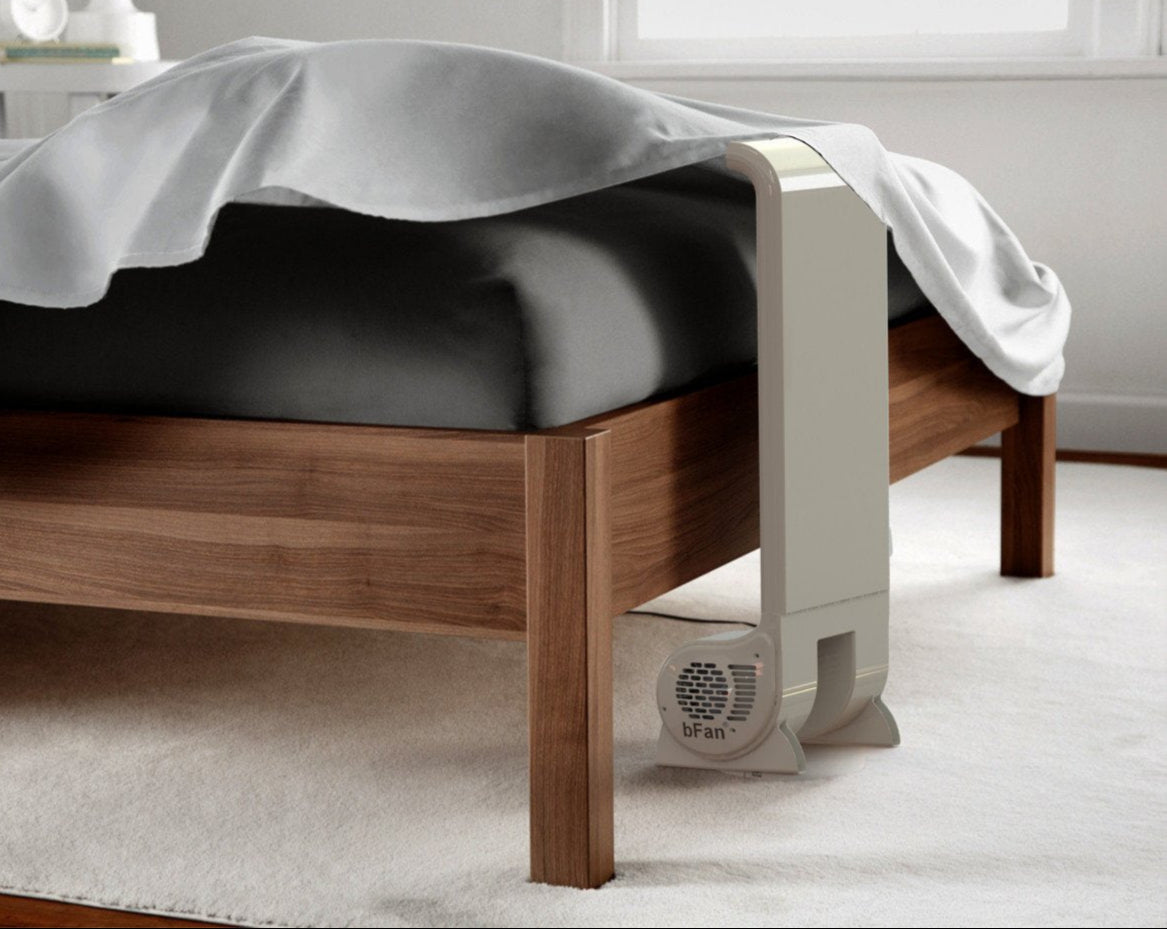
A bed fan works by pushing room air into the bed space, usually under the top sheet, so body heat doesn’t stay trapped around you. It does not refrigerate the air. It does not create cold air out of nowhere. It uses the cooler air already in the room and moves it where it matters most.
That point is worth being clear about, because it comes up in search results all the time. Neither the Bedfan nor the Bedjet cool the air itself. They only use the cool air in the room to cool your bed.
For hot sleepers, that simple difference can be enough to change the whole night. Instead of letting heat pool under the covers, a bed fan helps strip that heat away from the skin and keeps the bed microclimate drier and less stuffy.
The The bFan, often called a Bedfan or bed fan, is one of the long standing products in this category. The original Bedfan came to market several years before Bedjet was even thought of, and the basic idea still makes sense because the problem has not changed, people overheat in bed, not just in the room.
A few practical reasons bed fans help with deep sleep:
- Targeted cooling: Air goes where your body is holding heat, under the covers, not across the entire bedroom.
- Lower thermal load: Less trapped heat means less tossing, fewer wakeups, and a better shot at staying in deep sleep.
- Energy savings: A Bedfan often lets people raise the thermostat by about 5°F and still sleep cool, which can cut air conditioning costs.
- Gentle sound: The Bedfan sound level is about 28db to 32db at normal operating speed, quiet enough for many sleepers, and some people even like the soft white noise.
If you want a straightforward fix, the Bedfan from Bedfans USA, at www.bedfans-usa.com, is a practical option to look at, especially if overheating is happening inside the bed and not just in the room.
Bedfan benefits for night sweats, menopause, and hot sleepers
This is where sleep temperature turns from a nice to have into a real quality of life issue.
Night sweats are common during menopause and perimenopause, but they also show up with medications, thyroid issues, anxiety, infections, diabetes related lows, hormone shifts, and a long list of other causes. Even when the underlying reason needs medical care, your sleep still needs help tonight.
For many people with night sweats, the problem is not simply a warm room. It’s sudden bursts of heat under the covers, followed by damp sheets, a racing heart, and fragmented sleep. A bed fan helps by moving air across the body and reducing that trapped heat before it builds into a full wakeup.
Sleep experts commonly recommend a bedroom temperature between 60°F and 67°F, 15.5°C to 19.5°C, for better sleep. People dealing with hot flashes or night sweats often find that a Bedfan lets them keep the room a bit warmer, often about 5°F warmer, while still getting enough body cooling to fall back asleep faster and stay drier.
This is also one reason couples like bed level cooling. One partner may want the room cold, the other may hate that. Cooling the bed space instead of the whole room can be the middle ground.
Bedfan vs air conditioning and Bedjet pricing
Air conditioning is still the strongest whole room cooling tool, no question. If your house is roasting, you may need it. Still, air conditioning cools the whole space, which can cost a lot, dry the air, and create thermostat battles in shared bedrooms.
A Bedfan takes a different approach. It uses only about 18 watts on average, and it focuses on your sleep microclimate rather than the whole room. That is a tiny fraction of what central AC uses. If you can raise your room temperature by about 5°F and still sleep cool, the savings can add up over a summer.
There’s also the product comparison people search all the time, Bedfan vs Bedjet. Here are the plain facts. Neither Bedfan nor Bedjet cool the air. They only use the cooler air already in the room. So the choice is not about who has “real air conditioning” in bed, because neither one does.
Price is where the gap gets hard to ignore.
- Single unit cost: One Bedjet is more than twice the price of a single Bedfan.
- Dual zone cost: The dual zone Bedjet is over a thousand dollars, and it is more than twice the price of two Bedfans.
- Dual zone control: The Bedfan offers dual zone microclimate control using two fans, at a fraction of the dual zone Bedjet cost.
- Timer controls: The Bedfan offers timer controls, which can help you start cooler at bedtime and then taper off as your body settles into sleep.
If you are weighing cost against function, that matters. If what you need is cooler, drier sleep using room air under the sheets, the bFan from www.bedfans-usa.com is often the simpler and more budget friendly path.
Research on cooling interventions and deep sleep quality
The science around sleep temperature has gotten stronger over the last few years. Researchers studying mattress cooling, skin warming, and room heat have found a pretty consistent pattern, temperature changes can shift sleep architecture.
One 2024 study found that enhanced body cooling during sleep increased slow wave sleep time by about 7.5 minutes on average, a meaningful bump in deep sleep. Another one week home trial using a temperature controlled mattress cover found that cooler sleep conditions increased deep sleep in men early in the night and improved cardiovascular recovery markers overall.
Older research has shown something just as useful. Mild skin warming before sleep can help people fall asleep faster, especially older adults and people with insomnia, because it supports the body’s normal heat release pattern. Once asleep, though, trapped heat becomes the problem. So the winning setup is not “be cold” or “be warm.” It’s more like this, help the body unload heat at the right time and keep the sleep environment steady.
That’s exactly why bed fans can make sense even though they’re simpler than active cooling mattresses. They improve convective heat loss. They reduce the muggy feeling under the sheets. They help stop heat from pooling around your body, which is often enough to protect deep sleep from getting chopped up by repeated wakeups.
They are not the answer to every heat problem. In very hot, very humid rooms, a bed fan has limits because it still depends on room air. Still, for a lot of people in normal home conditions, it solves the actual issue more directly than lowering the thermostat another few degrees.
Sleep temperature differences for age, hormones, and shared beds
Not everyone has the same ideal sleep temperature. That’s one reason generic advice can feel off.
Older adults often have different thermoregulation patterns and may be more sensitive to heat buildup. Women often report different comfort needs than men, and hormonal changes can shift those needs fast. Menopause is the obvious example, but pregnancy, PMS, PMDD, thyroid changes, and hormone therapy can all change how warm a person feels at night.
Then there are medications. Antidepressants, steroids, some pain medications, diabetes medications, blood pressure drugs, and cancer treatments can all increase sweating or change heat tolerance. If that sounds familiar, you are not imagining it.
Shared beds add another layer. One person may want a cold room, the other may wake up with frozen feet. A bed fan setup can be more flexible because you can cool one side or use two fans for dual zone microclimate control without forcing both sleepers into the same setting.
How to set up a bed fan for better deep sleep
The setup matters. A bed fan can work well, but a few small details make a real difference.
The biggest one is airflow path. You want the air to move under the covers and across the body, not just blast your face or pile into one spot at the foot of the bed. Sheet choice matters too. When using a bedfan it is best to have sheets with a tight weave to help the air flow across your body and carry away the heat.
A simple setup checklist helps:
- Room temperature: Keep the bedroom in or near the usual recommended zone, 60°F to 67°F if you can, or somewhat warmer if your Bedfan is cooling your body well.
- Fan timing: Use stronger airflow at the start of the night, then use timer controls if you prefer less airflow later.
- Sheet choice: Tight weave sheets usually guide airflow across the body better than loose, heavy, heat trapping bedding.
- Noise comfort: Most people do fine with 28db to 32db at normal speed, still, test a few settings and see what feels best.
- Cleanliness: Keep the fan and the sleep area clean, especially if dust or allergies are an issue.
One more practical tip, if you wake up sweaty, don’t only think about the thermostat. Think about trapped bed heat. That’s often the bigger problem.
Frequently Asked Questions
What is the best sleep temperature for deep sleep?
Sleep experts commonly recommend a bedroom temperature between 60°F and 67°F, 15.5°C to 19.5°C, for better sleep. That range supports the normal drop in core body temperature that helps you fall asleep and stay in deep sleep.
The exact sweet spot still varies from person to person. If you sleep hot, you may need the bed microclimate to feel cooler than the room alone can provide.
Can a warmer room still work if I use a Bedfan?
Yes, for many people it can. A Bedfan can often let you raise the room temperature by about 5°F while still cooling the body enough for more restful sleep.
That’s because the bed fan is not trying to chill the whole house. It moves room air under the sheets and carries body heat away where it actually builds up.
Does a Bedfan actually cool the air?
No. Neither a Bedfan nor a Bedjet cools the air itself. They only use the cool air already in the room and direct it into the bed space.
That distinction matters. If the room is extremely hot, a bed fan has less cooling power to work with, because it is still using room air rather than making cold air.
Is a bed fan good for menopause night sweats?
For many women, yes. Menopause night sweats often start as a sudden rush of body heat under the covers, and a bed fan helps move that trapped heat away before it builds into a full wakeup.
It does not treat the underlying hormone shift. Still, it can make the night more manageable and help you get back to sleep faster and drier.
Is Bedfan quieter than a regular bedroom fan?
A Bedfan is designed for bed use, and the stated sound level is about 28db to 32db at normal operating speed. That’s quiet enough for many sleepers, and some people find the light white noise soothing.
Comfort with sound is personal, though. If you are very noise sensitive, try a moderate setting first and keep the airflow focused under the sheets instead of turning it up more than you need.
Does a Bedfan save money compared with air conditioning?
It often can. The Bedfan uses only about 18 watts on average, which is tiny compared with whole home air conditioning.
If the Bedfan lets you raise your bedroom temperature by about 5°F and still sleep cool, that can reduce overnight cooling costs while keeping your body comfortable enough for better sleep.
How does Bedfan compare with Bedjet?
The biggest differences are price and approach. Neither product cools the air, both use the cooler air already in the room, but the Bedjet costs much more.
One Bedjet is more than twice the price of a single Bedfan. The dual zone Bedjet is over a thousand dollars, and more than twice the price of two Bedfans, while two Bedfans can provide dual zone microclimate control at a fraction of that cost.
What bedding works best with a bed fan?
Sheets with a tight weave tend to work best. They help the air move across your body and carry heat away more effectively instead of letting airflow escape too quickly.
Very heavy, heat trapping bedding can reduce the benefit. You want enough cover for comfort, but not so much insulation that the airflow never reaches the warm areas.
Can a bed fan help couples with different sleep temperatures?
Yes, and this is one of the better use cases. Couples often fight over the thermostat because one person sleeps hot and the other doesn’t.
Using two bed fans can create dual zone microclimate control, so each person gets a different airflow experience without forcing the entire room into one temperature.
Resources
Sleep Foundation guide to the best bedroom temperature for sleep A clear overview of the room temperature range most sleep experts recommend.
Frontiers review on the temperature dependence of sleep A research review explaining how body cooling, skin temperature, and sleep stages interact.
NIH indexed review on thermal environment and sleep A useful summary of how hot and cold sleeping conditions affect sleep continuity and sleep stages.
Scientific Reports study on enhanced body cooling and slow wave sleep A recent paper showing that improving body heat loss during sleep can increase deep sleep and calm the heart.
Compartir